
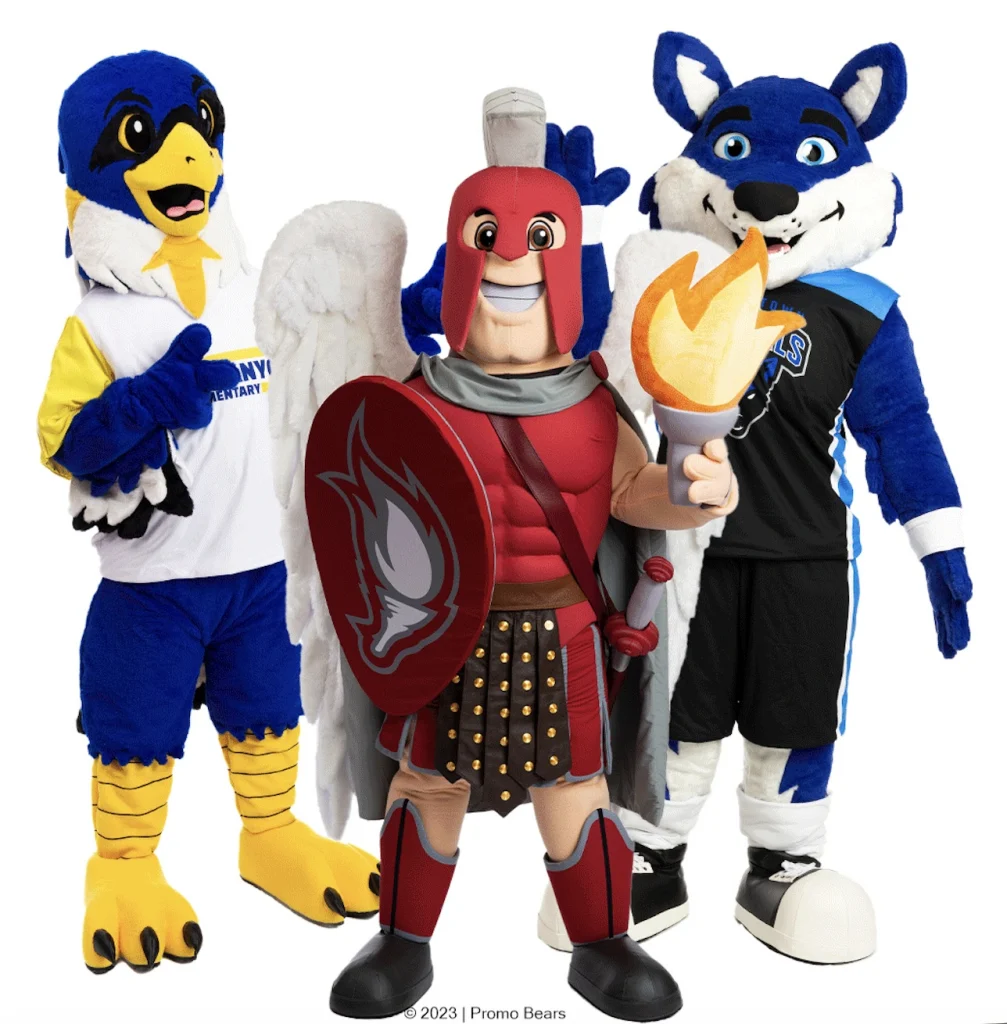
A brand mascot strategy is a deliberate plan to use a custom character as the central, recurring face of your brand across marketing, events, and customer touchpoints. It goes well beyond simply creating a fun logo or costume. The goal is to give your brand a personality that people recognize, remember, and connect with emotionally. Below, we answer the most common questions about how mascot strategies work, who they benefit, and how to build one from the ground up.
How does a brand mascot strategy work in practice?
A brand mascot strategy works by placing a consistent, recognizable character at the heart of your marketing efforts. The mascot appears across every channel, from events and social media to merchandise and in-store activations, reinforcing the same personality and values every time. Over time, audiences begin to associate the character with your brand automatically.
In practice, this means your team makes deliberate decisions about where, when, and how the mascot appears. A mascot might greet visitors at a trade show, star in a social media campaign, appear on branded merchandise, and anchor your seasonal promotions. The key is consistency. Every appearance should feel like the same character expressing the same brand voice.
Strong mascot strategies also plan for longevity. The character is designed with enough personality and flexibility to evolve alongside the brand without losing recognition. This is why the upfront design process matters so much. Getting the look, feel, and character right from the beginning saves significant effort down the line.
What are the key components of a successful brand mascot strategy?
A successful brand mascot strategy rests on four core components: a well-defined character, consistent deployment, multi-format merchandising, and a clear connection to brand values. Without all four working together, the mascot risks becoming a one-time novelty rather than a lasting brand asset.
- Character definition: The mascot needs a distinct personality, visual identity, and backstory that reflects your brand’s values and appeals to your target audience.
- Consistent visual identity: The character must look the same whether it appears on a plush toy, a giant inflatable, a stress ball, or a full costume. Visual consistency builds recognition.
- Multi-channel deployment: A mascot that only appears at one event per year has limited impact. Effective strategies put the character in front of audiences regularly and across multiple formats.
- Merchandise ecosystem: Physical products featuring the mascot, such as keychains, stickers, plush toys, and promotional items, extend the character’s reach and give audiences something tangible to take home.
Brands that invest in all four components consistently outperform those that treat their mascot as a one-off creative project. The character becomes a genuine marketing asset with compounding value over time.
What types of organizations benefit most from a mascot strategy?
Organizations that benefit most from a brand mascot strategy are those that rely heavily on emotional connection, community engagement, or repeat audience interaction. This includes sports teams, universities, retail brands, entertainment companies, FMCG brands, and corporate organizations running large-scale events or campaigns.
Sports teams and schools are natural fits because their audiences already have strong emotional investment. A mascot amplifies that loyalty and gives fans a character to rally around. Universities use mascots to build school spirit, drive alumni engagement, and strengthen recruiting efforts.
For corporate brands and retailers, the opportunity is different but equally powerful. A recognizable mascot gives a company a human face, making it easier for customers to form an emotional bond with what might otherwise feel like an abstract organization. Brands in FMCG and hospitality have long understood this, using mascot characters to drive product recognition on crowded shelves and in busy venues.
Non-profits and government organizations also benefit significantly. A mascot makes campaigns more approachable, encourages community participation, and helps communicate complex messages in a way that is accessible and memorable.
How does a mascot strategy improve brand recognition and engagement?
A mascot strategy improves brand recognition by giving your audience a visual and emotional anchor that is easier to remember than a logo or tagline alone. Characters trigger emotional responses in ways that abstract visuals cannot. When audiences see the same character repeatedly across different contexts, brand recall strengthens with each exposure.
Engagement improves because mascots invite interaction. A costumed mascot at an event draws crowds, creates photo opportunities, and generates organic social media content. Mascot merchandise gives people a reason to engage with your brand beyond the transaction itself. A child who takes home a plush version of your mascot becomes a daily reminder of your brand in that household.
There is also a word-of-mouth effect. When a mascot character is distinctive and well-executed, people talk about it, share photos, and recommend the brand to others. That kind of organic amplification is difficult to buy through advertising alone. A strong mascot turns your audience into brand ambassadors without asking them to do anything other than enjoy the experience.
What’s the difference between a brand mascot and a brand character?
A brand mascot is a physical, three-dimensional representation of a character that can be brought to life at events, worn as a costume, or reproduced as merchandise. A brand character is a broader term that includes illustrated or animated figures used in advertising and digital content, which may never exist in physical form. The key distinction is presence and physicality.
Brand characters like illustrated spokespersons or animated figures live primarily in two-dimensional media. They are powerful in advertising but cannot shake a hand, pose for a photo, or create a live moment with an audience. A brand mascot can do all of those things.
That said, the two are not mutually exclusive. Many of the most effective mascot strategies combine both. The mascot exists as a costume and as physical merchandise, while the same character also appears in illustrated form across digital channels and print materials. This dual presence maximizes the character’s reach and reinforces recognition across every format your audience encounters.
How do you develop a brand mascot from a logo or existing design?
Developing a brand mascot from a logo or existing design starts with translating your two-dimensional visual identity into a three-dimensional character with personality, proportion, and physical presence. The process typically begins with a concept illustration that extracts the core visual elements of your logo and reimagines them as a wearable, reproducible character.
- Concept illustration: A designer creates an initial visual interpretation of your logo or design idea as a mascot character, showing how the two-dimensional elements translate into a full character from multiple angles.
- Revision and refinement: You review the concept and provide feedback. This stage continues until the character perfectly reflects your brand identity and meets your expectations.
- Production planning: Once the design is approved, production begins across whichever formats you need, whether that is a full costume, plush toys, giant inflatables, or smaller promotional merchandise.
- Quality control and delivery: Finished products go through a thorough quality check before shipping, ensuring every item matches the approved design.
The most important principle in this process is not rushing the design phase. A mascot that does not accurately represent your brand will require costly corrections later. Taking the time to get the character right before production begins protects your investment and ensures the mascot works effectively across every format and channel.
How Promo Bears helps you build a brand mascot strategy
We specialize in bringing brand mascot strategies to life from concept to delivery. With over 19 years of experience and more than 4,000 custom mascots created for brands like NASA, Amazon, and Red Bull, we understand what it takes to build a mascot that works hard for your brand across every touchpoint.
Every project starts with a free concept illustration based on your logo or design idea, with unlimited revisions until the result is exactly right. Our team then produces your mascot across whichever formats your strategy requires:
- Custom mascot costumes ready in 12 to 16 weeks, with lifelike 3D eyes, a built-in ventilation system, and exceptional wearing comfort
- Giant mascot inflatables ready in 3 to 4 weeks, ideal for events, trade shows, and outdoor activations
- Plush toys ready in 12 to 18 weeks, perfect as branded merchandise or giveaways
- Custom stress balls ready in 10 to 12 weeks, fully custom shapes with PMS color matching and full-color print options
- Keychains, stickers, enamel pins, and more ready in as little as 3 to 6 weeks, giving your mascot presence at every price point
A dedicated project manager oversees every step, from your first concept to final delivery, so you always know where your project stands. If you are ready to turn your brand identity into a mascot that drives recognition, engagement, and revenue, get your free quote today and let us show you what is possible.
Frequently Asked Questions
How much does it typically cost to launch a brand mascot strategy?
Costs vary widely depending on the formats you need and the complexity of your mascot design. A single custom mascot costume might range from a few thousand dollars, while a full merchandise ecosystem spanning plush toys, inflatables, keychains, and stress balls will represent a larger investment. The best approach is to start with the formats that align most closely with your primary marketing channels and scale production as your strategy matures. Requesting a free quote is the most reliable way to get accurate pricing based on your specific needs.
How do I know if my brand is ready for a mascot strategy?
If your brand regularly engages audiences at events, relies on emotional connection to drive loyalty, or struggles to stand out in a crowded market, you are likely ready for a mascot strategy. The most important prerequisite is having a clear sense of your brand values and target audience, since those elements directly shape the mascot’s personality and visual identity. You do not need to be a large corporation — sports teams, universities, local retailers, and non-profits of all sizes have successfully launched mascot strategies with strong results.
What are the most common mistakes brands make when introducing a mascot?
The most common mistake is treating the mascot as a one-time creative project rather than a long-term brand asset. Brands that debut a mascot at a single event and then rarely use it again miss out on the compounding recognition that comes from consistent, multi-channel deployment. Another frequent misstep is rushing the design phase to meet a deadline, which often results in a character that does not accurately reflect the brand and requires costly revisions later. Finally, neglecting the merchandise component limits the mascot’s reach — physical products are what extend the character into everyday life beyond events.
Can a mascot strategy work for B2B brands, or is it only effective for consumer-facing companies?
Mascot strategies absolutely work for B2B brands, though the execution looks slightly different. In B2B contexts, mascots are particularly effective at trade shows, industry conferences, and corporate events where standing out in a sea of booths is a genuine challenge. A well-designed mascot draws foot traffic, creates memorable interactions, and gives your sales team a natural conversation starter. B2B brands like software companies, logistics providers, and professional services firms have all used mascots successfully to humanize their brand and improve recall among decision-makers.
How do I maintain consistency when the mascot appears across so many different formats and channels?
Consistency starts with locking in a fully approved master design before any production begins — this design becomes the single source of truth for every format. A detailed mascot style guide documenting approved colors, proportions, expressions, and usage guidelines helps ensure that everyone on your team, as well as any external partners, applies the character correctly. Working with a single production partner who handles multiple formats simultaneously is another practical way to guarantee visual consistency, since the same design specifications are applied across costumes, plush toys, inflatables, and promotional items without interpretation gaps.
How do I measure whether my mascot strategy is actually working?
The most straightforward metrics to track are brand recall, social media engagement, and event interaction rates. Before launching your mascot, establish a baseline by surveying your audience on brand recognition and sentiment, then repeat that survey after six to twelve months of consistent mascot deployment. At events, track crowd engagement, photo opportunities taken, and merchandise uptake as indicators of mascot effectiveness. On social media, monitor user-generated content featuring the mascot, since organic sharing is one of the clearest signals that the character is resonating with your audience.
What if my mascot needs to be updated or refreshed over time — does that mean starting from scratch?
A well-designed mascot rarely needs to be replaced entirely — most successful characters simply evolve through gradual refinements that modernize their look without erasing the recognition audiences have already built. Think of it like updating a logo: the core identity stays intact while small visual elements are refreshed to feel current. The key is to document exactly what makes your mascot recognizable and protect those defining elements during any refresh. If your original mascot was designed with longevity in mind from the start, updates tend to be minor and far less costly than a full redesign.