
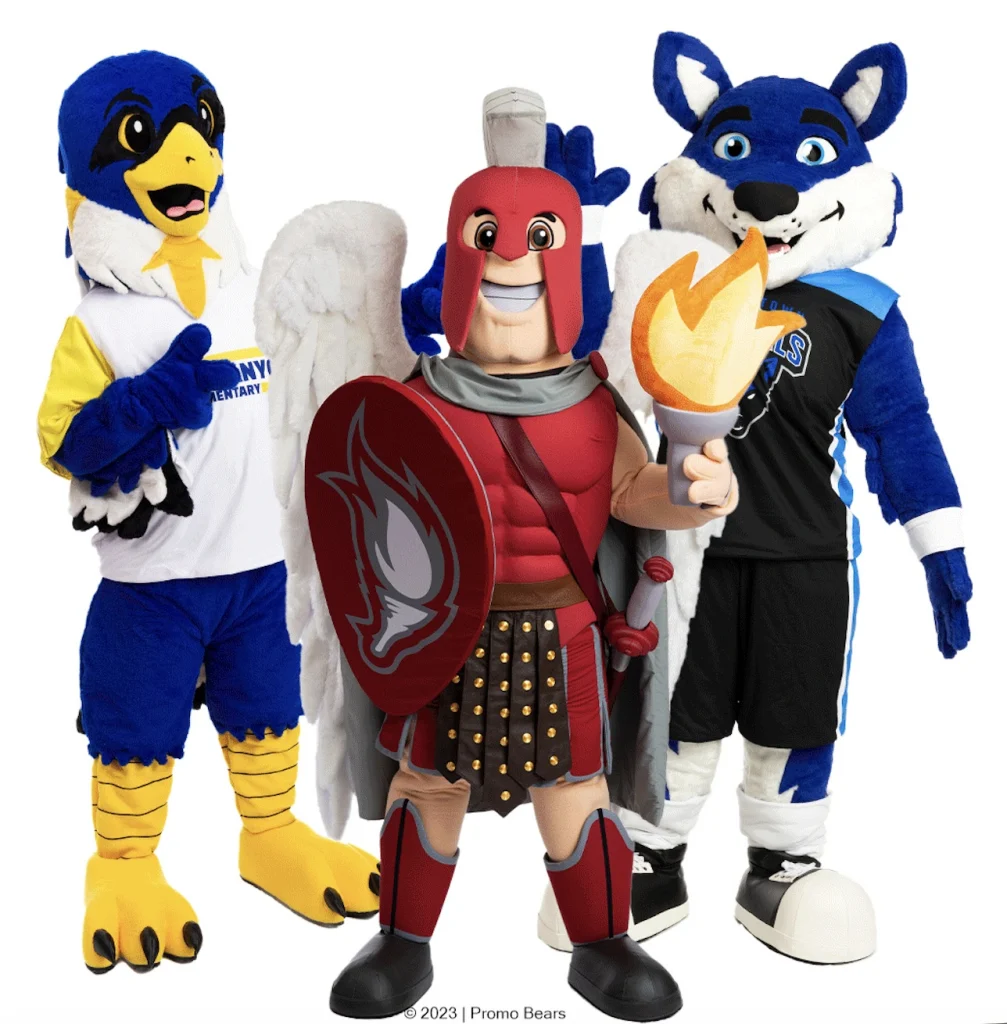
Mascots need a combination of physical stamina, expressive body language, crowd awareness, and genuine performance instinct. Because a mascot costume removes the performer’s voice and facial expressions from the equation, every skill they bring must work through movement, timing, and energy alone. The questions below unpack exactly what separates a great mascot performer from someone simply wearing a suit.
What physical demands does wearing a mascot costume involve?
Wearing a mascot costume is genuinely demanding physical work. Performers operate inside a heavily insulated, vision-limited suit that raises body temperature quickly, restricts movement, and adds significant weight to every gesture. Stamina, core strength, and heat tolerance are not optional extras — they are baseline requirements for anyone stepping into a professional mascot role.
Most full-body mascot costumes weigh between 15 and 25 pounds, and the performer inside is expected to move with energy and enthusiasm throughout an entire event. That might mean two to three hours of continuous interaction with crowds, punctuated by short breaks. Without a solid level of cardiovascular fitness, the quality of the performance drops quickly.
Heat management is one of the biggest physical challenges. Even mascot costumes built with integrated ventilation systems — like the ones we produce at Promo Bears — generate significant internal heat during active wear. Performers learn to hydrate aggressively before and during events, take scheduled cooling breaks, and recognize the early warning signs of overheating.
Physical demands that mascot performers regularly face include:
- Sustained aerobic activity across long event windows
- Carrying the full weight of the costume on the head and shoulders
- Performing exaggerated gestures and movements that require more effort than normal body language
- Operating with limited peripheral vision and restricted sightlines
- Maintaining consistent energy levels even when fatigued
Performers who prepare with regular cardio training and practice wearing the costume in advance are far better equipped to deliver a strong, consistent performance from the first minute to the last.
How do mascot performers communicate without speaking?
Mascot performers communicate entirely through body language, gesture, and physical energy. Without a visible face or an audible voice, every emotion, reaction, and interaction has to be translated into movement. A shrug, a wave, a head tilt, a slow dramatic look — these become the performer’s full vocabulary.
The most effective mascot performers think of their body as a single expressive instrument. When a mascot is excited, the whole body shows it: bouncing, wide arm movements, exaggerated head nods. When a mascot is surprised, the performer throws their hands up and staggers backward. These broad, theatrical gestures read clearly from a distance and land immediately with audiences of all ages.
Timing is equally critical. A well-timed pause before a big reaction, or a slow turn toward a child in the crowd, creates genuine comedic and emotional moments without a single word being spoken. Performers who understand rhythm and timing can hold an audience’s attention just as effectively as a trained actor.
Physical mirroring is another powerful tool. When a mascot mimics what a fan is doing — copying a dance move, pretending to take a photo alongside them, or matching their energy level — it creates an immediate sense of connection. That connection is what makes mascot appearances memorable long after the event ends.
What crowd-reading skills do professional mascots develop?
Professional mascot performers develop a sharp ability to read the energy of a crowd in real time and adjust their behavior accordingly. They learn to identify who in a group is most receptive, how to escalate or de-escalate interaction based on audience response, and when to move on before a moment loses its energy.
Crowd reading starts with observation. Because a mascot cannot rely on verbal cues, the performer constantly scans body language — who is leaning in, who is stepping back, who is pointing and laughing, who looks uncertain. Children and adults respond very differently to mascot interaction, and a skilled performer shifts their approach instinctively between the two.
Energy management across a large crowd is its own skill. A mascot appearing at a stadium event needs to project big, broad movements that land for people 50 rows back. The same mascot at a school visit needs to slow down, crouch to eye level with younger children, and create intimate one-on-one moments rather than theatrical spectacle.
Professional performers also learn to handle unexpected situations — a child who becomes frightened, an overly enthusiastic adult, or a moment where the crowd’s attention drifts. Knowing how to redirect, recover, and keep the energy positive without verbal communication is a skill that only develops through real performance experience.
Does a mascot performer need acting or entertainment experience?
Acting or entertainment experience is not strictly required, but it provides a significant advantage. The core skills that make someone a strong mascot performer — physical expressiveness, timing, audience awareness, and the ability to stay in character under pressure — overlap heavily with what trained performers develop through theater, dance, or improv comedy.
Performers with a theater or dance background tend to adapt quickly because they already understand how to use their body as a storytelling tool. Improv comedy training is particularly valuable because mascot performance is inherently improvised — no two crowd interactions are the same, and the ability to react spontaneously and commit fully to a moment is exactly what improv teaches.
That said, natural charisma and genuine enthusiasm can go a long way. Some of the most effective mascot performers have no formal training at all — they simply have an instinctive ability to connect with people, read the room, and bring consistent energy. What cannot be faked is genuine engagement. Crowds, especially children, sense immediately when a performer is going through the motions rather than truly inhabiting the character.
For organizations investing in a professional mascot program, pairing a high-quality costume with a performer who has at least some performance background produces noticeably better results at events and brand activations.
How does mascot costume design affect what skills a performer needs?
Mascot costume design directly shapes what a performer can and cannot do, which in turn determines which skills matter most. A costume with wide, padded arms limits fine motor gestures, so performers need to rely on full-body movement. A costume with restricted sightlines demands stronger spatial awareness. A heavier costume requires greater physical conditioning.
Vision is one of the most design-dependent variables. Some mascot costumes offer a relatively open sightline through mesh panels or realistic 3D eyes, while others require the performer to see through a small, obscured opening. The more limited the vision, the more the performer must develop spatial memory — learning exactly where they are in relation to the crowd, the stage, or the field based on limited visual input.
Head weight and balance also influence performance style. A large, top-heavy mascot head requires the performer to develop neck strength and learn controlled head movements. Exaggerated nodding and shaking, which are standard mascot communication tools, become more physically demanding when the head is heavy, and poorly controlled head movements can look clumsy rather than expressive.
Costume mobility plays a role too. A well-constructed costume that allows natural arm and leg movement gives the performer far more expressive range. That is why mascot costume design decisions made at the production stage have a direct downstream impact on performance quality — design and performance are not separate considerations.
What’s the difference between a trained mascot performer and an untrained one?
The difference between a trained mascot performer and an untrained one is immediately visible to any audience. A trained performer moves with intention, holds character consistently, and creates genuine moments of connection. An untrained performer tends to move stiffly, break character, and miss the small interactions that make a mascot appearance truly memorable.
Trained performers understand that every movement communicates something. They make deliberate choices about posture, gesture speed, and physical scale. An untrained performer often defaults to standing still or performing the same two or three gestures repeatedly, which causes the performance to feel flat within minutes.
Character consistency is another major dividing line. A trained performer stays in character from the moment they enter public view until the moment they exit, regardless of what happens around them. An untrained performer breaks character when something unexpected happens — reaching up to adjust the costume head, looking down at their feet, or reacting in a way that reminds the audience there is a person inside the suit.
The practical impact of this gap is significant for brands and organizations. A mascot appearance that falls flat does not just fail to generate engagement — it can actively undermine the brand impression the costume was meant to create. Investing in a high-quality costume and a trained performer together produces results that neither can achieve alone.
How Promo Bears help you get mascot performance right from the start
We understand that a mascot program is only as strong as the costume powering it. That is why every custom mascot we produce is built with the performer’s experience in mind, not just the visual result. When the costume works with the performer rather than against them, the skills above are far easier to execute.
Here is what sets our custom mascot costumes apart:
- An integrated ventilation system that helps manage heat during extended wear
- Lifelike 3D eyes that give performers better sightlines and audiences a more expressive character to connect with
- Exceptional comfort and mobility that allows natural, expressive movement
- A free concept illustration and unlimited revisions before production begins, so the final design serves both brand and performer
- A dedicated project manager overseeing every step from design to delivery
- Standard production in 12 to 16 weeks, with rush options available
We have created over 4,000 custom mascots for organizations ranging from schools and sports teams to globally recognized brands. Whether you are launching a mascot program for the first time or upgrading an existing one, we are ready to help you build something that performs as well as it looks.
Get your free concept illustration and start the conversation today — no commitment required.
Frequently Asked Questions
How long does it typically take to become a confident mascot performer?
Most performers need several practice sessions inside the costume before they feel genuinely comfortable — typically between 5 and 10 hours of active wear time spread across multiple sessions. The first priority is getting used to the physical limitations: restricted vision, added weight, and heat buildup. From there, developing expressive movement and crowd-reading instincts takes real event experience, and most performers report feeling truly confident after 3 to 5 live appearances.
What should a mascot performer wear underneath the costume?
A moisture-wicking base layer is the standard recommendation — something similar to athletic compression wear that draws sweat away from the skin and helps regulate body temperature. Avoid cotton, which retains moisture and accelerates overheating. Some performers also wear lightweight padded shorts or leggings to reduce friction from the costume interior during extended wear.
How do mascot performers handle children who are scared of the costume?
The most effective approach is to never force or rush the interaction. A skilled performer will crouch down to the child’s level, move slowly, and let the child set the pace — even if that means simply waving from a distance and moving on. Giving a frightened child space and a low-pressure moment often turns the situation around naturally. Trained performers treat fear as a cue to de-escalate, not a problem to push through.
Can one person perform in a mascot costume for an entire event, or is a second performer needed?
For events lasting longer than 60 to 90 minutes of continuous interaction, having a second performer available as a rotation is strongly recommended. Heat buildup, physical fatigue, and the mental focus required to stay in character all degrade performance quality over time. Many professional mascot programs schedule performers in 20 to 30-minute active intervals with cooling breaks in between, and two performers sharing the role ensures the character always appears at full energy.
What are the most common mistakes first-time mascot performers make?
The most frequent mistake is moving too fast and too frantically — overcorrecting for the costume’s limitations by throwing out constant, unfocused gestures. Effective mascot performance is actually built on deliberate, well-timed movements with clear pauses in between. Other common mistakes include breaking character when something unexpected happens, neglecting hydration before the event, and failing to practice in the actual costume ahead of the appearance.
Does the size of the mascot costume affect how the performer should train or prepare?
Yes, significantly. Larger or heavier costumes — particularly those with oversized heads — require targeted neck and shoulder conditioning beforehand to avoid strain and maintain controlled movement throughout the event. Performers stepping into a new costume for the first time should always do a full rehearsal session in it before any live appearance, regardless of their prior experience, because every costume has its own weight distribution, sightline profile, and mobility range that requires adjustment.
How do organizations find or hire qualified mascot performers?
Theater departments, improv comedy groups, dance studios, and entertainment staffing agencies are all strong starting points for finding performers with relevant physical and expressive skills. When auditioning candidates, prioritize movement quality and character commitment over appearance — the costume handles the visual identity. A short in-costume audition that tests crowd interaction, reaction timing, and the ability to stay in character under light pressure will reveal far more than a resume alone.