
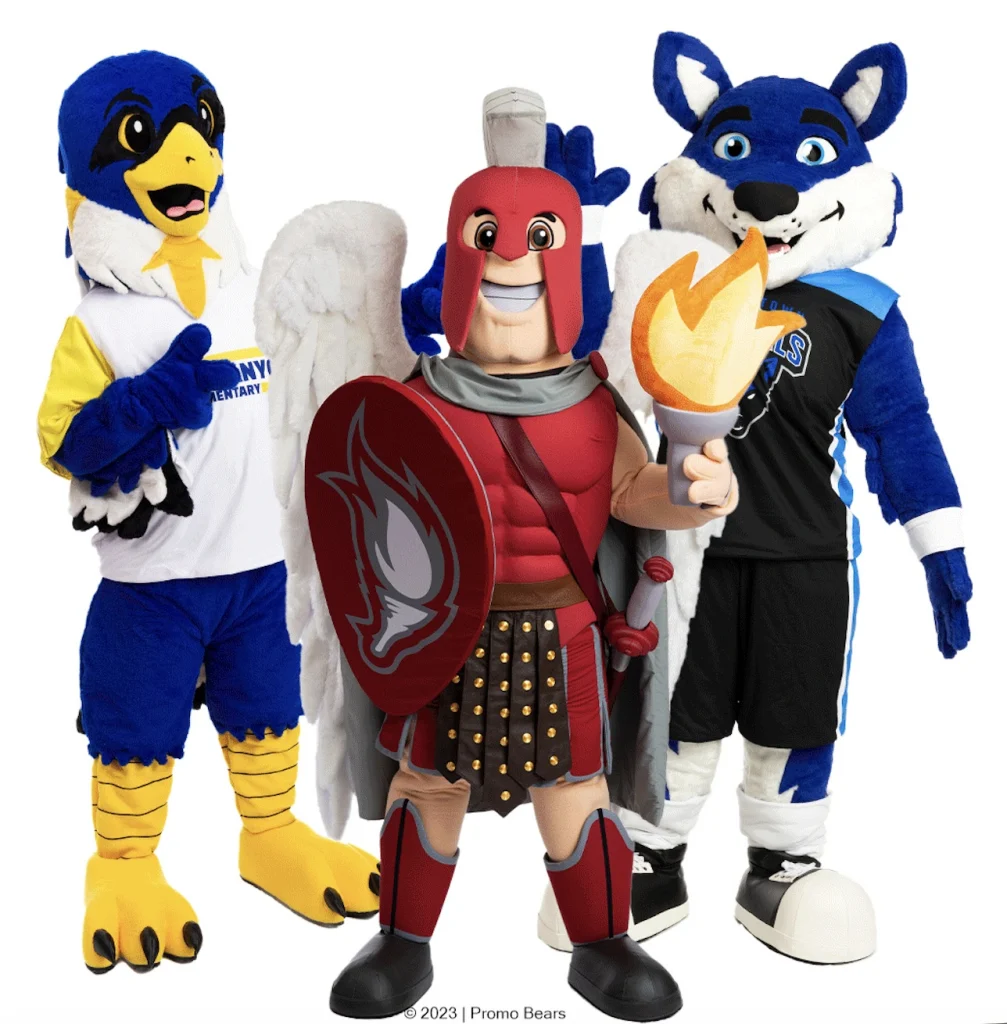
Good mascot ideas reflect your brand’s personality, connect emotionally with your target audience, and are visually distinctive enough to be remembered. The best mascots are not just cute or fun — they carry meaning, communicate values, and work across every format, from costumes to merchandise. Whether you represent a school, sports team, or corporate brand, the right mascot concept can become one of your most powerful marketing assets.
Below, we answer the most common questions about mascot design to help you find an idea that truly works for your organization.
What makes a mascot idea truly effective?
A mascot idea is truly effective when it creates an immediate emotional connection, communicates your brand’s core values at a glance, and remains recognizable across every format it appears in. The most successful mascots combine a strong visual concept with a personality that your audience genuinely relates to — whether that is playful, fierce, friendly, or bold.
Effective mascots share a few key traits. They are simple enough to translate into a costume, a plush toy, or a sticker without losing their identity. They feel authentic to the organization they represent rather than generic or borrowed. And they have staying power — meaning they do not feel tied to a trend that will fade in a year or two.
Strong mascot design also considers how the character will be used in practice. A mascot that only works as a logo graphic but falls flat as a wearable costume or an inflatable has limited marketing potential. The best mascot ideas are built to perform across every touchpoint, from sideline appearances to branded merchandise.
What are the most popular types of mascots for businesses and schools?
The most popular mascot types fall into three broad categories: animals, human archetypes, and abstract or branded characters. Animals are by far the most common choice across both schools and businesses because they carry built-in personality traits that audiences immediately understand — a bear signals strength and loyalty, a fox suggests cleverness, and a lion conveys power and pride.
For schools and sports teams, the following mascot types tend to dominate:
- Wild animals such as bears, wolves, eagles, and tigers — chosen for their associations with strength, speed, and competitive spirit
- Historical or cultural figures that reflect regional identity or school tradition
- Mythical creatures like dragons or phoenixes, which offer bold visual impact and a sense of legend
- Humanized characters built around a profession or archetype, such as knights, pirates, or explorers
For businesses and brands, mascot design often leans toward characters that embody the product or service itself. Think of a food brand that brings its signature ingredient to life, or a tech company that creates a friendly robot character. These branded mascots work especially well for customer-facing marketing because they make abstract products feel approachable and memorable.
How do you come up with a mascot idea that fits your brand?
Coming up with a mascot idea that fits your brand starts with a clear understanding of your audience and your brand’s core personality. Ask yourself what values your organization stands for, what emotions you want people to feel when they encounter your brand, and what kind of character would naturally represent those qualities.
A practical way to develop a mascot concept is to work through these questions in order:
- Define your brand personality. Is your brand energetic and bold, or warm and approachable? The mascot’s character should mirror this.
- Think about your audience. A mascot designed for children at a family entertainment venue will look very different from one created for a corporate financial services brand.
- Draw from your existing identity. Your logo, brand colors, and name can all serve as creative starting points. A company called Apex, for example, might naturally gravitate toward a mountain peak character or a bird of prey.
- Consider how the mascot will be used. If you need a wearable costume for live events, the design needs to be practical and comfortable. If you primarily need merchandise, you have more creative freedom with the visual concept.
- Test your concept with your audience. Before committing to full production, share early concept illustrations with a sample of your target audience and gather honest feedback.
Working with experienced mascot designers from the start can save significant time and budget. A professional team will help you move from a rough idea to a polished, production-ready concept without losing what made the original idea compelling.
What industries benefit most from a custom mascot?
Industries that rely on emotional connection, audience engagement, and memorable brand experiences benefit most from custom mascot design. Sports, education, retail, food and beverage, entertainment, and hospitality consistently see the strongest returns from mascot investment because their audiences are already primed to respond to personality-driven branding.
Sports teams and schools use mascots to build community and school spirit, creating a shared identity that fans and students rally around. Retail and FMCG brands use mascots to differentiate products on crowded shelves and build long-term brand recognition across generations. Entertainment venues and hospitality brands use costumed characters to create immersive experiences that guests remember and share.
Corporate brands in sectors like insurance, finance, and technology are increasingly investing in mascot design as well. A friendly, well-designed character can make a complex or abstract service feel more human and accessible — which directly supports customer acquisition and retention goals.
Non-profits and government organizations also benefit significantly. A mascot gives a cause or campaign a face, making it easier for the public to connect with the message on a personal level rather than an institutional one.
Should your mascot be an animal, a person, or something else?
The right choice between an animal, a human character, or an abstract concept depends entirely on your brand’s identity, audience, and intended use. Each type carries different strengths, and the best mascot idea is the one that fits your specific context rather than following a general rule.
Animal mascots
Animals are the most universally understood mascot format. They carry immediate personality associations, translate well into costumes and merchandise, and tend to age well over time. Animals work particularly well for schools, sports teams, and brands that want to project strength, energy, or warmth without relying on a human face.
Human and humanized mascots
Human archetypes — such as a chef, an athlete, or an explorer — work well when your brand wants to convey expertise, aspiration, or a specific lifestyle. They can feel more relatable to adult audiences and are often used by brands in the food, fitness, and retail sectors. Humanized animals, which blend human expressions and postures with animal characteristics, offer a middle ground that combines relatability with visual distinctiveness.
Abstract and product-based mascots
Bringing a product, shape, or abstract concept to life as a character is a bold creative choice that can pay off enormously when executed well. This approach works best for brands with a highly recognizable product or visual identity. The mascot becomes an extension of the product itself, reinforcing brand recognition every time it appears.
What should you avoid when choosing a mascot idea?
When choosing a mascot idea, the most common mistakes are selecting a concept that is too generic, ignoring practical production requirements, and failing to think long-term about how the character will grow with your brand. Avoiding these pitfalls from the start will save considerable time, budget, and frustration down the line.
Specific things to steer clear of include:
- Generic or overused concepts. If your mascot looks like dozens of others in your industry, it will not stand out. Aim for a distinctive design that is ownable and specific to your brand.
- Designs that do not translate into 3D. A mascot that looks great as a flat logo graphic but cannot be realistically produced as a costume or plush toy limits your marketing options significantly.
- Ignoring your audience’s perspective. A mascot that appeals to your internal team but does not resonate with your actual customers or fans will underperform in the market.
- Chasing trends. Mascot design should have longevity. A concept that feels current in 2026 but is tied to a passing cultural moment will feel dated quickly.
- Skipping the revision process. Rushing to production before the design is truly right is one of the most expensive mistakes in mascot development. Take the time to refine the concept until it is exactly right.
Cultural sensitivity is also critical. Before finalizing any mascot concept, ensure the character does not inadvertently rely on stereotypes or imagery that could be perceived as offensive by any segment of your audience.
How Promo Bears helps you bring your mascot idea to life
We specialize in turning mascot ideas into fully realized, production-ready characters that perform across every format. Whether you are starting with a rough sketch, a logo, or just a concept in your head, our team of mascot design experts will guide you from the first illustration to final delivery.
Here is what working with us looks like:
- Free concept illustration based on your design or logo, with unlimited revisions until you are completely satisfied
- Custom mascot costumes featuring 3D realistic eyes, a built-in ventilation system, and a comfortable fit for wearers between 5’7″ and 6’1″ (custom sizes available), ready in 12 to 16 weeks
- A full range of mascot merchandise including plush toys, stress balls (10 to 12 weeks), mascot stickers (approximately 4 weeks), and giant mascot inflatables (3 to 4 weeks)
- A dedicated project manager who oversees every stage from design approval through quality control and delivery
- Proven results across more than 4,000 mascot projects for brands including NASA, Amazon, Red Bull, and Walmart
If you are ready to move from idea to impact, explore our full range of custom mascot solutions and see what is possible. When you are ready to get started, request your free quote and receive a concept illustration with no upfront commitment required.
Frequently Asked Questions
How much does it typically cost to develop a custom mascot from scratch?
The cost of a custom mascot varies widely depending on the scope of the project. A professional mascot costume alone can range from a few thousand dollars to well over $10,000 depending on complexity, materials, and production quality. When budgeting, factor in not just the costume but also any accompanying merchandise, digital assets, and design revisions — a full mascot rollout covering costumes, plush toys, inflatables, and stickers will naturally require a higher investment than a single deliverable.
How long does the entire mascot design and production process take from start to finish?
The timeline depends on which deliverables you need and how quickly the design concept is approved. Mascot costumes typically take 12 to 16 weeks to produce after the design is finalized, while merchandise like stickers can be ready in as little as 4 weeks and plush toys or stress balls in 10 to 12 weeks. Building in extra time for concept revisions at the beginning of the process is strongly recommended — rushing the design phase is one of the most common causes of delays and added costs later on.
Can an existing logo be turned into a mascot character, or does the mascot need to be designed from the ground up?
An existing logo is actually one of the best starting points for mascot development, and many of the most successful mascot characters are direct evolutions of a brand’s existing visual identity. A professional mascot designer can extract the key shapes, colors, and personality cues from your logo and translate them into a fully dimensional character that feels like a natural extension of your brand. Starting from a logo also tends to speed up the approval process since stakeholders already have a visual reference point they are comfortable with.
What if our mascot needs to be worn by people of different heights and sizes at events?
This is a very common practical challenge, especially for organizations that use their mascot at multiple events with different performers. The standard approach is to design the costume for a core size range — typically around 5’7u0022 to 6’1u0022 — and then commission additional custom-sized versions if your team regularly includes performers outside that range. It is worth discussing your specific performer roster with your mascot producer upfront so that fit and comfort are built into the design brief from day one rather than addressed as an afterthought.
How do we know if our mascot concept will actually resonate with our target audience before investing in full production?
Testing your concept before committing to production is one of the smartest steps you can take. Share early-stage concept illustrations — not just descriptions — with a representative sample of your target audience and ask specific questions about first impressions, perceived personality, and memorability. Avoid asking only people inside your organization, as internal teams are often too close to the brand to give objective feedback. Even a small round of informal testing can reveal whether your mascot is landing the way you intend or needs refinement.
How do we keep our mascot feeling fresh and relevant over time without losing brand recognition?
The key is to evolve the mascot gradually rather than redesigning it dramatically every few years. Many long-standing brand mascots have been subtly modernized — updated proportions, refined color palettes, cleaner line work — without ever losing their core identity. Establish clear brand guidelines for your mascot from the beginning, including approved poses, expressions, color usage, and contexts, so that every appearance feels consistent even as the character is refreshed over time.
Are there any legal considerations we should be aware of when creating a new mascot?
Yes — intellectual property protection is an important step that is easy to overlook in the excitement of the design process. Once your mascot design is finalized, consider registering it as a trademark to protect the character from being copied or used without your permission. You should also ensure that your mascot design does not infringe on any existing trademarked characters, which is another reason why working with an experienced professional designer matters — they will help you create something genuinely original and ownable from the start.