
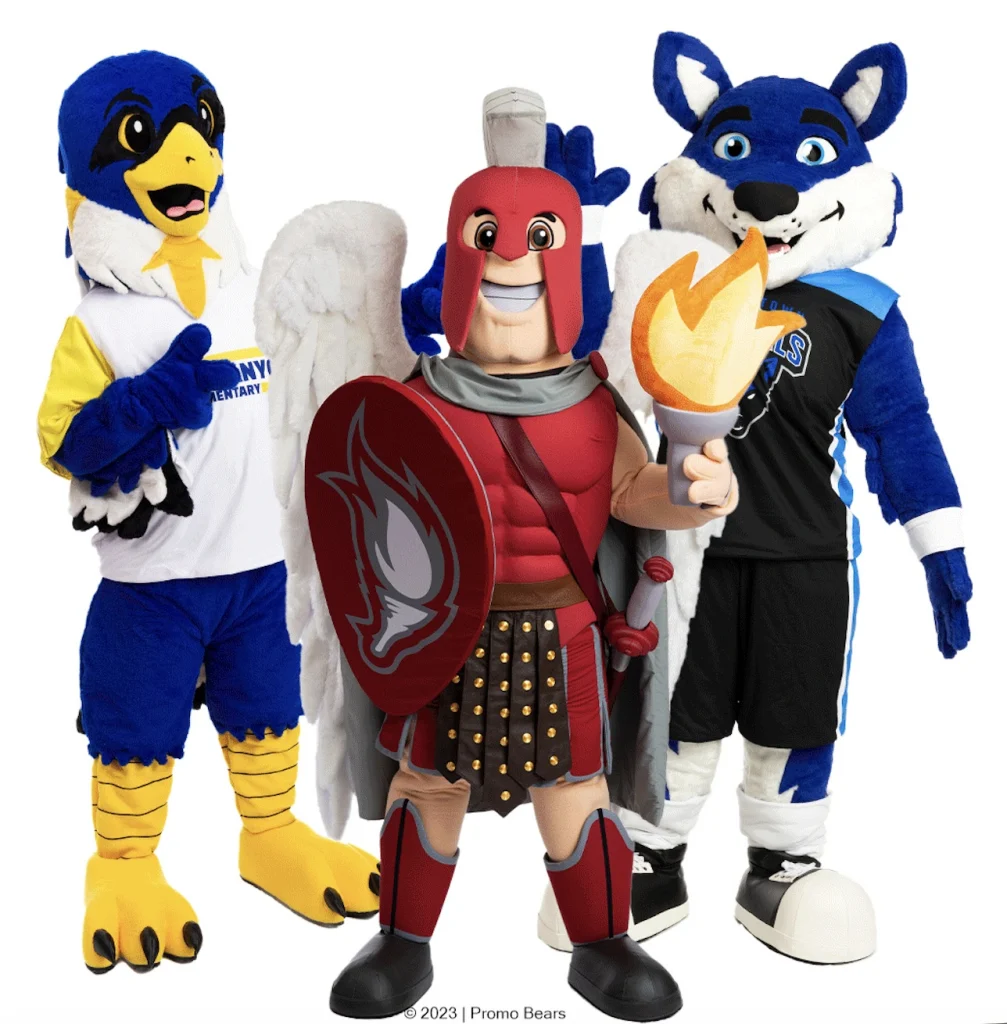
Yes, a branded mascot costume absolutely belongs in a children’s marketing strategy. Kids respond to characters far more strongly than to logos or taglines, which means a well-designed mascot costume can build emotional loyalty with young audiences faster than almost any other marketing tool. The sections below break down exactly how mascots work in children’s marketing and when the investment makes the most sense for your brand.
How does a mascot costume influence children’s brand perception?
A mascot costume shapes how children perceive a brand by giving it a face, a personality, and a physical presence they can interact with. Children process the world through characters and stories, not abstract concepts. When a brand shows up as a friendly, recognizable figure, kids immediately assign it human qualities like warmth, fun, and trustworthiness.
This emotional connection is powerful because it forms early and sticks. A child who meets a mascot at an event, sees it on packaging, and recognizes it on a school visit builds a layered, multi-touchpoint relationship with that brand. That kind of familiarity is what turns a brand into a household name among families.
Children also influence purchasing decisions more than many marketers realize. When a child asks for a product by name because they recognize and love the mascot, that is a direct conversion driven by character marketing. A mascot costume makes that connection tangible and real in a way that a cartoon on a screen simply cannot replicate.
What types of children’s brands benefit most from a mascot costume?
Children’s brands in food and beverage, entertainment, education, sports, and retail benefit most from a branded mascot costume. These are sectors where children are active participants in the brand experience, not just passive recipients of adult purchasing decisions.
- Food and beverage brands use mascots to make products feel fun and familiar, encouraging kids to ask for them by name
- Educational institutions and programs use mascots to build school spirit and make learning environments feel welcoming
- Sports teams and youth leagues use mascot costumes to energize young fans and create memorable game-day experiences
- Retail and entertainment venues use mascots to turn visits into events, increasing dwell time and return visits
- Non-profits and community organizations use mascots to communicate their mission in a way children can understand and get excited about
The common thread across all of these is that children are emotionally invested in the experience. A mascot costume amplifies that investment by making the brand feel alive and present.
How does a branded mascot costume compare to digital character marketing for children?
A branded mascot costume delivers something digital character marketing cannot: a physical, real-world encounter that children experience with their full senses. Digital characters are effective for reach and frequency, but a live mascot appearance creates a memory that lasts far longer than any screen interaction.
Think about the difference between a child watching a cartoon character on a tablet versus meeting that same character in costume at a store opening or school event. The in-person experience triggers excitement, laughter, and a genuine emotional response. Those moments become stories kids tell their friends and parents, generating organic word of mouth that no digital campaign can manufacture.
That said, mascot costumes and digital marketing are not competitors. The strongest children’s marketing strategies use both together. A digital character builds awareness and familiarity, while the mascot costume brings the character to life at key touchpoints. When children already know and love a character from a screen, meeting it in costume becomes a highlight they talk about for weeks.
What should a children’s mascot costume include to be effective?
An effective children’s mascot costume needs to be visually appealing, safe, expressive, and comfortable enough for the performer to maintain an engaging presence throughout an appearance. All four factors matter equally because a mascot that looks great but performs poorly will underdeliver at the moments that count.
On the visual side, children respond to bright colors, friendly facial expressions, and clear character identity. The costume should instantly communicate personality without requiring any explanation. Lifelike 3D eyes make a significant difference here because they give the mascot a sense of warmth and expressiveness that flat printed eyes simply do not achieve.
Performer comfort is non-negotiable. A mascot performer who is overheating or struggling to move freely cannot deliver the energetic, joyful presence that children expect. A built-in ventilation system extends performance time and keeps the performer focused on engaging with kids rather than managing discomfort.
For brands working with children specifically, ease of cleaning is also a practical must. Mascot costumes used at schools, events, and public venues encounter a lot of contact. A costume that is difficult to maintain will deteriorate quickly in both appearance and hygiene.
Where do branded mascot costumes deliver the most impact in children’s marketing?
Branded mascot costumes deliver the most impact at live events, retail environments, school visits, and sports games where children are already in an excited, receptive state. The setting matters because a mascot appearance works best when it amplifies energy that is already present.
- School visits and educational events: Children are in a structured environment where a mascot appearance feels like a special occasion, creating strong brand recall
- Retail activations and store openings: A mascot draws foot traffic, extends visit duration, and gives families a reason to engage beyond the transaction
- Sports events and youth leagues: Mascots fuel crowd energy and give young fans a character to cheer for alongside their team
- Brand activations at fairs and festivals: High foot traffic and a festive atmosphere make mascot appearances highly shareable and memorable
- Seasonal campaigns and holiday events: Pairing a mascot with a seasonal moment creates a recurring tradition that children look forward to year after year
The key across all of these settings is that children are present, engaged, and emotionally open. A mascot costume meets them in that moment and gives them something to connect with beyond the product or service itself.
When is the right time to invest in a custom mascot costume for a children’s brand?
The right time to invest in a custom mascot costume is when your brand has a clear character identity and a confirmed schedule of events or activations where the costume will be used. Investing before either of those elements is in place risks producing a costume that does not align with your brand direction or does not get enough use to justify the production cost.
From a planning perspective, timing matters practically as well. Custom mascot costumes take 12 to 16 weeks to produce from design approval to delivery. That means if you have a major brand event, a school partnership launch, or a seasonal campaign planned, you need to start the design process well in advance. Rushing a mascot costume order increases the risk of compromising on quality, and for a children’s audience where first impressions are everything, quality is not something to cut corners on.
In 2026, brands that are scaling their children’s marketing programs or entering new markets are particularly well positioned to benefit from a mascot investment. A recognizable brand for kids does not happen overnight, and a mascot costume is one of the fastest ways to build that recognition at live touchpoints while your digital presence grows in parallel.
How Promo Bears helps with your children’s marketing strategy
We work with marketing managers, brand directors, and event teams to bring children’s brand characters to life as high-quality, performance-ready mascot costumes. Here is what you get when you work with us:
- A free concept illustration based on your logo or character design, with unlimited revisions until it is exactly right
- Lifelike 3D eyes and a built-in ventilation system that make the costume both expressive and comfortable to wear
- A dedicated project manager who handles everything from design to delivery
- Production in 12 to 16 weeks with rush options available when your timeline is tight
- Final result photos and thorough quality control before the costume ships to you
We have created over 4,000 mascots for brands, schools, sports teams, and organizations across North America and beyond. If you are ready to give your children’s marketing strategy a character kids will remember, get a free quote and let us show you what is possible.
Frequently Asked Questions
How much does a custom children's mascot costume typically cost, and what affects the price?
Custom mascot costume pricing varies based on factors like character complexity, materials, size, and special features such as animatronic elements or premium ventilation systems. For a children’s brand, it is worth budgeting for quality construction rather than choosing the lowest-cost option, since durability and visual appeal directly affect how children respond to the character. A well-built costume used across dozens of events will deliver a far better return on investment than a cheaper alternative that deteriorates after a few appearances.
How do we train a mascot performer to connect effectively with young children?
Mascot performers working with children should be coached on body language, energy level, and safe interaction techniques, since the costume eliminates verbal communication and every emotion must be conveyed through movement and gesture. Key techniques include crouching to a child’s eye level, using exaggerated but gentle movements, and responding enthusiastically to children who approach rather than waiting passively. Many brands create a short performer guide specific to their character’s personality so that every appearance feels consistent, whether the costume is worn by a staff member or a hired entertainer.
Can the same mascot costume be used across multiple brand touchpoints, like events and packaging?
Yes, and this cross-channel consistency is actually one of the biggest advantages of investing in a well-designed mascot. A character that appears in costume at live events, on product packaging, in digital content, and on signage creates a unified brand identity that children recognize instantly across every context. To maximize this, work with your mascot costume designer to ensure the physical costume accurately reflects the 2D character used in your other marketing materials, so children make the connection immediately.
What is the best way to measure the ROI of a mascot costume in a children's marketing campaign?
The most practical metrics to track include event foot traffic increases, social media engagement and photo shares during mascot appearances, brand recall in post-event surveys, and any measurable uptick in sales or sign-ups following activations. For school visits or community events, tracking how many new families engage with your brand after an appearance gives a clear picture of reach. While mascot ROI can be harder to quantify than a digital ad, the long-term brand loyalty it builds with both children and their parents is a compounding asset that pays off well beyond a single campaign.
What if our brand does not have an existing character — can we still create a mascot costume?
Absolutely, and many brands actually develop their mascot character as part of the costume design process rather than starting with an established one. A good mascot costume provider will work with you to develop a character concept from scratch based on your brand values, color palette, and target audience before any fabrication begins. The key is to define the character’s personality and visual identity clearly upfront so the final costume communicates the right message to children without any additional context needed.
How should we store and maintain a children's mascot costume to keep it looking its best?
Mascot costumes should be stored in a cool, dry environment away from direct sunlight, ideally hanging or laid flat in a breathable garment bag to prevent compression of foam components. After each use, spot-clean contact areas and allow the costume to air out fully before storing it, since trapped moisture is the primary cause of odor and material degradation. For brands that use their costume frequently at schools and public events, scheduling a deeper professional clean every few months will preserve both the appearance and hygiene of the costume for years of consistent use.
Are there any safety considerations specific to using mascot costumes around young children?
Yes, and addressing them proactively protects both the children and your brand’s reputation. The costume should have no small detachable parts that could pose a choking hazard, all materials should be non-toxic and hypoallergenic where possible, and the performer should always have a handler nearby to manage crowd flow and ensure no child is accidentally bumped or knocked over. For very young audiences such as toddlers, it is also worth noting that some children experience fear rather than excitement when first encountering a large costumed character, so giving kids the option to approach on their own terms rather than being brought directly to the mascot creates a far more positive experience.