
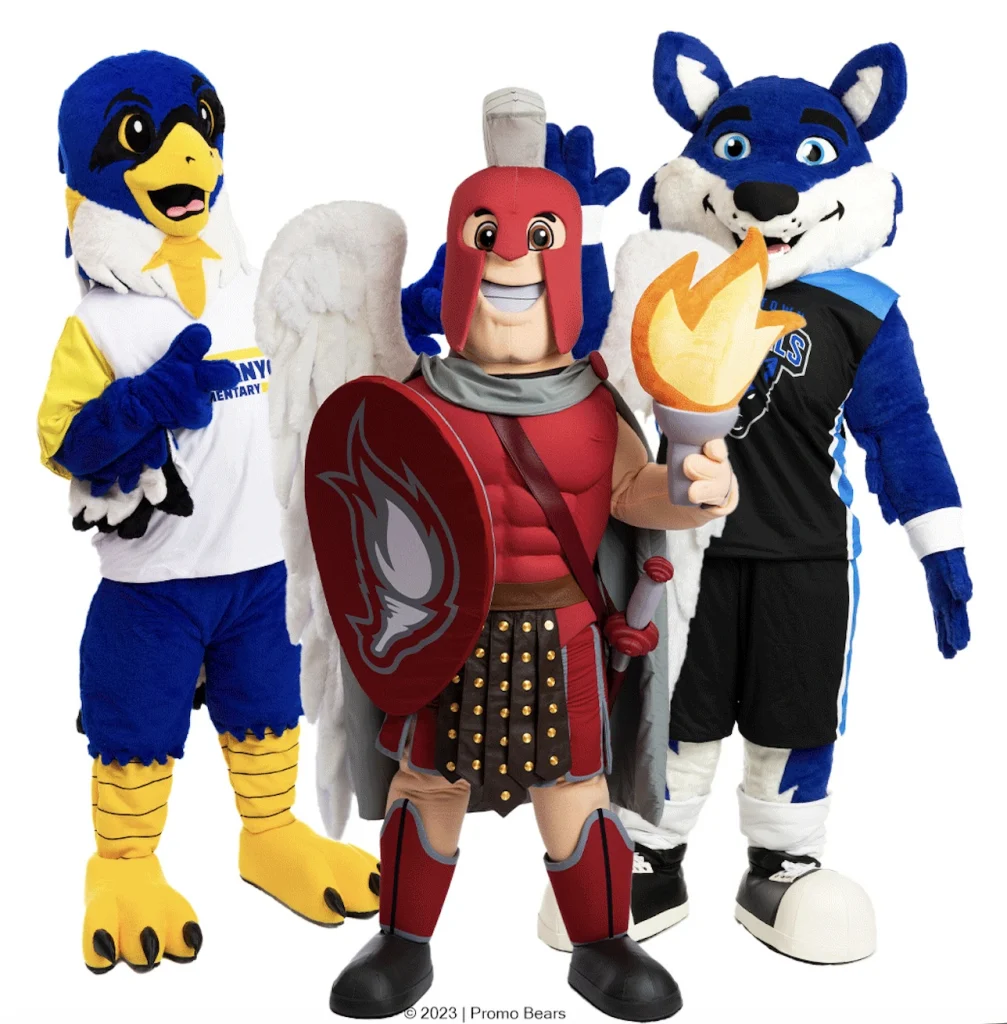
Sports teams use mascots to build a child-friendly brand image by giving young fans a fun, approachable character they can connect with emotionally. A mascot turns an abstract team identity into something a child can hug, high-five, and root for. The sections below explore exactly how that works, from the psychology of kids’ brand recognition to the merchandise strategies that keep mascots front and center in family life.
What makes a sports mascot appeal to young fans?
A sports mascot appeals to young fans because it translates a team’s identity into a character that feels safe, exciting, and fun all at once. Children respond to expressive faces, bold colors, and playful movement. When a mascot waves from the sideline or poses for a photo, it creates a personal moment that no logo on a jersey can replicate.
Several design and behavioral qualities drive that appeal:
- Friendly, exaggerated features such as large eyes and a wide smile signal warmth and approachability to younger audiences
- Consistent character behavior that is energetic but never intimidating keeps kids comfortable during live events
- Bold, high-contrast colors that match team branding make the mascot instantly recognizable even from a distance
- Interactive moments like dancing, high-fives, and crowd games give children a reason to pay attention throughout the event
The most effective mascots strike a balance between being exciting enough to hold a child’s attention and gentle enough that younger kids are not frightened. That balance is not accidental. It comes from intentional design choices made long before the costume is ever worn in public.
How do sports teams use mascots to create family-friendly experiences?
Sports teams use mascots to create family-friendly experiences by positioning the character as the emotional center of the event atmosphere. While the game itself may be too complex for very young children to follow, the mascot gives kids something to watch, cheer for, and interact with regardless of the score.
In practice, teams deploy mascots across multiple touchpoints during a game day:
- Pre-game arrival where the mascot greets fans at the entrance and sets an upbeat, welcoming tone
- In-seat visits that let families get up-close photos and create personal memories tied to the team
- Halftime and timeout entertainment including dance routines, mini-games, and crowd participation activities
- Post-game meet-and-greets where kids can spend time with the mascot in a calm, dedicated setting
Each of these moments reinforces the idea that attending a game is a family outing, not just a sporting event. When parents see their child light up around a mascot, they associate that positive feeling with the team itself. That emotional link is what turns a one-time attendee into a loyal, returning family.
What role do mascots play in children’s brand recognition?
Mascots play a central role in children’s brand recognition because young audiences process characters far more readily than text, logos, or abstract symbols. A child who cannot yet read a team name will still recognize the mascot’s face, color, and shape. That recognition becomes the foundation of brand loyalty that can last a lifetime.
Research in child development consistently shows that children form strong associations with characters from an early age. Sports teams that invest in a well-designed mascot give themselves a significant advantage in reaching the youngest segment of their fan base. The mascot becomes the team’s ambassador to an audience that adult-focused marketing simply cannot reach as effectively.
Beyond the stadium, mascots reinforce brand recognition every time a child encounters them on merchandise, social media content, or community appearances. Repeated exposure to the same friendly character builds familiarity, and familiarity builds trust. For a sports team, that trust is the starting point for a multi-decade relationship with a fan.
How do mascot merchandise and plush toys extend a team’s reach to kids?
Mascot merchandise and plush toys extend a team’s reach to kids by bringing the mascot into everyday life long after the game ends. A child who takes a plush toy home keeps the team present in their bedroom, their backpack, and their daily routine. That constant visibility deepens the emotional connection and keeps the team top of mind between seasons.
Plush toys are particularly powerful because they are tactile and comforting. Children form attachments to soft toys in a way they simply do not with a hat or a keychain. A well-made plush mascot becomes a companion, which means the team it represents earns a place in a child’s emotional world.
Other merchandise formats that perform well with younger fans include stickers, keychains, and temporary tattoos. These items are affordable enough for parents to say yes to at a concession stand, and they travel well, showing up at school, on water bottles, and in lunch boxes. Every time another child sees that sticker or keychain, the team’s mascot gets a little more exposure.
For teams thinking about production timelines, plush toys typically take around 12 to 18 weeks from design approval to delivery, while stickers and keychains can be ready in as little as 3 to 6 weeks. Planning merchandise around key events like season openers or playoffs makes a real difference in impact.
What’s the difference between a mascot costume and a mascot character?
A mascot character is the creative concept: the name, personality, backstory, and visual design that defines who the mascot is. A mascot costume is the physical product that brings that character to life at events. Both are important, but they serve different functions and require different kinds of thinking.
The character comes first. Teams that skip the character development phase and jump straight to building a costume often end up with something that looks good on paper but feels hollow in practice. A mascot without a defined personality gives performers nothing to work with, and it gives fans nothing to connect with beyond the visual.
Once the character is defined, the costume needs to translate that personality into three-dimensional form. That means making design choices about proportions, expression, color accuracy, and wearability. A performer who is uncomfortable inside the costume cannot deliver the energetic, engaging experience that young fans expect. Features like a built-in ventilation system and lifelike 3D eyes make a meaningful difference in both performer experience and audience impact.
The two elements work together. A strong character concept with a poorly constructed costume falls flat. A beautifully built costume with no defined character personality feels empty. The most successful sports mascots nail both.
[div style=”all:initial; font-family: Inter, Arial, Helvetica, sans-serif !important; display:block !important; max-width:760px !important; margin:0 auto !important; padding:40px 20px !important; box-sizing:border-box !important; background:#f6f6f6 !important;”] [div style=”all:initial; display:block !important; box-sizing:border-box !important; background:#ffffff !important; border-left:5px solid #0676c6 !important; border-radius:0 8px 8px 0 !important; padding:28px 32px !important; margin:0 !important;”] [p style=”all:initial; display:block !important; font-family: Inter, Arial, Helvetica, sans-serif !important; font-size:12px !important; font-weight:700 !important; text-transform:uppercase !important; letter-spacing:1.5px !important; color:#fc9e07 !important; margin:0 0 8px 0 !important; padding:0 !important;”]Custom Mascot Costume[/p] [p style=”all:initial; display:block !important; font-family: Inter, Arial, Helvetica, sans-serif !important; font-size:20px !important; font-weight:800 !important; color:#001626 !important; margin:0 0 8px 0 !important; padding:0 !important; line-height:1.3 !important;”]Ready to bring your mascot to life?[/p] [p style=”all:initial; display:block !important; font-family: Inter, Arial, Helvetica, sans-serif !important; font-size:15px !important; font-weight:400 !important; color:#444444 !important; margin:0 0 20px 0 !important; padding:0 !important; line-height:1.6 !important;”]Get a free quote and concept illustration — no commitment, response within 24 hours.[/p] [a href=”https://www.promobears.nl/offerte-mascotte-pakken-op-maat/?_gl=1*crobhp*_up*MQ..*_gs*MQ..&gclid=CjwKCAjwmdLSBhANEiwAkREMN0fUadA_pnTLOIiY_V2RGMDDEgVqB_LzUlc5W0LwcOw8yCLygr6FEBoCOMIQAvD_BwE&gbraid=0AAAAAD86lTiNujiAIhFH-M3l3wY2DX0W4″ style=”all:initial; display:inline-block !important; font-family: Inter, Arial, Helvetica, sans-serif !important; font-size:13px !important; font-weight:700 !important; text-transform:uppercase !important; letter-spacing:0.5px !important; color:#ffffff !important; background:#fc9e07 !important; border:3px solid #fc9e07 !important; border-radius:60px !important; padding:11px 26px !important; text-decoration:none !important; cursor:pointer !important; box-sizing:border-box !important;”]Request a Free Quote →[/a] [/div] [/div]How should sports teams design a mascot that works for all ages?
Sports teams should design a mascot that works for all ages by anchoring the character in the team’s authentic identity while keeping the visual design approachable and the personality broad enough to resonate across generations. A mascot that only appeals to children risks alienating adult fans. One that skews too mature loses the youngest audience entirely.
The design process should address a few key questions from the start:
- Does the character reflect the team’s values, location, or history in a way that adult fans will respect?
- Is the visual design friendly enough that young children will not find it intimidating?
- Can the costume be worn comfortably for extended periods so performers can stay active and engaging throughout an event?
- Does the color palette align with team branding so the mascot feels like a natural extension of the brand rather than a separate entity?
Getting the design right from the start saves significant time and money. Working through unlimited revisions at the concept illustration stage, before any production begins, is far more efficient than trying to rework a finished costume. Involving stakeholders from different departments, including marketing, community relations, and the event operations team, helps ensure the final design serves every use case it will face.
How Promo Bears helps sports teams build a child-friendly brand image
We work with sports teams across North America to bring mascot characters to life in ways that genuinely connect with fans of all ages, especially kids. Our custom mascot costume production process starts with a free concept illustration based on your existing design or a brand new idea, with unlimited revisions until the result is exactly right. No upfront commitment, no guesswork.
Here is what we bring to every mascot project:
- Lifelike 3D eyes and expressive design that appeal to young fans and photograph beautifully
- Built-in ventilation system so performers stay comfortable and energetic throughout long event days
- A dedicated project manager who keeps your timeline on track from first sketch to final delivery
- A full range of mascot merchandise including plush toys, stickers, keychains, and stress balls to extend your mascot’s reach beyond the stadium
Mascot costumes are ready in 12 to 16 weeks, and many merchandise items can be delivered in as little as 3 to 6 weeks. Whether you are building a mascot from scratch or expanding an existing character into a full merchandise line, we handle everything from concept to delivery.
Ready to give your fans a mascot they will never forget? Get a free quote and let’s start building something great together.
Frequently Asked Questions
How much does it typically cost to commission a custom sports mascot costume?
Custom mascot costume pricing varies widely depending on complexity, materials, and the level of detail involved, but most professional-grade sports mascot costumes range from a few thousand dollars to well over $10,000. Simpler designs with fewer moving parts or special features sit at the lower end, while fully articulated costumes with advanced ventilation, 3D eyes, and premium fabrics command higher investment. The best approach is to request a free quote with your specific design requirements so you get an accurate estimate rather than relying on general ranges.
What if we already have a mascot logo — can it be turned into a wearable costume?
Yes, an existing mascot logo or illustration is actually the ideal starting point for a custom costume build. A professional mascot manufacturer will use your 2D artwork as the creative brief and work through a concept illustration phase to translate it into a three-dimensional, wearable design. The key step is ensuring the proportions, colors, and personality of the original design translate well into a physical form, which is why unlimited revisions at the illustration stage are so valuable before any production begins.
How do we keep a mascot feeling fresh and engaging for kids year after year?
Keeping a mascot engaging over time comes down to consistent character development and fresh touchpoints rather than redesigning the character itself. Teams can introduce seasonal costume accessories, update the mascot’s social media presence with new content formats, or expand the merchandise line with new items kids can collect. Giving the mascot a defined personality and even a backstory also helps, since it gives your marketing and events teams ongoing material to work with and gives young fans a richer character to grow attached to.
What are the most common mistakes sports teams make when introducing a new mascot?
The most common mistake is rushing straight to costume production without fully developing the mascot’s character, personality, and role within the brand first. Another frequent misstep is designing the mascot primarily for visual appeal without considering performer comfort, which leads to limited in-event engagement and a poor fan experience. Teams also sometimes underestimate the importance of a coordinated merchandise launch alongside the costume debut, missing a major opportunity to reinforce the new character and drive early fan adoption.
How should we train the performers who will wear the mascot costume?
Mascot performer training should cover three core areas: physical stamina and movement, character consistency, and crowd interaction techniques. Performers need to understand the mascot’s defined personality so every appearance feels cohesive, regardless of who is inside the costume. Practical rehearsals in the actual costume before the first public event are essential, as the weight, visibility limitations, and heat of a professional costume require adjustment time. Many teams also develop an internal style guide or character bible that outlines approved behaviors, gestures, and interaction rules to keep the character experience consistent across all performers and events.
Can mascot merchandise be used for purposes beyond game-day sales?
Absolutely — mascot merchandise is a versatile tool that extends well beyond the concession stand. Teams use plush toys, stickers, and branded items as giveaways at community outreach events, school visits, and charity partnerships, all of which strengthen the team’s local identity and introduce the mascot to families who may not yet attend games. Merchandise also works effectively as a digital engagement driver, with social media contests, unboxing moments, and fan photo campaigns built around mascot products generating organic reach and building emotional investment in the character.
At what age do children typically start forming strong attachments to sports mascots?
Children as young as 2 to 3 years old begin forming strong emotional responses to characters, making mascots effective brand touchpoints even for toddlers attending their first game. By ages 4 to 7, kids are fully capable of recognizing, naming, and developing genuine affection for a mascot character, which is why this age group is particularly valuable for long-term fan development. The attachments formed during these early years are remarkably durable — a child who bonds with a team’s mascot at age 5 is far more likely to remain a fan into adulthood, making early mascot investment one of the highest-return strategies in sports marketing.