
You can make company culture visible without a big budget by turning everyday touchpoints into culture signals. Think branded merchandise, mascot characters, team rituals, and a consistent visual identity across your spaces and events. The good news is that most of the most effective culture-visibility tools are surprisingly affordable, especially when you focus on items that travel with your team and customers. This article walks through the most practical questions around making culture tangible, from what it actually means to how you measure whether it is working.
What does it actually mean to make company culture visible?
Making company culture visible means translating your internal values, personality, and way of working into things people can actually see, touch, and experience. Culture is not a mission statement on a wall. It is the energy in your booth at a trade show, the branded items your team hands out, and the characters or imagery that show up consistently across your communications.
Visibility matters because people cannot connect with something abstract. When your culture stays internal, it stays invisible to customers, partners, recruits, and the public. The moment you give it a physical or visual form, it becomes shareable and memorable.
For marketing managers and brand directors, this is really a question of translation. How do you take what your organization stands for and turn it into something a person can walk away with? That is where branded touchpoints come in. A consistent visual identity, a recognizable character, a piece of merchandise someone actually keeps. These are all forms of culture made visible.
What are the most cost-effective ways to show company culture?
The most cost-effective ways to make company culture visible include branded merchandise that people actually use, consistent visual storytelling across events and social media, and low-cost physical items that carry your brand into everyday life. You do not need a massive production budget to make a real impression.
Here are some of the most accessible options for organizations working with a realistic budget:
- Stickers and temporary tattoos: Fast to produce (stickers are ready in about 7 to 10 days, temporary tattoos in 3 to 4 weeks) and inexpensive per unit. Great for events, packaging inserts, and giveaways.
- Enamel pins and keychains: Small but collectible. These take about 3 to 6 weeks to produce and give people something they actually keep and wear.
- Drawstring bags and branded totes: Functional items that travel with people and put your brand in front of new audiences every time they are used.
- Custom mascot stickers: A character-driven version of your brand that takes about 4 weeks to produce and works across digital and physical channels.
- Frisbees and beach balls: Seasonal but highly social. These get used in group settings, which means more visibility per unit.
The key is choosing items that align with your brand personality. A playful consumer brand will get more mileage from a frisbee than a law firm would. Match the product to the culture you are trying to show.
How do branded mascots and characters communicate culture?
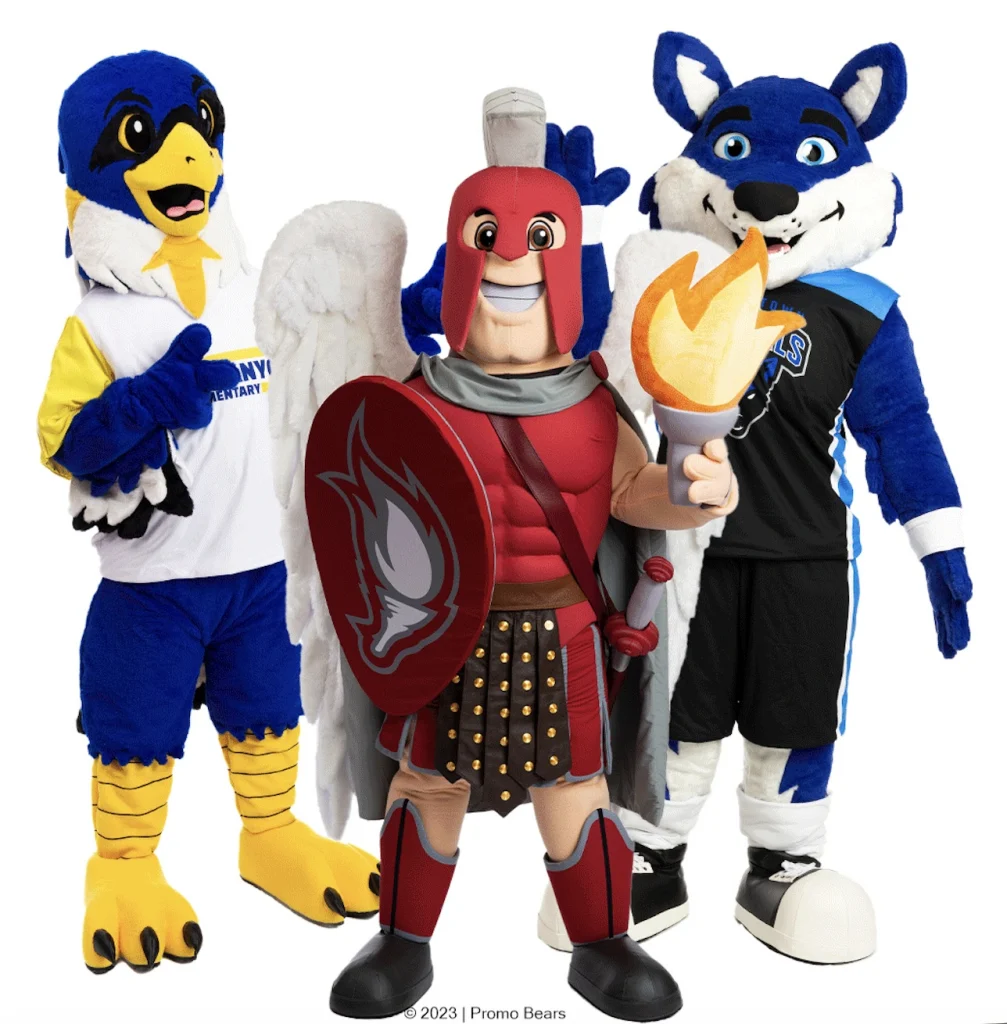
Branded mascots and characters communicate culture by giving your organization a personality that people can instantly recognize and emotionally connect with. A mascot is not just a costume or a graphic. It is a concentrated, visual expression of what your brand feels like, made accessible to anyone who encounters it.
Characters work because they bypass the need for explanation. You do not have to tell someone your brand is energetic, approachable, or fun. A well-designed mascot shows it immediately. This is especially valuable at events, in schools, at sports venues, and anywhere your brand needs to make a fast, positive impression on a crowd.
For organizations that want to go beyond a logo on a t-shirt, a custom mascot costume creates a living, interactive version of your brand. It gives your team something to rally around and gives your audience something to remember. Mascots also extend naturally into merchandise. Once you have a character, you can put it on plush toys, keychains, stickers, inflatables, and more, creating a consistent culture signal across every format.
Giant mascot inflatables, for example, are ready in just 3 to 4 weeks and immediately command attention at outdoor events. Player tunnels and inflatable arches have the same turnaround time and create a dramatic, branded moment that photographs well and sticks in people’s memories.
What role do promotional products play in culture-building?
Promotional products play a direct role in culture-building by giving your values a physical form that travels beyond your office, store, or event. Every time someone uses a branded item in their daily life, they are carrying a piece of your culture with them and putting it in front of new people.
The most effective promotional products for culture-building are the ones that feel useful or meaningful, not like generic giveaways. A stress ball shaped like your mascot is more memorable than a pen with a logo. A custom plush toy that reflects your brand character becomes something people display on their desks. These items create emotional associations that reinforce what your organization stands for.
Plush toys, for instance, take about 12 to 18 weeks from prototype to delivery, but the result is a premium product that people genuinely keep and display. Stress balls take 10 to 12 weeks and work well for high-volume events where you need something tactile and fun. The production timeline matters because culture-building is a long game. Planning ahead means you can have the right products ready for the right moment.
When should a company invest in culture-visibility tools?
A company should invest in culture-visibility tools when it is preparing for a moment where its brand identity needs to make a clear impression. That includes product launches, trade shows, hiring campaigns, rebrands, anniversaries, community events, and sports sponsorships. These are the moments when your culture is most visible and most likely to influence how people perceive you.
That said, culture-visibility is not only about big events. Ongoing investments in branded merchandise, mascot programs, and a consistent visual identity build cumulative recognition over time. The brands that feel most alive are the ones that show up consistently, not just when they have something to announce.
If you are working with longer lead times, plan accordingly. Mascot costumes take 12 to 16 weeks from design approval to delivery. Plush toys take 12 to 18 weeks. Stress balls take 10 to 12 weeks. Smaller items like enamel pins, keychains, and stickers can be ready in 3 to 6 weeks, which gives you more flexibility for shorter planning windows. Knowing your timelines in advance is what separates a polished brand moment from a last-minute scramble.
How do you measure whether your culture is coming across?
You measure whether your culture is coming across by tracking a combination of qualitative signals and quantitative indicators. No single metric tells the whole story, but together they give you a clear picture of whether your culture is landing the way you intend.
On the qualitative side, pay attention to how people describe your brand in their own words. Customer reviews, social media comments, and feedback from event attendees often reveal whether your intended culture is being received. If people are using the words you associate with your brand, that is a strong signal.
On the quantitative side, useful indicators include:
- Social media engagement on branded content: Are people sharing, commenting, or tagging friends when your mascot or merchandise appears?
- Merchandise pickup and retention rates at events: Items people actively seek out or keep are resonating. Items left behind are not.
- Employee advocacy: Are your own team members sharing branded content and wearing or using branded products voluntarily?
- Brand recall in follow-up conversations: After a trade show or event, do prospects remember who you are and what you stood for?
- Repeat engagement: Customers who return, fans who follow your mascot on social media, and partners who reference your brand character are all showing that your culture made an impression.
Culture visibility is cumulative. The more consistently you show up with a clear, recognizable identity, the stronger the signal becomes over time.
How Promo Bears helps you make company culture visible
We work with marketing managers, brand directors, and organizations across North America who want their culture to show up in the real world, not just in internal documents. From custom mascot costumes to branded merchandise, we handle the full process from concept to delivery so you can focus on the moments that matter.
Here is what we bring to your culture-visibility strategy:
- A free concept illustration based on your logo or design idea, with unlimited revisions until it is exactly right
- Custom stress balls in any shape, with PMS color matching and full color print options, ready in 10 to 12 weeks
- Custom mascot costumes with 3D realistic eyes, a built-in ventilation system, and a comfortable fit, ready in 12 to 16 weeks
- A dedicated project manager who oversees your project from design to delivery
- A full range of branded merchandise including plush toys, enamel pins, stickers, inflatables, and more
With over 4,000 mascots created for organizations ranging from NASA and Amazon to schools and sports teams, we know what it takes to make a brand feel alive. If you are ready to give your culture a face, a character, and a presence that people remember, get a free quote and let us show you what is possible.
Frequently Asked Questions
How do I get started with culture-visibility if I have never done it before?
The best starting point is to identify two or three words that describe your brand personality, then choose one physical touchpoint that reflects those words. For example, if your brand is playful and community-focused, a custom mascot sticker or a branded frisbee is a low-risk, low-cost way to test how your culture lands with an audience. Start small, get feedback, and scale what resonates. You do not need a full merchandise line on day one.
What is the biggest mistake companies make when trying to show their culture through branded products?
The most common mistake is choosing products based on price alone rather than brand fit. A generic pen with a logo does very little for culture visibility because it carries no personality. The items that actually build cultural recognition are the ones that feel intentional and specific to your brand, like a mascot-shaped stress ball or a character-driven sticker set. Always ask whether a product reflects who you are, not just whether it is cheap to produce.
Can a small business or nonprofit benefit from culture-visibility tools, or is this only for large brands?
Culture-visibility tools are arguably more impactful for smaller organizations because they level the playing field. A well-designed mascot or a set of high-quality stickers can make a small nonprofit or local business feel just as polished and memorable as a national brand. Many of the most effective options, like stickers, temporary tattoos, and enamel pins, are affordable at low minimum order quantities, making them accessible regardless of budget size.
How far in advance should I start planning branded merchandise or mascot products for an upcoming event?
As a general rule, work backward from your event date and add a buffer of at least two weeks for shipping and approvals. For smaller items like stickers and keychains, a 6 to 8 week lead time is usually sufficient. For premium items like custom mascot costumes or plush toys, you should begin the process at least 16 to 20 weeks out to account for design, production, and delivery. Starting early is what gives you room for revisions without sacrificing quality.
How do I keep culture-visibility consistent across both digital and physical channels?
Consistency comes from anchoring everything to a core visual identity, whether that is a mascot character, a color palette, or a recurring graphic style. Once you have that anchor, apply it across every format: your event merchandise, your social media graphics, your email signatures, and your booth displays. A mascot is especially powerful here because it translates naturally from a physical costume to a digital sticker, an inflatable, a plush toy, and an avatar, giving you a single character that shows up everywhere.
What if my team is skeptical about investing in mascots or branded merchandise? How do I make the case internally?
Frame the investment in terms of outcomes your stakeholders already care about: brand recall, event ROI, employee engagement, and talent attraction. Point to the measurable signals covered in the post, such as merchandise pickup rates, social sharing, and post-event brand recall, as your success metrics. Starting with a smaller, lower-cost pilot, like a custom sticker set for an upcoming trade show, is a low-risk way to demonstrate value before committing to a larger program like a full mascot costume.
Can branded merchandise and mascot programs also support internal culture, not just external visibility?
Absolutely, and this is often an underused opportunity. When employees voluntarily wear, use, or share branded products, it signals genuine pride in the organization and reinforces the culture from the inside out. Mascot programs in particular give internal teams a shared symbol to rally around, especially useful during onboarding, company milestones, or team events. Internal culture and external brand perception are closely linked: the way your team experiences your culture directly shapes how authentically it comes across to the outside world.
Related Articles
- How do you choose the right promotional products for your brand?
- What are the most effective promotional products for schools?
- What makes a promotional product feel premium instead of cheap?
- What are the most memorable promotional products for giveaways?
- How do promotional products support corporate social responsibility?