
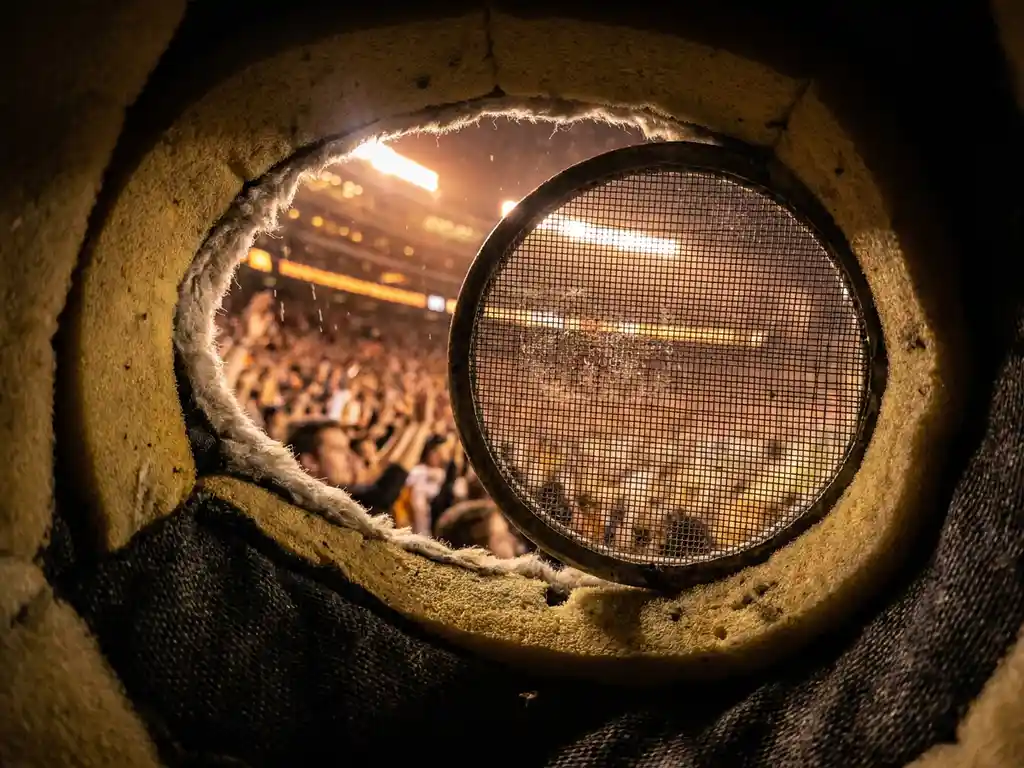
Mascot costume performers see through a mesh panel built into the costume’s head, typically hidden behind the character’s eyes, mouth, or another facial feature. The mesh is dark on the outside and open enough on the inside to give the wearer a workable field of vision. Visibility is limited compared to normal sightlines, which is why professional costume design, performer training, and smart staging all matter. Below, we break down exactly how mascot vision works, what materials are involved, and what to look for when choosing a costume.
Where exactly are the eye holes in a mascot costume?
In most mascot costumes, the eye holes are positioned behind the character’s eyes, inside the mouth area, or across a wider mesh panel on the front of the head. The exact placement depends on the character’s design. A costume with large cartoon eyes might hide the mesh directly behind the pupil, while a more realistic head might use the open mouth or nostrils as the viewing area.
The goal is always to make the mesh invisible to the audience while keeping it functional for the performer. Designers work hard to align the mesh with natural facial features so that the costume looks polished from every angle. For characters with smaller or narrower heads, the viewing panel is often positioned slightly lower than you might expect, around the chin or mouth level, because that placement keeps the mesh hidden while still giving the performer a downward view of the ground directly ahead.
Placement also affects how the costume is worn. A performer needs to position the head correctly so their eyes line up with the mesh. A well-fitted costume makes this intuitive, while a poorly fitted one forces the wearer to tilt or strain, which quickly becomes uncomfortable during long appearances.
What materials are used for mascot costume eye mesh?
The most common material used for mascot costume eye mesh is a fine woven fabric called buckram, sometimes combined with or replaced by a thin wire mesh or specialized black nylon mesh. Each material offers a slightly different balance of visibility, durability, and concealment.
- Buckram: A stiff, open-weave fabric that blocks the performer’s face from view while allowing light through. It is lightweight, easy to shape, and widely used in theatrical and mascot applications.
- Wire mesh: More durable than fabric and offers better airflow, which is a real advantage during high-energy performances. It holds its shape well over time but requires careful finishing to avoid sharp edges.
- Black nylon mesh: A softer option that is comfortable against the skin and provides good outward visibility. The dark color helps it disappear visually from the audience’s perspective.
The color of the mesh matters as much as the material. Dark mesh, typically black or very dark grey, creates a one-way visual effect. From outside the costume, the mesh blends into shadow and the character’s features remain the focus. From inside, the performer can see through it clearly, especially in well-lit environments. Bright or light-colored mesh would make the performer’s face visible to the audience, which defeats the purpose entirely.
How much can you actually see inside a mascot costume?
Visibility inside a mascot costume is noticeably limited compared to normal vision. Most performers can see a cone-shaped field of view directly in front of them, typically covering what is straight ahead and slightly to each side. Peripheral vision is significantly reduced, and looking directly downward or upward is often difficult without tilting the entire head.
The practical effect is that performers can usually see people and obstacles at eye level or slightly below, which is enough to navigate a crowd, interact with guests, and stay aware of their immediate surroundings. What they cannot easily do is spot hazards at their feet without deliberately looking down, see anything behind them, or track fast-moving objects at the edges of their vision.
Lighting conditions have a big impact. In bright outdoor settings or well-lit venues, visibility through the mesh is noticeably better. In dim environments, such as evening events or indoor spaces with low lighting, the mesh becomes harder to see through, and performers need to move more slowly and deliberately.
Why do mascot performers sometimes need a spotter?
A spotter is a handler who walks alongside the mascot performer to guide them safely through crowds, up stairs, around obstacles, and in situations where the limited field of vision inside the costume creates a real safety risk. Spotters are standard practice at professional sporting events, large public appearances, and any setting where the performer cannot fully see their environment.
The need for a spotter comes down to the gap between what the performer can see and what the environment demands. Stairs, uneven ground, excited children running from unexpected directions, and tight corridors are all situations where a mascot’s restricted sightlines become a genuine hazard, for both the performer and the people around them.
A good spotter communicates through light touches or agreed signals rather than shouting instructions, which would break the character’s illusion. They stay close enough to intervene quickly but position themselves so they do not appear in photos or distract from the mascot’s performance. At large events, some mascots work with two spotters to cover both sides.
How do professional mascot costume makers improve visibility?
Professional mascot costume makers use several design techniques to maximize a performer’s visibility without compromising the character’s appearance. The most impactful improvements come from thoughtful head design, high-quality mesh selection, and built-in ventilation that keeps the interior clear of fog and condensation.
One of the most effective approaches is enlarging the mesh panel while keeping it visually concealed. Rather than a small peephole, a well-designed costume uses a wider viewing area that gives the performer a broader field of vision. This wider panel is then disguised within the character’s design, tucked behind teeth, feathers, fur, or other features that naturally absorb visual detail.
Ventilation also plays a direct role in visibility. When a performer’s body heat builds up inside the costume, it creates moisture and condensation that can cloud the mesh and make it harder to see through. A built-in ventilation system, like the one we include in every custom mascot costume we produce, keeps air moving through the head and reduces this effect significantly. The result is clearer vision for longer, which directly supports safer and more confident performances.
The interior finish of the costume head also matters. A dark lining inside the head reduces light reflection that could create glare against the mesh, making it easier for the performer to see outward without visual interference.
What should you look for in a mascot costume’s vision system?
When evaluating a mascot costume’s vision system, the most important factors are mesh quality and size, head fit, interior ventilation, and how well the viewing area aligns with the performer’s natural eye position. A costume that scores well on all four gives performers confidence, comfort, and safety during appearances.
- Mesh size and placement: Look for a viewing panel that is wide enough to give a genuine field of vision, not just a narrow slit. The mesh should be positioned so the performer’s eyes naturally align with it when the costume is worn correctly.
- Mesh material and color: Dark, fine-weave mesh provides the best combination of outward visibility and inward concealment. Avoid costumes that use light-colored or coarse mesh, which reduces performance quality.
- Interior ventilation: A built-in fan or airflow system keeps the interior cool and the mesh clear of condensation. This is especially important for high-energy performances or warm environments.
- Head fit and sizing: The costume head should sit securely without shifting. If the head moves independently of the performer’s own head, the mesh panel drifts out of alignment and visibility drops immediately.
- Interior lining: A dark interior lining reduces glare and makes it easier to see through the mesh from inside the costume.
Asking to see photos or video of the interior before ordering is always a reasonable step. A manufacturer confident in their vision system will have no hesitation sharing that detail.
How Promo Bears Helps with Mascot Costume Visibility
Every mascot costume we produce is built with performer comfort and visibility at the center of the design process. Our team of mascot experts works through every detail of the head design to maximize the performer’s field of vision while keeping the character’s appearance completely intact from the outside.
- Lifelike 3D eyes designed to conceal high-quality dark mesh without reducing the viewing area
- An integrated ventilation system that keeps air moving through the head, reducing heat and condensation for clearer vision throughout the appearance
- Standard sizing for performers between 5’7″ and 6’1″, with custom sizing available to ensure proper head alignment and mesh positioning
- A free concept illustration before production starts, with unlimited revisions so every design detail, including the vision system, is approved before a single stitch is made
- A dedicated project manager who oversees the full process from design to delivery, with result photos shared for final approval before shipping
Our mascot costumes are ready in 12 to 16 weeks and are shipped directly to your door. If you are ready to create a mascot that your performers will actually enjoy wearing, get a free quote and let us show you what is possible.
Frequently Asked Questions
How long does it take to get used to performing in a mascot costume with limited vision?
Most new performers need several practice sessions before they feel confident moving in a mascot costume. A good starting point is practicing in a controlled, familiar space — walking through doorways, navigating stairs, and crouching down — before ever appearing in front of an audience. Many professional mascot programs include structured training that covers sightline awareness, communication with spotters, and crowd navigation techniques. Expect a realistic adjustment period of a few weeks of regular practice before a performer moves comfortably and confidently in full costume.
Can mascot costumes be fitted with cameras or screens to improve visibility?
Yes, some high-end custom mascot costumes can be fitted with a small camera mounted on the exterior and a compact screen or monitor inside the head, giving the performer a live feed of their surroundings. This setup is more common in theme park or broadcast-level productions where budget allows for the added technology. For most standard mascot appearances, high-quality mesh and a well-designed head remain the most practical and reliable solution. If camera integration is a priority, discuss it with your costume manufacturer early in the design process, as it requires specific structural planning.
What are the most common mistakes first-time mascot performers make because of limited visibility?
The most frequent mistakes include moving too quickly, misjudging distances to objects and people, and forgetting to scan the environment by turning the entire head rather than just shifting their eyes. First-timers also tend to look straight ahead and miss hazards at ground level, such as steps, cords, or small children. Developing a habit of slow, deliberate movement and regularly tilting the head downward to check the ground ahead dramatically reduces the risk of trips and collisions. Working with a spotter during early appearances is strongly recommended until the performer builds reliable spatial awareness inside the costume.
Does the type of event affect how much the vision system matters?
Absolutely — the demands on a mascot’s vision system vary significantly depending on the event environment. Outdoor daytime events in good lighting are generally the most forgiving, as bright natural light passes through the mesh more effectively. Indoor events with dim lighting, evening appearances, or high-energy settings with fast-moving crowds place much greater demands on both the mesh quality and the performer’s training. For events involving stairs, stages, or tight backstage corridors, a well-designed vision system combined with an experienced spotter is not optional — it is a safety requirement.
How do I clean a mascot costume without damaging the eye mesh?
The eye mesh area requires gentle handling during cleaning to avoid warping, tearing, or loosening the material from its frame. Avoid soaking the head or running it through a washing machine, as this can distort the mesh and the surrounding structure. Instead, spot-clean the interior with a damp cloth and a mild fabric-safe disinfectant spray, allowing it to air dry completely before storage. For wire mesh panels specifically, avoid pressing or scrubbing directly on the mesh surface, as this can deform the weave and reduce visibility. Always follow the care instructions provided by your costume manufacturer.
Is there a minimum performer height or size requirement for mascot costumes to work properly?
Yes — proper head fit is directly tied to how well the performer’s eyes align with the mesh panel, which means sizing genuinely matters for both safety and visibility. Most standard mascot costumes are designed for performers within a specific height range, commonly around 5’7u0022 to 6’1u0022, to ensure the head sits at the right position on the wearer. Outside that range, the mesh panel can sit too high or too low relative to the performer’s eyes, significantly reducing what they can see. Reputable manufacturers offer custom sizing options to accommodate performers outside the standard range, and it is always worth specifying the intended performer’s measurements before production begins.