
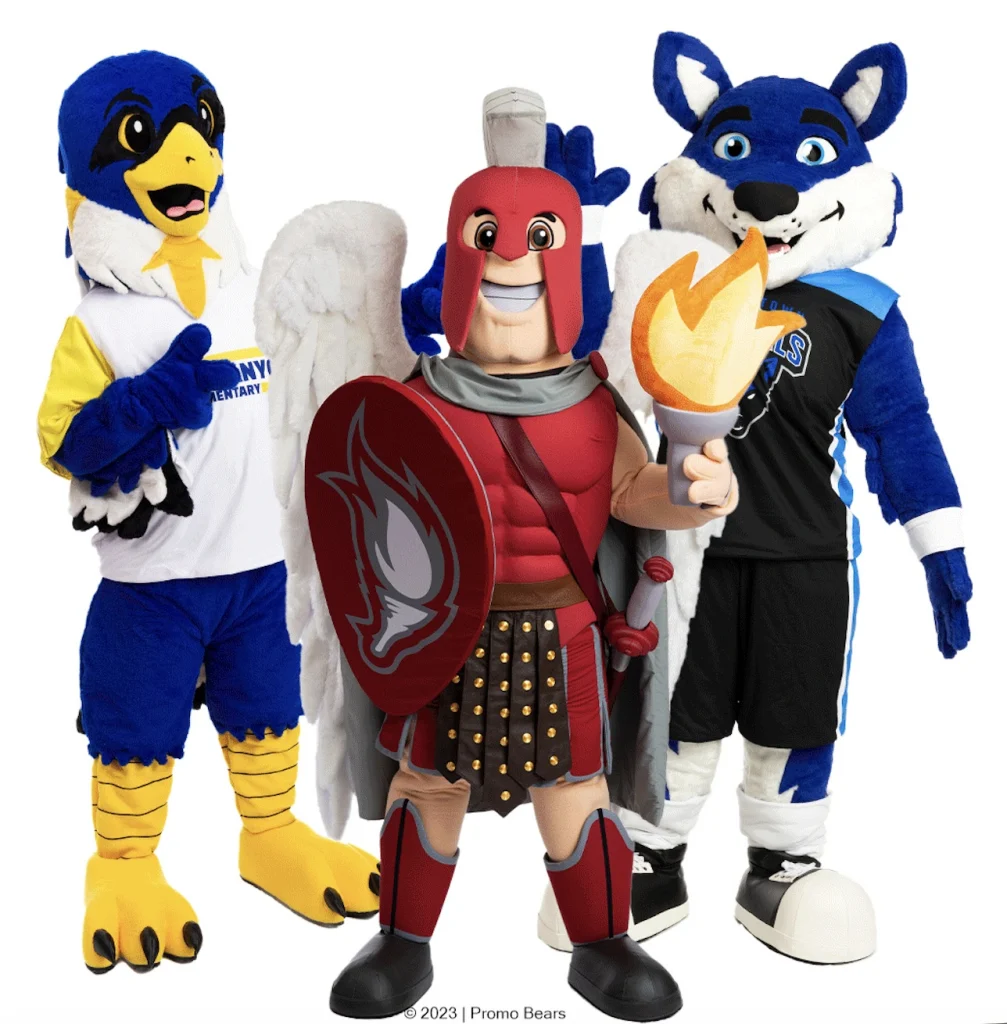
A mascot costume helps create a recognizable brand for kids by giving your brand a face, a personality, and a physical presence that children can connect with emotionally. Kids respond to characters far more readily than to logos or taglines, which makes a well-designed mascot one of the most powerful children’s marketing ideas available to brands today. The questions below unpack exactly how that works and what to keep in mind when building a mascot strategy aimed at younger audiences.
Why do children respond so strongly to mascot characters?
Children respond so strongly to mascot characters because their brains are wired to process faces, expressions, and personalities before abstract symbols. A mascot gives a brand human-like traits, which makes it immediately approachable and easy to trust. For kids, a character with expressive eyes and a friendly posture feels like a companion rather than an advertisement.
This emotional response runs deep. From an early age, children build relationships with characters through books, cartoons, and toys. When a brand introduces a mascot that mirrors that kind of character energy, it fits naturally into a mental space the child already has. The mascot stops being a marketing tool and starts feeling like a friend.
That emotional bond has real consequences for brand perception. A child who likes a mascot will actively seek out the brand, ask parents to engage with it, and remember it far longer than any banner or billboard. For brands targeting families, this kind of instinctive, character-driven connection is one of the most reliable children’s marketing ideas in the playbook.
How does a mascot costume make a brand more memorable to kids?
A mascot costume makes a brand more memorable to kids by turning something abstract into something physical, tangible, and alive. When a child sees a mascot costume in person at an event or a store, they are not just seeing a logo. They are meeting a character, and that experience creates a memory that sticks in a way that a printed image simply cannot replicate.
Memory in children is heavily tied to sensory experience and emotion. A mascot costume delivers both. The child sees the character, may high-five it, hug it, or take a photo with it. Each of those moments creates a positive emotional anchor connected directly to your brand. That anchor gets reinforced every time the child sees your logo, your packaging, or any merchandise featuring the mascot.
Repetition also plays a role. When the same mascot character appears consistently across events, merchandise, and communications, children begin to recognize it instantly. That recognition is the foundation of a truly recognizable brand for kids, and it builds faster when the character has a consistent look, color palette, and personality.
What makes a mascot costume design effective for a young audience?
An effective mascot costume design for a young audience combines approachability, visual clarity, and expressive features that children can read at a glance. Oversized eyes, bright colors, a friendly facial expression, and a proportionally large head all signal warmth and safety, which are the qualities kids need to feel before they engage.
Visual features that connect with children
Children process visual information differently from adults. They are drawn to high contrast, bold colors, and exaggerated proportions. A mascot with realistic 3D eyes, for example, creates an immediate sense of life and personality that flat printed graphics cannot achieve. The eyes are often the first thing a child looks at, so getting them right matters enormously.
Bright, saturated colors that align with your brand palette also help. Kids associate certain colors with emotions, so a warm, energetic color scheme signals fun and excitement, while softer tones suggest comfort and friendliness. The right combination depends on your brand values and the specific age group you want to reach.
Comfort and wearability for the performer
A mascot costume is only as effective as the performance inside it. If the person wearing the costume is uncomfortable, overheated, or restricted in movement, the character loses its energy and warmth. Kids pick up on that immediately. A costume with a built-in ventilation system and a comfortable fit allows the performer to move naturally, interact enthusiastically, and stay in character throughout an event.
Ease of cleaning is equally important when the costume is used regularly at children’s events. A mascot that looks fresh and vibrant every time it appears reinforces the professionalism and quality of your brand, even to a six-year-old who has no idea what brand quality means but absolutely notices when something looks dingy.
Which industries use mascot costumes to reach kids most successfully?
The industries that use mascot costumes most successfully to reach kids are food and beverage, sports, retail, entertainment, and education. These sectors share a common trait: they rely on repeat engagement with families, and a mascot character gives them a consistent, friendly face that children recognize and request.
- Food and beverage brands use mascots to make their products feel fun and familiar at the point of sale and at live events.
- Sports teams use mascot costumes to energize young fans at games, building loyalty that often lasts a lifetime.
- Retailers deploy mascots during seasonal campaigns and in-store events to drive foot traffic and create shareable moments.
- Entertainment companies use character costumes to bring their intellectual property to life at theme parks, tours, and promotions.
- Schools and universities use mascots to build community and school spirit among students of all ages, including the youngest.
What these industries have in common is a long-term relationship with their audience. A child who bonds with a sports team mascot at age seven may still be buying season tickets at thirty. That kind of loyalty starts with a character, and it starts young.
How does a mascot costume support long-term brand loyalty in children?
A mascot costume supports long-term brand loyalty in children by creating repeated positive experiences that become associated with your brand over time. Each encounter, whether at an event, on packaging, or through merchandise, reinforces the emotional connection. Over months and years, that connection becomes a preference, and that preference becomes loyalty.
Children are creatures of habit and attachment. Once they form a bond with a character, they advocate for it within their family. They ask for the cereal with the mascot on the box, the team jersey with the character on it, or the school bag featuring their favorite school animal. That advocacy directly influences purchasing decisions made by adults, which is why mascot-driven children’s marketing ideas deliver measurable ROI for brands.
Consistency is the engine behind this loyalty. A mascot that looks the same, acts the same, and appears regularly across touchpoints builds familiarity. Familiarity builds trust. Trust, especially when established in childhood, is remarkably durable. Brands that invest in a strong mascot character early often find that their most loyal adult customers are the ones who grew up with the character.
What should brands consider when ordering a custom mascot costume for kids’ events?
When ordering a custom mascot costume for kids’ events, brands should consider design appropriateness for the target age group, production timeline, performer comfort, and how the costume will be maintained between uses. Getting these details right from the start saves significant time and cost later.
- Design for your audience: Make sure the character’s features, colors, and proportions are calibrated for the age group you are targeting. What delights a five-year-old may not land the same way with a ten-year-old.
- Plan for your timeline: Custom mascot costumes typically take 12 to 16 weeks from design approval to delivery, so build that into your event calendar well in advance.
- Prioritize performer comfort: A ventilated, well-fitted costume keeps the performer energetic and the character believable throughout the event.
- Think about maintenance: Costumes used at children’s events get touched, hugged, and sometimes drooled on. Choose a costume that is easy to clean and built to hold up over repeated use.
- Start with a concept illustration: Before committing to production, work with a design team to visualize the character. Seeing the mascot on paper before it is built prevents costly surprises.
- Consider the full merchandise ecosystem: A mascot costume is most powerful when it connects to a broader range of branded items. Plush toys, stickers, and keychains extend the character’s reach beyond the event itself.
One practical note on timing: if you are planning a mascot debut at a specific event, work backward from that date. With a 12 to 16 week production window, brands targeting summer or back-to-school events in 2026 should be initiating their design process now.
How Promo Bears helps you build a recognizable brand for kids
We have spent over 19 years helping brands across North America create mascot characters that genuinely connect with children. Our process starts with zero upfront commitment. You receive a free concept illustration based on your logo or design idea, with unlimited revisions until the character is exactly right. Production only begins once you are fully satisfied with the result.
Every costume we produce includes:
- Lifelike 3D eyes that children respond to immediately
- An integrated ventilation system for performer comfort during events
- High-quality, easy-to-clean materials built for repeated use
- A dedicated project manager who oversees every step from concept to delivery
Beyond the costume itself, we can extend your mascot character across plush toys, stickers, keychains, and more, giving kids multiple ways to connect with your brand long after the event is over. If you are ready to give your brand a face that kids will remember, get a free quote and let us show you what is possible.
Frequently Asked Questions
How do I know if my mascot character design will actually resonate with kids before committing to production?
The best way to validate your mascot design before production is to test the concept illustration with a small sample of your target audience, whether that means showing it to parents, running a quick social media poll, or getting informal feedback at a community event. Pay close attention to children’s first reactions, since kids are instinctively expressive and their immediate response to a character is one of the most honest signals you will get. Working with a design team that offers unlimited revisions, like Promo Bears, also ensures you can refine the character based on real feedback before a single stitch is made.
What are the most common mistakes brands make when introducing a mascot to a young audience?
The most common mistake is designing a mascot that appeals to adults rather than children, resulting in a character that feels too sleek, too abstract, or too cool to be approachable for kids. Another frequent misstep is inconsistency, rolling out a mascot at one event and then failing to reinforce it across packaging, social media, and merchandise, which prevents the character from ever becoming truly familiar. Finally, many brands underestimate the performer’s role; even the most beautifully crafted costume will fall flat if the person inside it is not trained to interact enthusiastically and naturally with children.
Can a mascot costume work for digital and social media content, or is it only effective in person?
A mascot costume is highly effective in digital and social media content and should absolutely be used beyond in-person events. Short videos featuring the mascot interacting with kids, behind-the-scenes content, and character-driven posts on platforms like Instagram, TikTok, and YouTube extend the mascot’s reach to families who may never attend a live event. The key is to keep the character’s personality consistent across every format so that children recognize and connect with the same mascot whether they see it at a store or on a screen.
How many times should a mascot appear at events before kids start to recognize it on their own?
There is no fixed number, but research on children’s brand recognition suggests that consistent exposure across three to five touchpoints, such as a live event, product packaging, a sticker, and a social media post, is typically enough to establish recognition in children aged four to eight. The more varied and emotionally engaging those touchpoints are, the faster recognition builds. This is precisely why pairing a mascot costume with supporting merchandise like plush toys and keychains accelerates familiarity far more quickly than live appearances alone.
What is the best way to handle mascot character interactions with very young children who might be scared of costumes?
Some toddlers and young children experience costume shyness or even fear, which is completely normal and should be planned for rather than ignored. Train your mascot performer to approach hesitant children slowly, crouch down to the child’s eye level, and never force an interaction, letting the child set the pace. Having a brand ambassador or staff member nearby to act as a friendly bridge between the child and the mascot can also ease the introduction significantly. A positive, pressure-free first encounter is far more valuable than a forced photo opportunity, since it lays the groundwork for a genuine connection at future events.
How should a brand budget for a custom mascot costume, and what factors affect the final cost?
Custom mascot costume pricing typically varies based on the complexity of the character design, the materials used, the size of the costume, and the features included, such as ventilation systems, animatronic elements, or specialty fabrics. As a general rule, treat a custom mascot costume as a long-term brand asset rather than a one-time expense, since a well-built costume can last for years of regular use and deliver ongoing ROI through brand recognition and customer loyalty. Requesting a free quote with a concept illustration, as Promo Bears offers, is the most practical first step to understanding the investment required for your specific character and goals.
Can an existing logo or brand character be turned into a mascot costume, or does the character need to be created from scratch?
An existing logo character or illustrated brand mascot can absolutely be translated into a three-dimensional costume, and this is actually a very common starting point for brands that already have visual brand equity built around a character. The process involves adapting the flat design into a wearable, structurally sound form while preserving the key visual elements, such as color, expression, and proportions, that make the character recognizable. Working closely with an experienced mascot manufacturer during this adaptation phase ensures that the final costume feels like a faithful, lifelike version of the original character rather than a generic approximation.