
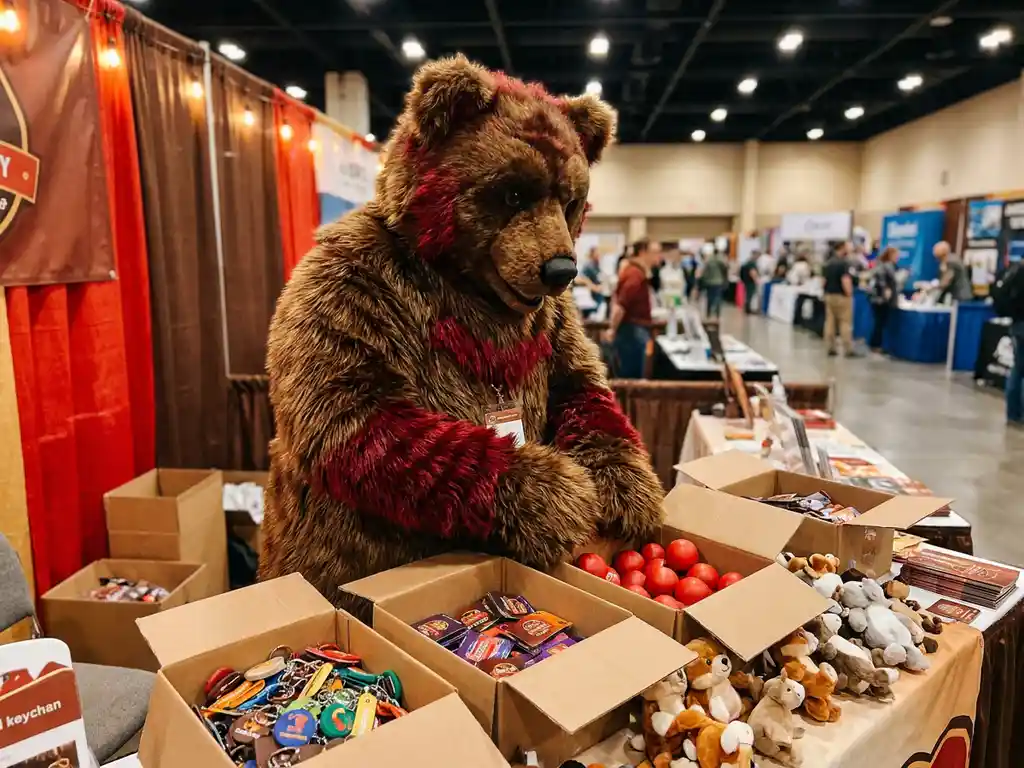
For most trade shows, plan to bring enough trade show giveaways to cover 50–75% of your expected booth visitors. That range accounts for no-shows, casual passersby who skip your booth, and the reality that not every attendee is your target audience. The exact number depends on your booth size, show type, and giveaway strategy — and the sections below walk through each factor in detail.
How do you estimate the number of attendees at your booth?
Start with the total show attendance figure provided by the event organizer, then work backward. As a general rule, a standard 10×10 booth at a mid-size trade show will attract between 5% and 15% of total foot traffic over the course of the event. A larger or more prominently placed booth can pull significantly more.
To sharpen your estimate, consider these factors:
- Show attendance data: Request historical attendance figures from the organizer. Many events publish post-show reports with verified numbers.
- Your booth location: Corner booths, end-cap positions, and spots near entrances or food areas consistently draw more visitors than mid-aisle locations.
- Your industry relevance: If the show is highly targeted to your sector, your conversion from passerby to visitor will be higher.
- Pre-show marketing: If you’ve promoted your booth through email campaigns or social media, factor in the additional traffic those efforts generate.
- Show duration: A two-day regional expo and a five-day international conference require very different quantities.
Once you have a realistic visitor estimate, you can start calculating how many giveaways to order — rather than guessing and either running short or shipping home boxes of unused stock.
What’s the right ratio of giveaways to expected visitors?
A ratio of 1 giveaway per 1.5 to 2 expected visitors is a practical starting point. This accounts for the fact that not every person who stops at your booth will be a genuine lead worth engaging, and it prevents you from handing out premium items to people who have no real interest in your brand.
If your giveaway is a high-value item, tighten the ratio further. Reserve those pieces for qualified conversations — visitors who sit down for a demo, scan a badge, or fill in a contact form. For lower-cost, high-volume items like branded stress balls or keychains, a closer-to-one ratio makes sense because the goal is broad brand visibility rather than targeted lead capture.
Always build in a 10–15% buffer above your calculated number. Shipping delays, damaged items, and unexpectedly high booth traffic are all real risks. Running out of giveaways on day one of a three-day show is a missed opportunity that no amount of apologizing can recover.
Should you bring the same giveaway for everyone or different items?
A tiered approach works better than a single giveaway for everyone. Giving the same item to every visitor regardless of their level of interest dilutes the impact of your investment and reduces the perceived value of your brand interaction.
A practical tiered structure looks like this:
- Tier 1 — General visitors: A small, branded item for anyone who stops by. Think keychains, stickers, or a compact stress ball. Low cost, high volume, and still effective for brand recall.
- Tier 2 — Engaged prospects: A more substantial item for visitors who have a genuine conversation with your team, watch a demo, or show clear interest. Custom stress balls with your logo or mascot shape work well here — tactile, memorable, and useful.
- Tier 3 — Hot leads: A premium gift reserved for decision-makers, buyers, or partners who represent real business potential. This could be a higher-value branded product or an exclusive item tied to your brand identity.
This approach stretches your budget, rewards real engagement, and ensures your best items end up in the hands of the people most likely to act on them.
What types of promotional products work best at trade shows?
The best trade show giveaways are useful, portable, and distinctively branded. Items that people actually use after the show keep your brand visible long after the event ends — turning a single giveaway into weeks or months of passive brand exposure.
Products that consistently perform well at trade shows include tactile items like custom stress balls, which are compact, satisfying to hold, and easy to customize in shapes that directly reflect your brand. They sit on desks, get passed around offices, and generate the kind of casual curiosity that sparks brand conversations. Custom stress balls shaped around your logo or mascot are especially effective because they stand out from the sea of flat, printed merchandise that fills most trade show bags.
Beyond stress balls, strong performers include branded tote bags (because attendees carry them all day, advertising your brand to everyone at the show), portable phone accessories, and quality pens. The common thread is practicality — giveaways that get used generate impressions; giveaways that get thrown away generate nothing.
How far in advance should you order trade show giveaways?
Order your trade show giveaways at least 12–16 weeks before the event. This timeline gives you enough room to finalize your design, complete any revisions, move through production, and receive delivery without relying on rush options that increase costs and risk.
For fully custom items, the production timeline is longer than most people expect. Custom stress balls, for example, require tooling and injection molds specific to your design, which means our production time runs 10–12 weeks after design approval. Factor in 1–2 weeks for the design and revision process upfront, and you’re looking at a minimum of 12–14 weeks from your first conversation to delivery.
If you’re ordering multiple product types from different suppliers, coordinate delivery windows carefully. Arriving at a trade show to discover one of your key giveaways is still in transit is an avoidable problem — one that almost always traces back to placing the order too late.
What should you do with leftover giveaways after the show?
Leftover trade show giveaways are still branded assets — don’t treat them as waste. With a little planning, unused stock can extend the reach of your trade show investment well beyond the event itself.
Practical ways to put leftover giveaways to work include sending them as follow-up gifts to leads you met at the show, adding them to welcome kits for new clients or employees, using them in social media giveaway campaigns, or distributing them at the next event on your calendar. A branded item that didn’t get handed out at one show can still do its job at a community event, a sales meeting, or a product launch.
If you consistently have significant leftover stock after shows, it’s worth revisiting your estimation process. Chronic overordering either means your visitor projections are too high or your giveaway strategy isn’t converting enough booth visitors into takers. Both are fixable with better planning before the next event.
How Promo Bears helps you nail your trade show giveaway strategy
Getting your trade show giveaways right means having the right product, in the right quantity, ready on time. That’s exactly where we come in. At Promo Bears, we specialize in fully custom promotional products built around your brand — not generic stock items with a logo slapped on.
Here’s what working with us looks like:
- Free concept artwork: Every project starts with a free illustration based on your design idea, with unlimited revisions until it’s exactly right.
- Fully custom shapes: Our stress balls are precision-molded to your specifications — your logo, mascot, or product shape, not a standard round ball with a print.
- PMS color matching: Specific color accuracy is available, so your brand colors are reproduced exactly as they should be.
- Physical prototype approval: Before bulk production begins, you can approve a physical sample — no surprises on delivery.
- Dedicated project manager: One person oversees your order from design through delivery, keeping everything on track.
- Worldwide shipping: We deliver to clients across the USA, Canada, Europe, Australia, and beyond.
With a production lead time of 10–12 weeks after design approval, the earlier you start, the smoother the process. Ready to create a trade show giveaway that people actually keep? Request a free quote and concept illustration today and let’s build something worth squeezing.
Frequently Asked Questions
How do I choose between a custom-shaped stress ball and a standard round one for my trade show?
Custom-shaped stress balls — molded to reflect your logo, mascot, or product — create a stronger brand association and are far more likely to be kept and displayed on a desk than a generic round ball with a printed logo. If brand recall and long-term visibility are your goals, the custom shape is worth the additional lead time. Standard round stress balls are a solid choice when you need a faster turnaround or a higher volume at a lower per-unit cost, but they won’t generate the same level of curiosity and conversation that a distinctive custom shape does.
What's the minimum order quantity I should consider for a trade show giveaway?
Minimum order quantities vary by product type and supplier, but for fully custom promotional items like molded stress balls, most manufacturers require a minimum of 100–250 units due to the tooling and setup costs involved. Before placing an order, cross-reference that minimum against your estimated booth visitor count and your chosen giveaway tier — if the minimum exceeds your realistic distribution target, it’s a sign to either adjust your strategy or select a product with a lower entry point. Ordering significantly above your actual need just to hit a minimum is a budget drain that compounds with storage and shipping costs.
How can I track whether my trade show giveaways are actually generating ROI?
The most reliable way to measure giveaway ROI is to tie distribution to a trackable action — badge scans, QR code visits, contact form submissions, or promo codes printed on the item itself. For tiered giveaway strategies, log which tier each lead received so you can later correlate giveaway level with post-show conversion rates. At a minimum, compare the number of qualified leads captured at the show against the cost of your giveaway budget; if your cost-per-lead is lower than your other marketing channels, your giveaway strategy is working.
What's the biggest mistake companies make when planning trade show giveaways?
The most common and costly mistake is treating giveaways as an afterthought — ordering too late, choosing items based on price alone, and handing them out indiscriminately without a strategy. This approach wastes budget on items that end up in the trash and misses the opportunity to use giveaways as a lead qualification and engagement tool. A close second is underestimating production timelines for custom items, which forces last-minute rush orders at premium cost or arriving at the show empty-handed.
Can I use the same giveaway items across multiple trade shows throughout the year?
Yes, and this is actually a smart way to maximize your per-unit cost by ordering in larger quantities upfront. If your brand identity and messaging are consistent across events, a well-designed custom giveaway can serve you across an entire show season. The key consideration is storage — ensure you have a clean, dry space to hold inventory between events, and track your stock carefully so you’re never caught short or over-ordering duplicates. If you attend shows in different industries or with very different audiences, a small variation in giveaway tier or item type may be worth the extra planning.
How do I brief a supplier on a custom giveaway design if I'm not sure exactly what I want?
Start with your brand assets — your logo files, brand color codes (ideally PMS values), and any mascot or product imagery you want incorporated — and describe the feeling or function you want the item to convey rather than a precise shape. A good supplier will translate that brief into concept artwork for your review, which is exactly how the process works at Promo Bears: you share your idea, and the team produces a free illustration with unlimited revisions until the design is right. Coming in with a clear sense of your audience, your budget range, and your event date is more useful than having a finished design in hand.
Is it worth ordering a physical prototype before committing to a full production run?
Absolutely — especially for fully custom or molded items where color, texture, and size are critical to the final impression. A physical prototype lets you verify that the shape reads clearly at small scale, that colors match your brand standards, and that the item feels right in hand before thousands of units are produced. Skipping this step to save time is a false economy; discovering a color mismatch or an awkward shape after bulk production is far more expensive and stressful than a short delay for sample approval.