
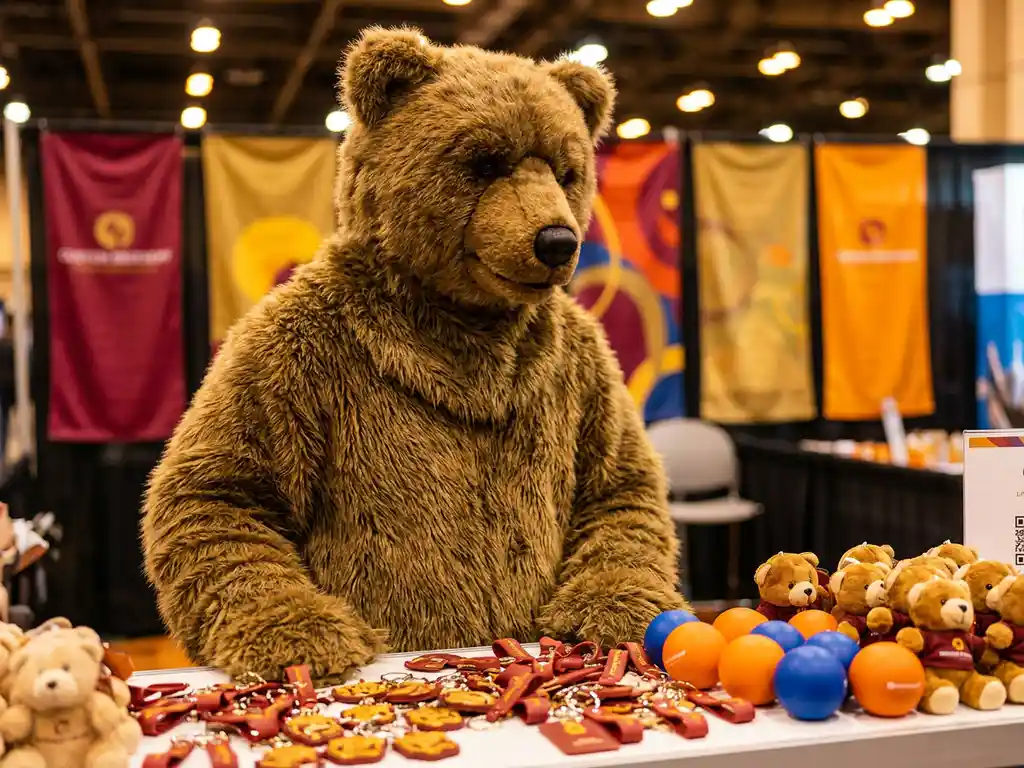
Trade show giveaways are most commonly called promotional products or promotional items. You may also hear them referred to as swag, branded merchandise, or corporate gifts, depending on the context. The unifying idea is simple: these are branded, tangible items given away at trade shows to create a lasting impression and keep your brand visible long after the event ends.
For marketers and brand managers, trade show giveaways are one of the most direct ways to put something physical and useful into the hands of potential customers. Whether you call them freebies, promos, or branded giveaways, the goal is always the same: make your brand memorable.
Below, we answer the most common questions about trade show giveaways so you can make smarter decisions for your next event.
What types of items are typically given away at trade shows?
Trade show giveaways span a wide range of product categories, from everyday functional items to creative branded novelties. The most common types include writing instruments, tote bags, drinkware, tech accessories, apparel, and stress balls. Anything that is portable, useful, and easy to brand tends to work well in a trade show environment.
Popular categories include:
- Functional items: Pens, notebooks, USB drives, phone chargers, and reusable bags
- Wearables: Branded caps, lanyards, and T-shirts
- Drinkware: Branded water bottles, travel mugs, and cups
- Novelty and tactile items: Custom stress balls, keychains, and figurines
- Edibles: Branded candy, snacks, and mints
- Digital or tech items: Branded power banks, earbuds, and screen cleaners
The best trade show giveaways are items people actually want to keep and use. A branded item that ends up on someone’s desk or in their bag continues working as a mini advertisement for your brand every single day.
What is the difference between swag, merch, and promotional products?
Swag, merch, and promotional products are often used interchangeably, but they carry slightly different meanings. Promotional products is the formal industry term for branded items distributed to promote a business or organization. Swag is an informal, catch-all term for free branded items given at events. Merch (short for merchandise) typically refers to branded products that fans or customers purchase, rather than receive for free.
In a trade show context, the term “swag” is widely used and perfectly understood. However, when you are briefing a supplier, requesting a quote, or writing a procurement brief, “promotional products” is the correct professional terminology.
The distinction matters because it shapes expectations. Merch implies perceived value high enough that someone pays for it. Promotional products are designed to be given away at scale, which means cost efficiency, durability, and brand visibility are the primary design criteria.
What makes a trade show giveaway effective?
An effective trade show giveaway is relevant to the audience, useful in daily life, and clearly branded without being overwhelming. The most effective items create a moment of genuine delight at the booth and then continue delivering brand impressions long after the event. Relevance, utility, and quality are the three pillars of a giveaway that actually works.
Here is what separates a forgettable freebie from a truly effective trade show giveaway:
- Relevance to your audience: A giveaway that aligns with your industry or your audience’s lifestyle feels intentional, not generic.
- Daily utility: Items people use regularly keep your brand visible for weeks or months after the event.
- Quality that reflects your brand: A cheap, flimsy item sends the wrong message. Quality signals that your brand takes itself seriously.
- Memorability: Unique shapes, textures, or concepts make your giveaway stand out in a sea of identical tote bags and pens.
- Clear, attractive branding: Your logo and brand colors should be prominent but tasteful, not plastered across every surface.
The goal is not to give away the most items. It is to give away the right item to the right people so that your brand stays top of mind when they are ready to make a purchasing decision.
How do companies choose branded giveaways for trade shows?
Companies choose trade show giveaways by aligning the item with their brand identity, their target audience, and their campaign goals. The selection process typically starts with budget and audience profiling, then moves into product category shortlisting, before finalizing items that can be customized to a high standard within the available lead time.
Smart brand managers ask themselves several key questions before committing to a product:
- Who will be attending this trade show, and what do they value?
- What impression do we want to leave: fun and approachable, or premium and professional?
- How will this item be used after the event, and for how long?
- Does this product allow for high-quality customization that matches our brand standards?
- What is the realistic lead time, and does it fit our event schedule?
Lead time is often underestimated. Fully custom promotional products, such as custom stress balls in unique shapes, require tooling and mold production before manufacturing can begin. That process takes 10 to 12 weeks after design approval, so planning ahead is essential for any event-driven campaign.
What are the most memorable trade show giveaways for brand recognition?
The most memorable trade show giveaways are three-dimensional, tactile, and visually distinctive. Items that break away from flat, printed formats and instead take on a unique shape or form create a stronger sensory impression and are far more likely to be kept, displayed, and talked about. Custom-shaped stress balls, miniature figurines, and branded plush toys consistently rank among the most recalled giveaways at events.
What makes these items so powerful for brand recognition is the combination of physical interaction and visual novelty. When someone picks up a stress ball shaped like your product or mascot, they engage with your brand in a way that a brochure or flat keyring simply cannot replicate. That tactile connection creates a stronger memory anchor.
Memorability also comes from exclusivity. A giveaway that looks like it could have come from any company at the show will be forgotten. A giveaway that is unmistakably yours, in your brand’s exact colors, shaped around your own concept, tells a story the moment someone picks it up.
How Promo Bears helps you stand out at trade shows
We at Promo Bears specialize in fully custom promotional products that go far beyond standard off-the-shelf items. Our custom stress balls are a perfect example: every piece is crafted 100% to your design, built from durable PU foam, and precision-molded to capture fine details and exact brand colors, including specific PMS color matching.
Here is what makes our approach different:
- Fully custom shapes based on your own logo, mascot, or product concept
- Free concept artwork with unlimited revisions before production begins
- Physical prototype approval available before committing to a bulk order
- PMS color matching for precise brand consistency
- A dedicated project manager from design to delivery
- Worldwide shipping to clients across the USA, Canada, Europe, Australia, and beyond
Production takes 10 to 12 weeks after design approval, so the earlier you start, the smoother your campaign timeline. Whether you are preparing for a major industry trade show in 2026 or planning a year-round branded merchandise strategy, we are ready to bring your concept to life.
Ready to create a trade show giveaway that people actually remember? Request a free quote and concept illustration today and let us show you what fully custom looks like.
Frequently Asked Questions
How far in advance should I order trade show giveaways?
For standard off-the-shelf promotional products, a 2–4 week lead time is usually sufficient. However, for fully custom items — such as custom-shaped stress balls, molded figurines, or bespoke plush toys — you should budget at least 10–12 weeks after design approval to allow for tooling, mold production, manufacturing, and shipping. If you are exhibiting at a major industry event, starting the process 4–6 months out gives you the safest buffer and the most flexibility for revisions.
How many giveaway items should I order for a trade show?
A common rule of thumb is to estimate 30–50% of expected booth traffic, since not every attendee will stop at your booth or qualify as your target audience. For a show with 2,000 attendees, ordering 600–1,000 units is a reasonable starting point. It is also worth ordering a tiered quantity — a larger run of a lower-cost item for general visitors and a smaller run of a premium custom piece reserved for high-value prospects or scheduled meetings.
What is a realistic budget for trade show promotional products?
Budgets vary widely depending on item type, quantity, and customization level. A practical framework is to allocate roughly 10–15% of your total trade show budget to giveaways and branded merchandise. Entry-level items like pens or lanyards can cost under $1 per unit at volume, while premium custom items such as molded stress balls, power banks, or branded drinkware typically range from $3–$15 per unit. Investing more per item in a smaller, well-targeted quantity often delivers better ROI than distributing thousands of cheap, forgettable freebies.
What are the most common mistakes companies make with trade show giveaways?
The biggest mistake is prioritizing quantity over relevance — ordering the cheapest item available in the highest volume, only to have most of it thrown away or left on the table. Other common pitfalls include ordering too late and being forced into generic off-the-shelf options, choosing items with poor print quality that make the brand look unprofessional, and selecting giveaways with no connection to the company’s product or audience. A single well-chosen, high-quality custom item will outperform a bag full of generic branded pens every time.
Can I use the same giveaway item for multiple events throughout the year?
Absolutely — and for many brands, this is the most cost-effective approach. Ordering a larger production run of a custom item lowers the per-unit cost significantly and gives you a consistent branded asset to deploy across multiple trade shows, conferences, or client meetings. Just ensure the item is evergreen in design (avoiding event-specific dates or themes) so it remains relevant across different occasions and audiences throughout the year.
How do I make sure my logo looks good on a custom promotional product?
Always provide your logo in a vector file format (such as .AI, .EPS, or .SVG) rather than a low-resolution PNG or JPEG. Work with a supplier that offers PMS color matching to ensure your brand colors are reproduced accurately, especially on three-dimensional or molded items where color consistency across surfaces matters. Reputable suppliers will provide a digital proof and, for custom-shaped items, a physical prototype before committing to full production — always take advantage of this step to catch any issues before they are multiplied across your entire order.
Are eco-friendly or sustainable trade show giveaways worth the extra cost?
For many audiences — particularly in industries like technology, healthcare, and professional services — sustainability is increasingly a purchasing and partnership consideration, and your giveaways communicate your brand values before a single conversation takes place. Eco-friendly options such as recycled material tote bags, bamboo drinkware, seed paper products, or biodegradable packaging can reinforce a sustainability narrative and resonate strongly with environmentally conscious attendees. The slight premium in cost is often offset by the positive brand perception and the higher likelihood that recipients will actually keep and use the item.