
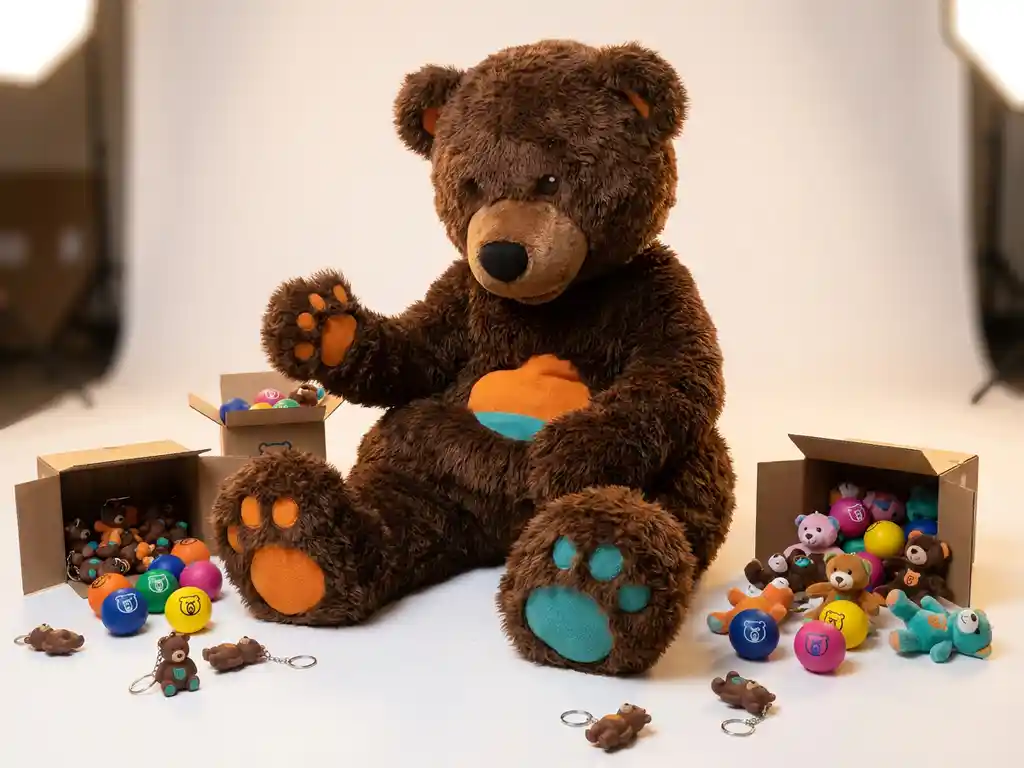
Company swag refers to branded items that a business gives away to employees, customers, or event attendees as a form of promotional marketing. These items carry the company’s logo, colors, or messaging and serve as physical touchpoints that keep a brand visible and memorable long after an interaction has ended. Below, we answer the most common questions about company swag and how to make it work for your brand.
What types of items count as company swag?
Company swag includes any branded physical item given away for promotional or goodwill purposes. This covers a wide spectrum of products, from everyday essentials like pens, notebooks, and tote bags to more creative items like custom stress balls, plush toys, keychains, and stickers. If it carries your brand and gets handed to someone for free, it counts as swag.
The category is deliberately broad, which is part of what makes it so flexible as a marketing tool. Swag can be split into a few natural groupings:
- Wearables: T-shirts, caps, hoodies, lanyards
- Office and desk items: Notebooks, pens, mousepads, mugs
- Tech accessories: USB drives, phone stands, wireless chargers
- Novelty and fun items: Stress balls, plush toys, keychains, stickers
- Eco-friendly products: Reusable water bottles, bamboo pens, recycled tote bags
- Event-specific items: Branded lanyards, badges, goodie bags
The best swag items tend to be things people actually use in their daily lives. The more visible and functional an item is, the more brand impressions it generates over time.
What is the difference between company swag and branded merchandise?
The key distinction is intent and audience. Company swag is typically given away for free to build goodwill, reward loyalty, or increase brand visibility. Branded merchandise, on the other hand, is often sold to customers or fans who actively want to own and wear the brand. Both carry logos and brand identity, but their business purpose differs significantly.
Think of swag as a gift and branded merchandise as a product. A tech company handing out branded water bottles at a trade show is distributing swag. A sports team selling branded jerseys in its online store is selling merchandise. The line can blur when brands give away high-value items, but the core difference comes down to whether money changes hands and whether the recipient sought out the item or received it unexpectedly.
For B2B marketing teams, understanding this distinction matters when setting budgets and measuring success. Swag is measured by reach, engagement, and brand recall. Merchandise is measured by revenue and fan loyalty.
Why do companies invest in swag for employees and customers?
Companies invest in swag because physical branded items create lasting impressions that digital marketing simply cannot replicate. A well-chosen piece of swag stays in someone’s home or office for months, generating repeated brand exposure at a fraction of the cost of paid advertising. For employees, swag also builds a sense of belonging and pride in the organization.
There are several strong business reasons behind the investment:
- Brand recall: Physical objects engage multiple senses, making them more memorable than a digital ad that disappears after a scroll.
- Word of mouth: Unique or high-quality swag gets noticed and talked about, turning recipients into informal brand ambassadors.
- Employee engagement: Branded onboarding kits and team swag reinforce company culture and make employees feel valued.
- Event ROI: At trade shows and conferences, swag drives foot traffic to stands and gives attendees a reason to stop and engage.
- Customer loyalty: Unexpected gifts create positive emotional associations with a brand, encouraging repeat business and referrals.
In 2026, with attention spans shorter than ever and digital ad fatigue at an all-time high, tangible branded items offer something screens cannot: a physical presence in someone’s daily environment.
What makes company swag actually effective?
Effective company swag is useful, well-made, and genuinely aligned with the brand it represents. Items that sit in a drawer or get thrown away immediately fail at their core purpose. The most effective swag earns a permanent spot in someone’s daily routine, which means it needs to be practical, visually appealing, and high enough in quality to reflect well on the brand behind it.
Quality matters more than quantity. A single premium item that someone uses every day outperforms a bag full of cheap giveaways that end up in the bin. Relevance also plays a major role. Swag that connects to the recipient’s lifestyle, profession, or interests feels thoughtful rather than generic.
Customization is another critical factor. Generic items with a small logo printed in one color rarely make an impression. Items that are shaped, colored, and designed to reflect the brand’s identity stand out immediately and create a stronger visual association. This is especially true for novelty items like custom stress balls, where the shape itself can mirror a company’s product, mascot, or logo.
Finally, the context of distribution matters. Swag handed out at the right moment, whether during onboarding, at a product launch, or as a thank-you after a purchase, carries far more emotional weight than a random giveaway.
How do you choose the right swag for your brand?
Choosing the right swag starts with understanding your audience and your brand’s personality. The best swag feels like a natural extension of what your brand stands for, not just a logo slapped onto a random object. Start by asking who will receive it, where they will use it, and what impression you want to leave.
A few practical questions to guide your decision:
- Who is the recipient? Employees, customers, event attendees, or partners each have different preferences and needs.
- What is the occasion? Trade show giveaways, onboarding kits, and customer appreciation gifts all call for different items.
- What is your budget per unit? Higher-value recipients often warrant a higher investment per item.
- Does the item reflect your brand’s values? An eco-conscious brand should choose sustainable materials. A playful brand can go for something fun and tactile.
- Will it be used repeatedly? Daily-use items generate the most brand impressions over time.
It also pays to think beyond the obvious. While pens and notebooks are reliable, they are also forgettable. Brands that choose something unexpected, like a fully custom-shaped stress ball that mirrors their product or mascot, tend to generate far more conversation and recall. The goal is to give people something they genuinely want to keep.
How Promo Bears helps you get company swag right
We specialize in custom promotional products that go well beyond the standard off-the-shelf options. Our custom stress balls are a great example of swag done properly: fully shaped to your design, color-matched with precision, and built from high-quality PU foam that holds its form and detail over time.
Here is what sets our approach apart:
- Every piece is crafted 100% to your specifications, not a standard shape with a printed logo
- Specific PMS color matching ensures your brand colors are represented accurately
- The process starts with free concept artwork and includes unlimited revisions
- You can approve a physical prototype before committing to a bulk order
- A dedicated project manager guides your order from design through to delivery
- Production takes 10 to 12 weeks after design approval, with rush options available
Whether you are planning a trade show campaign, an employee welcome kit, or a seasonal brand activation, we are here to help you create swag that people actually want to keep. Request a free quote today and let us show you what truly custom promotional products look like.
Frequently Asked Questions
How much should we budget per person for company swag?
Budget depends heavily on the recipient and occasion. For general event giveaways or trade show items, $3–$10 per unit is a common range. For employee onboarding kits or VIP client gifts, $25–$75+ per person is more appropriate and better reflects the value of the relationship. A useful rule of thumb: match your per-unit investment to the lifetime value of the recipient — the more strategic the relationship, the more worthwhile a premium item becomes.
What are the most common mistakes companies make when ordering swag?
The biggest mistake is prioritizing quantity over quality — ordering large volumes of cheap items to hit a low cost-per-unit, only to have most of them discarded immediately. Other common pitfalls include choosing items with no relevance to the recipient’s lifestyle, using small or low-contrast logo placements that get lost on the product, and ordering too close to a deadline without accounting for production and shipping lead times. Planning at least 12–16 weeks ahead for fully custom items gives you the time needed to get prototypes right without rushing.
Can swag be effective for remote or distributed teams who can't attend in-person events?
Absolutely — swag for remote teams has become one of the most impactful ways to build culture across distributed organizations. Branded onboarding kits shipped directly to a new hire’s home, care packages sent ahead of a virtual all-hands, or seasonal gifts mailed to remote employees all create the same sense of belonging that in-person swag delivers. The key is working with a supplier who can handle individual fulfillment and shipping logistics, rather than only bulk delivery to a single address.
How do we make sure our swag reflects our brand accurately, especially when it comes to colors and shapes?
The safest way to ensure brand accuracy is to work with a supplier that offers PMS (Pantone Matching System) color matching and physical prototype approval before bulk production begins. PMS matching eliminates the guesswork of screen-to-product color translation, ensuring your brand colors appear exactly as specified. Requesting a pre-production sample or prototype also lets you assess shape, texture, print quality, and overall feel before committing to a full order — catching any issues early rather than at scale.
Is eco-friendly swag worth the higher cost, and will recipients actually notice?
Yes — and increasingly so. Sustainability-conscious recipients do notice material choices, especially in industries like tech, wellness, and education where environmental values are front of mind. Eco-friendly swag made from recycled, organic, or biodegradable materials also signals something meaningful about your brand’s values, which adds a layer of storytelling that a standard plastic item simply can’t. While the unit cost may be slightly higher, the positive brand association and reduced reputational risk often make it the smarter long-term investment.
What is the minimum order quantity for fully custom swag items like custom-shaped stress balls?
Minimum order quantities (MOQs) vary by product and supplier, but for fully custom-shaped items like bespoke stress balls, MOQs typically start around 100–250 units, since custom tooling and molds are created specifically for your design. This makes custom swag most cost-effective when ordered for events, campaigns, or team rollouts with a defined audience in mind. If you need smaller quantities, some suppliers offer semi-custom options — standard shapes with custom printing — as a more accessible starting point.
How do we measure whether our swag campaign actually worked?
Measuring swag ROI requires setting clear goals before distribution. For brand awareness campaigns, track metrics like social media mentions, tagged photos, or post-event surveys asking recipients about brand recall. For employee swag, pulse surveys on engagement and culture sentiment can reveal impact. For trade show swag, compare booth traffic, lead capture rates, and follow-up conversion rates against previous events where no swag was used. Adding a QR code or unique URL to your swag item is one of the most practical ways to create a direct, trackable link between the physical item and digital engagement.