Robot Mascot Costumes for Adults:
How to Build a Bot People Remember
A robot mascot is one of the easiest ways to show people that your brand is curious, clever and a little bit fun. Whether you run a tech company, coach a robotics team or plan a product launch, a walking, waving robot gets attention fast. In this guide, we walk you through how a custom robot mascot costume for adults is designed, what makes it comfortable to wear, and how to get more out of your character once it exists.
If you are new to mascots in general, our page on custom mascot costumes is a good place to start.

Why a Robot Mascot Works So Well for Brands
Robots come with a built-in story. People already link them with innovation, problem solving and the future, so your mascot starts with a head start before it says a single word. That makes a robot a natural fit for brands that want to feel modern without feeling cold.
Research on brand characters backs this up. Patterson et al. (2013) found that the most successful anthropomorphic mascots have a clear personality and a world of their own, which gives audiences something to connect with beyond the logo. Cayla (2013) adds that mascots often become a shared symbol inside the company too, something employees rally around.
In short, a robot mascot gives you a character people recognize, talk about and want to take a photo with.
Who Uses Robot Mascots?
We see robot mascots work best for organizations that already have a link to technology or learning. Some of the most common examples:
- Tech and software companies that want a friendly face at trade shows, conferences and recruiting events
- Schools and STEM programs, including robotics clubs that want a mascot for competitions
- Sports teams and leagues with a futuristic or mechanical team name
- Product launches for smart devices, apps or electronics
- Theme parks, science centers and museums looking for a character for family events
If your brand already has a robot in its logo, you are halfway there. Our article on corporate mascots shares more ideas on using a character across your business.
Designing a Robot Mascot Costume for Adult Performers
The design stage decides how your mascot looks, moves and feels on stage. A good robot mascot costume balances recognizable robot details with a body that an adult performer can actually move in.
Start with Your Brand, Not a Movie Robot
It is tempting to point to a famous film robot and say “something like that.” The problem is that those characters are protected, and a copy will never feel like yours. We start from your logo, colors, product or values instead, so your robot mascot becomes a character only your brand owns.
Friendly Beats Scary
Robots can tip into creepy very quickly. Roboticist Masahiro Mori described this as the uncanny valley: when something looks almost human but not quite, people tend to feel uneasy (Mori et al., 2012). For mascots, the fix is simple. Big eyes, rounded shapes and a clear smile or expressive screen keep your robot cute instead of unsettling.
Proportions Built for an Adult Body
An adult mascot costume has to fit a real person, with room to walk, wave, dance and climb stairs. We plan the head size, the position of the eye openings and the shape of the body around the performer, so the robot looks great from every angle and still feels natural to wear. Our guide to custom mascot heads goes deeper into how the head is shaped.
A well-planned design means fewer surprises once the costume arrives and a performer who can focus on bringing the character to life.


Materials and Comfort Inside a Robot Suit
Robot mascots often look hard and metallic, but the costume underneath needs to stay light and flexible. The goal is a shiny, mechanical look on the outside and comfort on the inside.
Lightweight Shapes with a Robot Look
Foam bases, smooth fabrics and metallic or reflective details can give the impression of panels, bolts and joints without the weight of a real shell. Details like antennae, chest panels or light-up elements can be added as mascot accessories, so you can swap them for different events.
Cooling and Visibility
Wearing any full-body costume is warm work, especially at outdoor summer events. The U.S. National Institute for Occupational Safety and Health recommends regular rest breaks, water and shade for anyone working in hot conditions (Jacklitsch et al., 2016). Ventilation in the head, breathable linings and optional cooling vests all help, as does a handler who keeps an eye on the performer. Clear visibility through the eye or screen area matters just as much, so your robot can move safely through a crowd.
A comfortable performer is a better performer, and that shows in every high five and photo.
Robot Suit, Robot Outfit or Robot Mascot: What Is the Difference?
You will see a lot of terms online, and they do not always mean the same thing. A robot suit or robot outfit is usually a ready-made Halloween or cosplay costume, sold in standard sizes and designs. Searches for a “robot suit for sale” mostly lead to these.
A robot mascot is different. It is a custom made costume for adults, designed around one specific brand and built to be worn again and again at events. If you need a character that represents your company, school or team, a custom robot mascot costume is the better fit.
Take Your Robot Mascot Beyond the Costume
Once your robot has a look, you can use it in many more places. Some ideas:
- An inflatable mascot version for outdoor events and storefronts
- Plush toys or keychains of your robot as giveaways at trade shows
- Robot-shaped stress balls for your booth (see how to turn your mascot into stress balls)
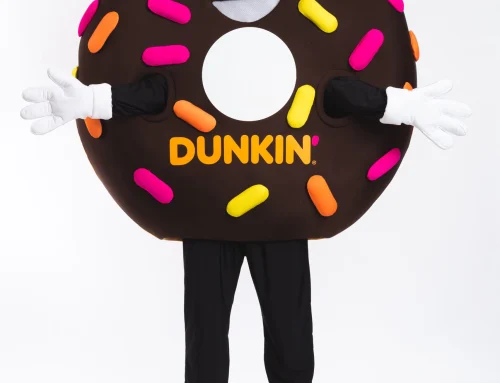
We have helped brands do this with all kinds of characters, from the corn mascot we made for Harbes Family Farms to donut mascots for Dunkin’. A robot works the same way: one design, many touchpoints.

Caring for Your Robot Mascot Costume
Good care keeps your robot looking sharp for years. Air the costume out after every event, store it dry and away from direct sunlight, and check small details like antennae or panels for wear. Our guide on how to clean mascot costumes walks you through the full routine.
Ready to Build Your Robot Mascot?
A robot mascot gives your brand a character that feels smart, friendly and impossible to ignore. With a design based on your brand, a comfortable fit for adult performers and a plan to use your robot beyond the costume, you get a mascot that keeps working for you long after the first event.
With robot mascots, the first thing we look at is the face. A robot can come across as cold very quickly, so we work on the eyes, the shapes and the expression until it feels friendly. If people want to walk up and high five it, we know we got it right.
Frequently Asked Questions About Robot Mascots
Absolutely. Once your robot has a design, it can become an inflatable mascot, plush toys, keychains or stress balls. That way one character shows up at your booth, in your giveaways and online.
Plan regular breaks, offer water and shade, and keep a handler close by. Ventilation in the head, breathable linings and cooling vests also help a lot during warm or long events.
A robot costume for adults is usually a ready-made outfit in standard sizes, often for Halloween or cosplay. A robot mascot is a one-of-a-kind design that belongs to your brand and is made to last through repeated use.
Yes. Our mascot costumes for adults are designed around a real performer’s body, with room to walk, wave and dance. We plan the head, eye openings and body shape so the costume fits comfortably and looks right from every angle.
A robot mascot is a custom character costume shaped like a robot, designed to represent a specific brand, school or team. Unlike a store-bought robot suit, it is built around your logo, colors and personality and made to be worn at many events.
References
Cayla, J. (2013). Brand mascots as organisational totems. Journal of Marketing Management, 29(1–2), 86–104. https://doi.org/10.1080/0267257X.2012.759991
Jacklitsch, B., Williams, W. J., Musolin, K., Coca, A., Kim, J.-H., & Turner, N. (2016). NIOSH criteria for a recommended standard: Occupational exposure to heat and hot environments (DHHS [NIOSH] Publication No. 2016-106). U.S. Department of Health and Human Services, Centers for Disease Control and Prevention, National Institute for Occupational Safety and Health. https://www.cdc.gov/niosh/docs/2016-106/
Mori, M., MacDorman, K. F., & Kageki, N. (2012). The uncanny valley. IEEE Robotics & Automation Magazine, 19(2), 98–100. https://doi.org/10.1109/MRA.2012.2192811
Patterson, A., Khogeer, Y., & Hodgson, J. (2013). How to create an influential anthropomorphic mascot: Literary musings on marketing, make-believe, and meerkats. Journal of Marketing Management, 29(1–2), 69–85. https://doi.org/10.1080/0267257X.2012.759992