
The promotional products that work best at trade shows are items that are useful, memorable, and closely tied to your brand. Think beyond the generic pen or tote bag. The products that actually move the needle are the ones people want to keep, use in public, or talk about with others. For marketing managers and brand directors planning their 2026 trade show strategy, this guide covers everything from giveaway selection to supplier criteria.
Which promotional products get the most attention at trade shows?
The products that attract the most attention at trade shows are high-visibility, interactive, or unexpected items. Custom plush toys, giant inflatables, mascot appearances, stress balls in unique shapes, and branded games consistently outperform standard giveaways when it comes to drawing foot traffic and sparking conversations at your booth.
Attention at a trade show is earned in the first few seconds. Visitors walk past dozens of booths and only stop when something genuinely catches their eye. Products that create a visual moment, whether it is a life-size inflatable version of your mascot or a quirky custom stress ball shaped like your product, give people a reason to pause and engage.
Items that perform well for booth traffic include:
- Giant mascot inflatables that create a recognizable landmark on the show floor
- Custom plush toys that people pick up and do not want to put down
- Stress balls in fully custom shapes based on your brand or product
- Enamel pins and keychains with strong visual design
- Frisbees and beach balls that invite interaction
The common thread is that each of these items has a physical presence. They invite touch, conversation, and photos, which means your brand gets shared beyond the event floor itself.
What makes a trade show giveaway worth keeping?
A trade show giveaway is worth keeping when it is useful in everyday life, visually appealing enough to display, or emotionally connected to something the recipient genuinely cares about. Items that check at least two of those three boxes have a much longer shelf life than standard branded merchandise.
Most giveaways end up in a bag, then a drawer, then the trash. The ones that survive are the ones that earn a spot in someone’s daily routine or workspace. A well-designed enamel pin goes on a jacket. A custom plush toy sits on a desk. A quality drawstring bag gets used at the gym. These items keep your brand visible long after the show ends.
When evaluating whether a product is worth the investment, ask yourself three questions. First, would someone buy this if it did not have your logo on it? Second, does it reflect the quality of your brand? Third, will the person who receives it actually use it or display it? If the answer to all three is yes, you have a strong candidate for a trade show giveaway.
How do custom mascots boost engagement at trade show booths?
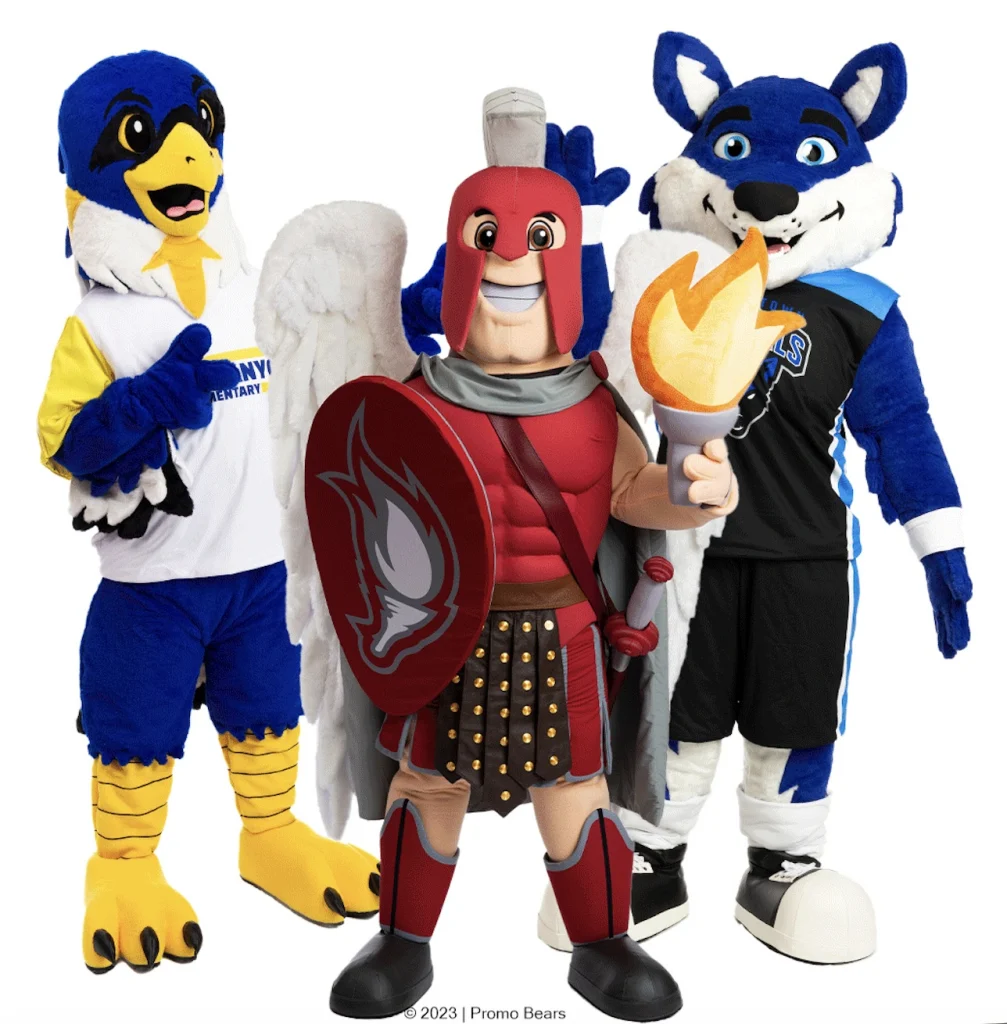
Custom mascots boost engagement at trade show booths by creating an immediate focal point that attracts visitors, encourages photos, and gives your brand a personality people can interact with. A mascot costume or inflatable transforms a standard booth into an experience, which increases dwell time and makes your brand far more memorable than a table with brochures.
People are naturally drawn to characters. A well-designed mascot in costume creates organic social media moments as visitors stop to take photos, which extends your brand’s reach well beyond the event itself. Giant mascot inflatables serve a similar purpose, acting as a visual beacon that guides people to your booth from across a crowded exhibition hall.
Beyond the visual impact, mascots create a human connection. They are approachable, fun, and give your team a natural conversation starter. Visitors who stop for a photo are already engaged, and that engagement makes them far more receptive to learning about what your company actually does.
If you are planning a mascot appearance for a trade show, production timelines matter. custom mascot costumes typically take 12 to 16 weeks to produce, and giant mascot inflatables take around 3 to 4 weeks. Building that lead time into your event planning calendar is essential.
What promotional items work best for brand recognition after the show?
The promotional items that work best for long-term brand recognition are products people use or see repeatedly in their daily environment. Plush toys, enamel pins, keychains, stickers, and quality bags all have strong staying power because they integrate into everyday life rather than sitting in a drawer.
Brand recognition is built through repeated exposure. Every time someone sees your logo on an item they use or display, that impression compounds. This is why the quality and design of your merchandise matter so much. A cheap item that breaks or looks poor reflects badly on your brand. A well-made item that holds up over time works in your favor every single day.
For post-show brand recognition, the strongest performers tend to be:
- Custom plush toys, which often end up on desks or in children’s rooms where they are seen daily
- Enamel pins and keychains, which attach to bags, jackets, and lanyards that go everywhere
- Stickers, which get placed on laptops, water bottles, and notebooks
- Drawstring bags and sports bags, which are used in public settings and seen by many people at once
- Custom mascot stickers, which combine the brand recognition of a mascot character with the versatility of a sticker
The best strategy is to pair a high-impact booth item like a mascot or inflatable with a smaller take-home item that keeps your brand visible long after the event ends.
How much should a company budget for trade show promotional products?
The right budget for trade show promotional products depends on the size of the event, the number of expected visitors, and the role you want your booth to play. As a general starting point, companies investing seriously in promotion at trade shows typically allocate a meaningful portion of their overall event budget to merchandise, often ranging from 15 to 30 percent of the total show spend.
Rather than starting with a fixed number, start with your goals. Are you trying to drive foot traffic to your booth, generate leads, or create a memorable brand moment that gets shared on social media? Each goal points to a different product mix and a different investment level.
A few practical considerations when setting your budget:
- Custom products with tooling or molds (like stress balls or plush toys) have higher upfront costs but lower per-unit costs at scale
- Items like stickers, keychains, and enamel pins are cost-effective at high volumes and work well as mass giveaways
- A single high-impact item like a mascot costume or inflatable is a one-time investment that can be reused across multiple events
- Factor in production lead times when budgeting, as rush production can add cost
The smartest approach is to combine a hero item that drives booth engagement with a range of smaller, branded take-home products at different price points. This gives you flexibility to reward high-value leads with premium items while still having something for every visitor.
What should you look for in a trade show promotional products supplier?
The most important qualities in a trade show promotional products supplier are consistent quality, transparent pricing, creative capability, and reliable production timelines. You need a partner who can deliver exactly what was agreed upon, on time, without surprises, because a trade show has a fixed date that cannot move.
Beyond reliability, look for a supplier who offers a genuine end-to-end service. That means design support, a dedicated point of contact, clear communication at every stage, and quality control before shipping. When you are managing multiple product types for a major event, having one partner who handles everything is far more efficient than coordinating across several vendors.
Ask any prospective supplier these questions before committing:
- Do they provide a free concept illustration before any financial commitment?
- Can they match specific brand colors (PMS matching)?
- What are their realistic production timelines for each product type?
- Do they assign a dedicated project manager to your account?
- Can they provide examples of work done for comparable brands or events?
A supplier who cannot answer those questions clearly is one who will likely create problems closer to your event date. Transparency from the start is a reliable indicator of how a supplier will perform under pressure.
How Promo Bears helps with promotion at trade shows
We are a full-service promotional products partner with over 19 years of experience helping brands make a real impact at trade shows and events. Whether you need a custom mascot costume, a giant inflatable, plush toys, or smaller branded merchandise like enamel pins and stress balls, we handle everything from concept to delivery.
Here is what working with us looks like in practice:
- Every project starts with a free concept illustration based on your logo or design idea, with unlimited revisions at no extra cost
- A dedicated project manager oversees your order from design approval through to delivery
- Custom stress balls are produced in fully custom shapes with PMS color matching, ready in 10 to 12 weeks
- Giant mascot inflatables are ready in 3 to 4 weeks, making them one of the fastest high-impact options available
- Custom mascot costumes take 12 to 16 weeks and are built with 3D realistic eyes, a built-in ventilation system, and a washable design
We have created over 4,000 mascots and promotional products for globally recognized brands including NASA, Amazon, Red Bull, and Walmart, as well as sports teams, universities, and nonprofits across the US and Canada. If you are planning your next trade show and want merchandise that actually works, get a free quote and let us show you what is possible.
Frequently Asked Questions
How far in advance should we start planning our trade show promotional products?
Ideally, you should begin planning your trade show promotional products at least 4 to 6 months before the event date. Custom items like mascot costumes require 12 to 16 weeks of production time alone, and that window does not account for design revisions, shipping, or any unexpected delays. Starting early also gives you more flexibility on pricing, since rush production can significantly increase your costs.
What is the biggest mistake companies make when choosing trade show giveaways?
The most common mistake is prioritizing low cost per unit over actual perceived value and usability. Ordering thousands of cheap items that end up in the trash the same day does nothing for brand recognition and may even reflect poorly on your company. A smaller quantity of well-designed, high-quality items that people genuinely want to keep will almost always deliver a better return on investment than a large volume of forgettable merchandise.
Can promotional products work for smaller booths or companies with a limited presence at a trade show?
Absolutely. In fact, a well-chosen promotional product can be one of the most effective tools for a smaller booth to compete with larger exhibitors for foot traffic and attention. A single high-impact item like a custom inflatable or an eye-catching giveaway can draw visitors to your space regardless of booth size. Focus on one strong hero item rather than spreading a limited budget across many mediocre ones.
How do we make sure our promotional products actually reflect our brand identity and not just our logo?
Work closely with your supplier during the design phase to ensure the product’s shape, color palette, materials, and overall feel align with your brand’s personality, not just its visual identity. For example, a tech company might lean toward sleek, minimalist designs, while a children’s brand might prioritize bright colors and soft textures. The best promotional products feel like a natural extension of your brand, so that even without a logo, someone familiar with your company would recognize the connection.
Is it worth investing in a mascot costume if we only attend one or two trade shows per year?
Yes, because a mascot costume is not limited to trade show use. The same costume can be deployed at company events, community sponsorships, retail activations, school visits, and social media content shoots, making it a highly versatile long-term asset. When you calculate the cost per use across multiple appearances and marketing touchpoints over several years, the investment typically justifies itself well beyond trade show attendance alone.
How do we measure whether our trade show promotional products were actually effective?
Track a combination of qualitative and quantitative signals both during and after the event. During the show, monitor booth traffic volume, the number of leads captured, and how quickly your giveaways were claimed. After the show, watch for social media mentions, tagged photos featuring your products, and whether your branded items appear in post-event content shared by attendees. You can also survey your sales team on how often booth visitors referenced the giveaway during follow-up conversations, which is a strong indicator of memorability.
What is the best way to distribute promotional products at a trade show without giving everything away to unqualified visitors?
Use a tiered distribution strategy that matches product value to visitor engagement level. Make lower-cost items like stickers, pins, or keychains freely available to all booth visitors, while reserving premium items like custom plush toys or mascot merchandise for attendees who complete a demo, scan their badge, or engage in a meaningful conversation with your team. This approach stretches your budget further while also creating a natural incentive for visitors to spend more time at your booth.