
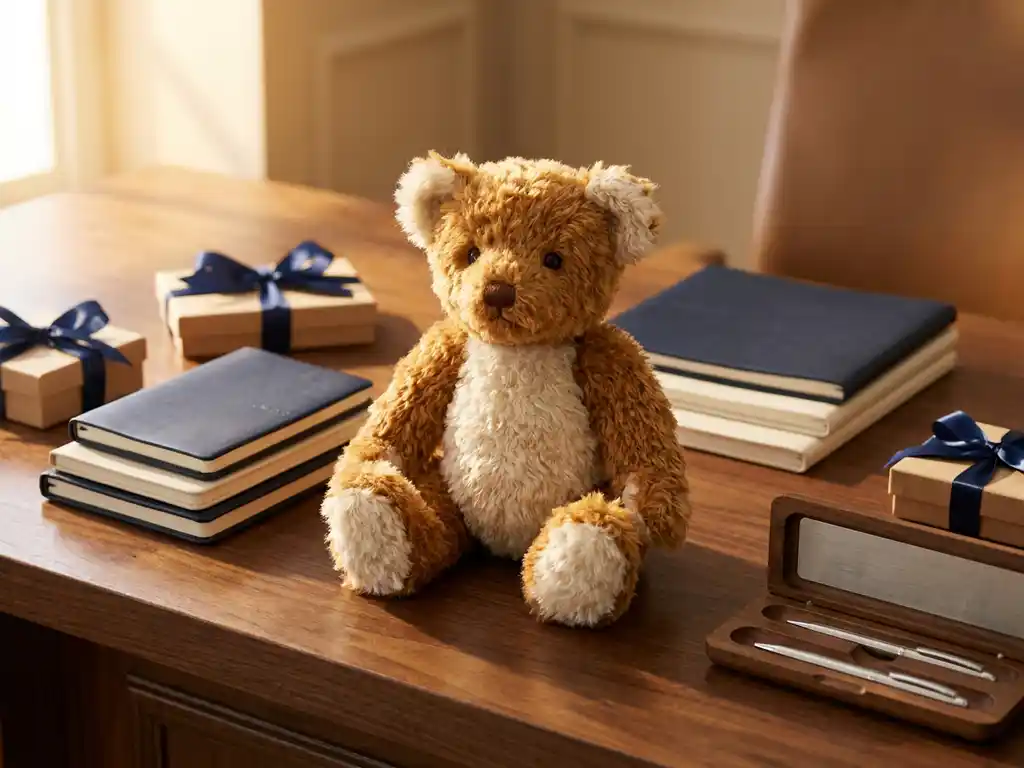
The most popular corporate gifts in 2026 include branded merchandise, tech accessories, custom plush toys, stress balls, drinkware, and premium stationery. The best corporate gifts combine everyday usefulness with strong brand visibility, making them items recipients actually keep and use rather than discard. Below, we unpack the questions most marketing managers ask when building a corporate gifting strategy that delivers real results.
What makes a corporate gift effective for brand recognition?
An effective corporate gift builds brand recognition by being useful, memorable, and visually connected to your brand identity. The best gifts are ones that earn a permanent place on someone’s desk, in their bag, or in their home — creating repeated exposure to your logo, colors, and message without any additional spend.
Several factors determine whether a corporate gift actually moves the needle for brand recognition:
- Relevance: The gift should feel thoughtful and appropriate for the recipient’s context, not generic.
- Quality: A well-made item signals that your brand cares about standards. A cheap, flimsy gift does the opposite.
- Visibility: Items used in public or shared spaces — like a branded tote bag or a custom stress ball on a desk — generate passive impressions every day.
- Uniqueness: Gifts that stand out from the standard pen-and-notepad approach are far more likely to be remembered and talked about.
- Emotional connection: A gift that surprises, delights, or makes someone smile creates a positive association with your brand that lasts well beyond the moment of receiving it.
When these factors align, a corporate gift stops being a giveaway and starts functioning as a brand touchpoint with a long shelf life.
What are the most popular corporate gift categories?
The most popular corporate gift categories are branded drinkware, tech accessories, premium stationery, apparel, and custom promotional products such as stress balls and plush toys. These categories consistently perform well because they combine practicality with strong branding potential.
Here is a closer look at each category and why it works:
- Branded drinkware: Reusable water bottles, travel mugs, and tumblers are among the most retained corporate gifts. They are used daily and carry your brand into offices, gyms, and commutes.
- Tech accessories: Wireless chargers, USB hubs, and cable organizers appeal to modern professionals and tend to stay on desks for years.
- Premium stationery: Quality notebooks, pens, and planners feel personal and professional, particularly for B2B gifting where the recipient is a decision-maker.
- Branded apparel: Jackets, polos, and caps turn recipients into walking brand ambassadors, especially effective for teams and event staff.
- Custom promotional products: Items like custom stress balls, keychains, and plush toys occupy a unique space — they are tactile, fun, and highly customizable, making them ideal for trade shows, product launches, and large-scale campaigns.
The right category depends on your audience, budget, and the context in which the gift is being given. A premium notebook works well for a client dinner; a custom stress ball is far more effective on a busy trade show floor.
What corporate gifts work best for large-scale events and trade shows?
For large-scale events and trade shows, the best corporate gifts are compact, eye-catching, and easy to carry. Items that create a moment of interaction at the booth — something visitors pick up, squeeze, or show to a colleague — generate the most organic attention and foot traffic.
At events where hundreds of brands compete for attention, practical and playful items consistently outperform standard printed materials. Custom stress balls, branded tote bags, mini plush toys, and novelty keychains all perform strongly because they are lightweight, easy to distribute in volume, and highly visible once in someone’s hands.
The key principle for event gifting is this: the gift should do some of the work for you. When a visitor picks up a uniquely shaped, fully branded item and shows it to the person next to them, your brand has just earned a warm introduction without any additional effort from your team.
Production lead times matter here. Custom items like fully shaped stress balls typically require 10 to 12 weeks from design approval to delivery, so planning ahead is essential if you have a fixed event date on the calendar.
How do custom mascots and plush toys fit into a corporate gifting strategy?
Custom mascots and plush toys fit into a corporate gifting strategy as premium, high-impact items that create strong emotional connections with recipients. Unlike standard branded merchandise, a custom plush mascot is a character — it has personality, it is displayable, and it is far less likely to end up in a drawer or a bin.
For brands that already have a mascot or character identity, producing a plush version of that character as a corporate gift is a powerful extension of the brand. Recipients tend to keep plush toys on their desks, give them to their children, or display them at home — each of which extends your brand’s visibility into personal spaces that traditional advertising never reaches.
For companies without an existing mascot, a custom plush toy designed around a product, logo element, or brand concept can serve as the introduction of a new brand character. This approach works particularly well for brands in retail, FMCG, sports, and entertainment, where emotional engagement with the audience is a core business priority.
Mascot-led gifting also scales well. A plush toy works as a high-value client gift, a trade show giveaway, a seasonal campaign item, or an employee welcome pack — making it one of the most versatile assets in a corporate gifting toolkit.
What’s the difference between promotional products and corporate gifts?
The key difference between promotional products and corporate gifts is intent and audience. Promotional products are typically distributed broadly to raise brand awareness among a wide audience — think trade show giveaways or event freebies. Corporate gifts are more targeted, given to specific clients, partners, or employees to strengthen a relationship.
In practice, the line between the two often blurs. A well-designed custom stress ball can function as both a promotional product at a trade show and a thoughtful client gift when paired with a handwritten note and a branded box. The distinction matters most when setting expectations around budget, personalization, and purpose.
Promotional products prioritize volume and visibility. Corporate gifts prioritize quality and relationship value. The most effective brand investment strategies use both — deploying promotional products to build awareness at scale and corporate gifts to deepen connections with the people who matter most to the business.
How much should companies spend on corporate gifts?
How much a company should spend on corporate gifts depends on the relationship, the occasion, and the strategic goal. As a general guideline, client gifts for key accounts or senior decision-makers typically warrant a higher per-unit spend than mass-distributed event giveaways.
Rather than setting a single budget figure, it is more useful to think in tiers:
- High-value client gifts: Reserved for top accounts, strategic partners, or VIP relationships. These should feel premium and personalized.
- Mid-range team or event gifts: Suitable for employee recognition, conference attendees, or loyal customers. Quality matters, but volume is also a factor.
- Mass-distribution promotional items: Designed for broad reach at events or campaigns. The focus is on brand visibility per unit, so cost efficiency is key without sacrificing quality.
The most important shift in thinking is from cost per item to value per impression. A well-made custom item that stays in use for two years delivers far more brand value than a cheaper alternative that gets discarded after a week. When evaluating spend, factor in retention rate, usage frequency, and the quality signal the gift sends about your brand.
How Promo Bears helps with your corporate gifting strategy
We help companies turn their corporate gifting strategy into a genuine brand-building tool — from fully custom plush mascots and inflatables to tactile, memorable promotional items that audiences actually keep.
One of our most popular solutions for corporate gifting and events is our custom stress ball range. Here is what sets our approach apart:
- Fully custom shapes: We do not offer standard shapes with a simple logo print. Every stress ball is sculpted 100% to your design, whether that is your mascot, product, or brand concept.
- PMS color matching: We match your exact brand colors so every unit is on-brand and consistent.
- Free concept artwork: Every project starts with a free concept illustration and includes unlimited revisions before production begins.
- Prototype approval: You can approve a physical sample before committing to a full order.
- Dedicated project manager: One point of contact guides your order from design to delivery, worldwide.
Production takes 10 to 12 weeks after design approval, so the earlier you start, the smoother the process. Whether you are planning a trade show campaign, a client gifting program, or a seasonal promotional push, we are ready to bring your brand to life in a way that gets noticed and remembered.
Request a free quote today and let our team show you what a fully custom corporate gift can do for your brand.
Frequently Asked Questions
How far in advance should I start planning a corporate gifting campaign?
For custom corporate gifts — especially fully shaped items like stress balls, plush toys, or inflatables — you should plan at least 14 to 16 weeks ahead of your target delivery date. This accounts for the design and revision process, prototype approval, and the standard 10 to 12 week production window. For off-the-shelf branded items with simple logo printing, a 4 to 6 week lead time is usually sufficient, but starting early always gives you more flexibility if changes are needed.
What information do I need to provide to get a custom corporate gift made?
At minimum, you will need your brand logo in a vector format (AI, EPS, or SVG), your PMS color codes for accurate color matching, a general idea of the shape or concept you want, your required quantity, and your delivery deadline. The more reference material you can provide — mood boards, product images, mascot guidelines — the faster and more accurately a supplier can bring your vision to life. A good supplier, like Promo Bears, will provide free concept artwork and guide you through the brief if you are starting from scratch.
How do I measure the ROI of a corporate gifting campaign?
Measuring ROI on corporate gifts depends on your goal. For client retention, track renewal rates, upsell activity, or referral volume among gifted accounts versus non-gifted ones. For trade show campaigns, monitor booth traffic, lead capture rates, and post-event follow-up conversion. For brand awareness campaigns, track social media mentions, photo tags, or direct feedback from recipients. While corporate gifting ROI is not always as immediately quantifiable as digital advertising, the long-term brand impression value — especially from high-quality, retained items — consistently justifies the investment when tracked properly.
Can corporate gifts be customized for different recipient groups within the same campaign?
Yes, and this is actually a best practice for maximizing the impact of a gifting campaign. For example, you might order a premium custom plush mascot for VIP clients, a mid-range branded tumbler for general conference attendees, and a compact custom stress ball for broad trade show distribution — all within the same campaign. Segmenting your gifts by audience tier ensures that each recipient receives something appropriately valued, and it allows you to allocate your budget where the relationship stakes are highest.
What are the most common mistakes companies make with corporate gifting?
The most common mistakes are prioritizing price over quality, ordering too late to allow for customization, and choosing gifts that are generic or irrelevant to the recipient. A low-cost item with a poorly printed logo can actually damage brand perception rather than strengthen it. Another frequent misstep is neglecting the unboxing or presentation experience — how a gift is packaged and delivered is part of the impression it makes. Finally, many companies underestimate lead times for custom items, forcing them to settle for stock alternatives that lack the uniqueness needed to stand out.
Are there any industries or contexts where corporate gifting is particularly effective?
Corporate gifting delivers especially strong results in B2B sales, financial services, real estate, healthcare, and retail, where relationship-building is central to business development and client retention. It is also highly effective in sports, entertainment, and FMCG, where mascot-driven or character-based gifts create emotional engagement with fans and consumers. Events-heavy industries — such as tech, SaaS, and professional services — also see strong returns from well-executed trade show gifting strategies, where a memorable item can keep a brand top-of-mind long after the event floor has cleared.
Can small businesses or startups benefit from custom corporate gifts, or is it only viable for large companies?
Custom corporate gifting is absolutely viable for small businesses and startups — in fact, it can be a particularly powerful differentiator at an early stage when every client relationship and first impression counts. Many suppliers offer lower minimum order quantities for custom items, making it accessible without requiring large upfront investment. A startup that gifts a thoughtfully designed, fully custom item to its first 50 clients sends a signal of professionalism and brand confidence that generic gifts simply cannot replicate.