
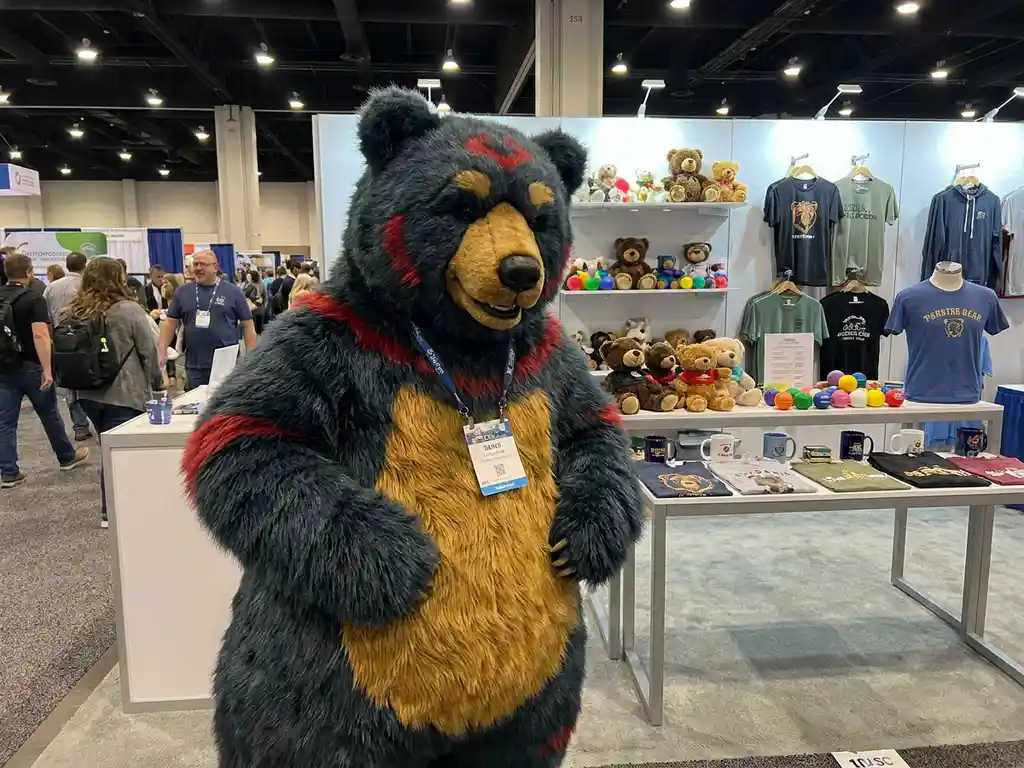
The products that sell best at trade shows are practical, memorable, and directly tied to your brand identity. Items like custom stress balls, tote bags, pens, and branded snacks consistently perform well because they offer immediate value to attendees. The real differentiator, though, is not just what you hand out but how well it represents your brand and sparks a conversation.
Whether you are exhibiting for the first time or refining a strategy that has worked for years, knowing which products drive the most engagement and revenue can make or break your booth’s performance. Below, we answer the questions trade show marketers ask most.
What types of products actually drive sales at trade shows?
Products that drive sales at trade shows are useful, visually distinctive, and easy to carry away. The top performers tend to be items attendees will keep and use after the event, which means your brand stays visible long after the show floor closes. Think branded drinkware, custom stress balls, tote bags, portable chargers, and notebooks.
Beyond utility, novelty matters. Unique shapes, bold colors, and items that feel genuinely custom rather than off-the-shelf generate more interest at the booth and more social sharing. When something looks different from the standard pen or lanyard, people stop, ask questions, and remember the brand behind it.
Products that tie directly to your brand story or mascot tend to outperform generic alternatives because they create an emotional connection rather than just a functional one.
What makes a trade show product worth buying?
A trade show product is worth buying when it delivers perceived value to the recipient and lasting brand exposure to the giver. The best items pass a simple test: would the attendee pick this up even if it had no logo on it? If the answer is yes, you have a product worth investing in.
Key qualities that make a trade show product genuinely worthwhile include:
- Daily usability: Items people reach for regularly keep your brand top of mind between events.
- Quality construction: Cheap materials reflect poorly on your brand. A well-made item signals that your company takes quality seriously.
- Relevance to your audience: A wellness brand handing out stress balls makes more sense than one handing out bottle openers. Alignment matters.
- Distinctiveness: Custom shapes, specific color matching, and original designs set you apart from every other booth on the floor.
- Portability: Attendees carry bags all day. Bulky items get left behind. Compact, lightweight products travel home.
Price per unit is only one factor. The real metric is cost per brand impression over the product’s useful life.
Which promotional items get the best brand recall after the event?
Promotional items that get the best brand recall after a trade show are three-dimensional, tactile, and used repeatedly. Research in the promotional products industry consistently shows that items people interact with physically, such as stress balls, fidget toys, and branded tools, outperform flat printed items when it comes to long-term memory.
Custom stress balls are a particularly strong performer in this category. Because they are squeezed and handled repeatedly, they create a physical association with your brand that flat media simply cannot replicate. A fully custom shape, such as a stress ball molded to match your product, mascot, or logo, reinforces brand identity every single time it is used.
Wearable items like branded hats and shirts also perform well because they turn recipients into walking advertisements. The common thread across high-recall items is repeated, active engagement rather than passive display.
How do custom mascots and inflatables help sell at trade shows?
Custom mascots and giant inflatables help sell at trade shows by making your booth impossible to ignore. In a hall full of competing stands, a life-size mascot costume or a towering branded inflatable draws foot traffic from across the floor, giving your team more opportunities to start conversations and convert interest into leads.
Mascots create an emotional hook that static banners and pop-up displays cannot. They are photogenic, shareable on social media, and give attendees a reason to stop, engage, and remember the experience. When paired with branded merchandise featuring the same character, they create a cohesive brand world that feels premium and intentional.
Giant inflatables serve a similar function at scale. A branded inflatable arch, product replica, or mascot figure signals presence and confidence, communicating to attendees that your brand is worth paying attention to before they have even read a single word of your display.
What’s the difference between giveaways and items you actually sell?
The key difference between trade show giveaways and sellable items is perceived value and pricing strategy. Giveaways are distributed freely to build brand awareness, generate goodwill, and collect leads. Sellable items are priced to generate direct revenue and are typically higher quality, more exclusive, or tied to a limited-edition release.
Giveaways work best when they are:
- Low enough in cost to distribute at volume
- Useful enough that recipients keep them
- Branded clearly but not so heavily that they feel like advertising rather than a gift
Sellable merchandise, on the other hand, works best when it carries genuine desirability. Exclusive event merchandise, limited-run apparel, or high-quality branded collectibles can generate real revenue at a booth, especially for sports teams, entertainment brands, and organizations with a loyal following.
Many successful exhibitors use both strategies together: a free giveaway to attract visitors and a premium item available for purchase to reward the most engaged attendees.
How early should you order custom trade show products?
You should order custom trade show products at least three to four months before your event. This timeline accounts for design approvals, production, and shipping, and gives you room to handle any revisions without rushing the process.
For fully custom items that require tooling or injection molds, such as custom-shaped stress balls, the lead time is typically 10 to 12 weeks after design approval. That means if your trade show is in spring, you should be briefing your supplier in January at the latest. Rush production options are sometimes available, but they come at a premium and reduce the time available for revisions.
A practical timeline for ordering custom trade show products looks like this:
- 12+ weeks out: Brief your supplier, share your design concept, and request a free concept illustration.
- 10 weeks out: Review and approve the final design, confirm quantities, and lock in your order.
- 4 to 6 weeks out: Production is underway. Use this time to plan your booth layout and distribution strategy.
- 2 weeks out: Products ship. Confirm delivery address and logistics.
- 1 week out: Products arrive, giving you time to inspect and repack if needed.
Starting early is not just about avoiding stress. It gives you time to get the design right, approve a prototype, and ensure the finished product genuinely represents your brand at its best.
How Promo Bears helps you stand out at trade shows
We specialize in exactly the kind of custom promotional products that perform best at trade shows: fully custom mascot costumes, giant inflatables, and branded merchandise that turns heads and drives engagement. One of our most popular trade show products is our custom stress balls, which we produce entirely to your specifications.
Here is what makes our custom stress balls different from standard suppliers:
- Fully custom shapes based on your logo, mascot, or product concept
- Precise PMS color matching so your brand colors are always accurate
- Full color printing available on round stress balls
- Built from durable, high-quality PU foam that captures fine details
- Free concept artwork included, with unlimited revisions before production begins
- Option to approve a physical prototype before committing to a bulk order
- A dedicated project manager who guides your order from brief to delivery
Production takes 10 to 12 weeks after design approval, so the earlier you reach out, the better. Whether you need a squeezable version of your mascot, a branded product replica, or something completely original, we bring it to life with the quality and detail your brand deserves.
Ready to make your next trade show unforgettable? Request a free quote and let us show you what is possible.
Frequently Asked Questions
How many promotional items should I bring to a trade show?
A general rule of thumb is to bring enough giveaways to cover roughly 50–70% of the expected attendee count, not every person on the floor. Over-ordering inflates costs, while under-ordering means missing opportunities during peak traffic hours. Factor in your booth size, staffing capacity, and whether you plan to qualify leads before handing items out — strategic distribution often outperforms blanket giveaways.
Can I mix different promotional products, or should I stick to one hero item?
Using a tiered approach works better than relying on a single item. A low-cost, high-volume giveaway (like a branded pen or sticker) attracts casual visitors, while a premium item (like a custom stress ball or branded drinkware) rewards qualified leads or serious prospects. This strategy stretches your budget while ensuring your best merchandise lands in the hands of people most likely to convert.
What's the biggest mistake exhibitors make when choosing trade show products?
The most common mistake is prioritizing price over perceived value — buying the cheapest item available and slapping a logo on it. Low-quality giveaways can actually damage brand perception, signaling that your company cuts corners. A smaller quantity of well-made, genuinely useful items will generate better impressions, stronger recall, and more conversations than a table full of forgettable freebies.
How do I make sure my custom products arrive on time if I'm working with a tight deadline?
Contact your supplier immediately and ask specifically about rush production availability, expedited shipping options, and where your order would sit in the production queue. Fully custom items with molds or tooling — like custom-shaped stress balls — are harder to rush than standard products, so be transparent about your deadline upfront. If the timeline is truly too tight for a fully custom piece, ask whether a semi-custom option (such as a standard shape with custom printing) can be produced faster while still delivering strong branding.
Do branded promotional products actually generate measurable ROI at trade shows?
Yes, when tracked correctly. The most reliable way to measure ROI is to tie giveaways to a lead capture mechanism — for example, requiring a badge scan or business card exchange before handing out a premium item. You can then track how many of those leads convert post-show and attribute a portion of that revenue to the booth experience, including the products. Studies from the Advertising Specialty Institute (ASI) consistently show that promotional products deliver a lower cost-per-impression than most traditional advertising channels.
Should my trade show products match the theme or industry of the specific event?
Whenever possible, yes — relevance dramatically increases the perceived value of a giveaway. Attendees at a health and wellness expo will respond more positively to a stress ball or fitness-related item than to a generic branded pen. Tailoring your product selection to the audience signals that your brand understands their world, which builds trust before a single conversation even begins. If you exhibit at multiple events, consider maintaining a core branded item and supplementing it with event-specific additions.
What should I look for when evaluating a supplier for custom trade show products?
Look for suppliers who offer free concept artwork, prototype approval before bulk production, and a dedicated point of contact who manages your project from start to finish. Transparent lead times, clear revision policies, and verifiable quality standards (such as PMS color matching and material specifications) are non-negotiable for custom work. Reading reviews from other trade show exhibitors — not just general customers — will give you the most relevant picture of how a supplier performs under real event deadlines.