
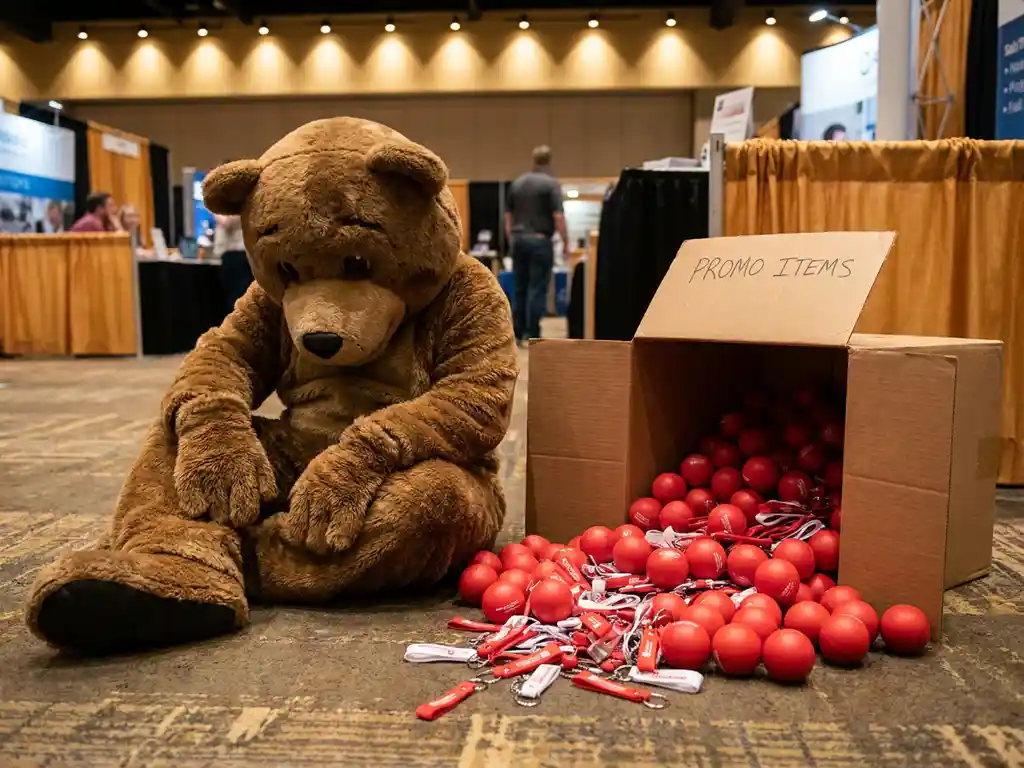
The most common giveaway mistakes are choosing items that feel cheap, ignoring brand alignment, and failing to track results. These errors are surprisingly widespread, even among experienced marketing teams, and they quietly drain budget without delivering the brand impact you’re paying for. The questions below break down exactly where giveaway strategies go wrong and how to fix them.
Why do so many branded giveaways fail to leave a lasting impression?
Most branded giveaways fail because they prioritize volume over value. When the goal becomes “give something to everyone,” the result is a forgettable item that gets tossed in a bag, left on a table, or thrown away before the event is even over. A giveaway only works if the recipient actually wants to keep it.
The deeper issue is that many giveaway decisions are made too quickly, often as an afterthought in the event planning process. Items get chosen based on what’s available, what’s cheap, or what was used last time. Without a clear strategic brief, even a generous giveaway budget produces weak results.
Lasting impressions come from items that are useful, well-made, and feel personal to the brand. When someone picks up a trade show giveaway and thinks “this is exactly what I needed,” that’s when brand recall kicks in. Generic items simply don’t create that moment.
What happens when giveaway items don’t match your brand identity?
When giveaway items don’t align with your brand identity, they send a confusing message. A tech company handing out cheap plastic keychains, or a premium lifestyle brand giving away flimsy tote bags, creates a disconnect that actually works against the brand. The item becomes a representation of how much you value your audience.
Brand identity is built through consistency. Every touchpoint, including the items you hand out at trade shows and events, contributes to how people perceive you. A mismatch between your brand values and the quality or style of your giveaway can undermine campaigns you’ve invested heavily in elsewhere.
The fix is straightforward: before selecting any giveaway item, ask whether it reflects your brand’s personality, quality standards, and target audience. If the answer is no, keep looking.
How does poor product quality affect brand perception?
Poor product quality directly damages brand perception. When a giveaway item breaks, fades, or feels flimsy, it transfers that negative association onto the brand. Recipients don’t separate “the free item” from the company that gave it to them. In their mind, the quality of the product reflects the quality of the business.
This is especially critical at trade shows, where competition for attention is high and first impressions are everything. A well-made trade show giveaway that someone keeps on their desk for months creates repeated brand exposure. A poor-quality item that gets discarded on day one generates zero return.
Investing in quality doesn’t mean spending more overall. It often means ordering fewer items at a higher unit quality rather than flooding an event with low-cost products that no one values. Fewer, better items consistently outperform large quantities of forgettable ones.
What are the most overlooked mistakes in giveaway planning?
The most overlooked mistakes in giveaway planning are poor timing, no target audience definition, and skipping the approval process. These aren’t flashy errors, but they’re responsible for a significant portion of failed giveaway campaigns.
- No clear audience profile: Handing the same item to everyone at an event ignores the fact that different attendees have different needs and interests.
- Ordering too late: Custom items, especially high-quality ones, require production lead time. Rushing an order often means compromising on design or quality.
- Skipping a prototype review: Approving a design on screen without seeing a physical sample is a gamble. Colors, textures, and proportions can look very different in real life.
- No distribution strategy: Leaving items on a table for anyone to grab is not a strategy. Intentional distribution, tied to a conversation or interaction, dramatically increases engagement.
- Ignoring lead time for custom production: For fully custom items, production timelines are real and non-negotiable. For example, custom stress balls take 10 to 12 weeks from design approval to delivery.
Planning giveaways with the same rigor as any other marketing campaign prevents most of these mistakes from happening in the first place.
Should giveaway items be functional or purely promotional?
Giveaway items should be functional whenever possible. Functional items get used repeatedly, which means repeated brand exposure over time. A purely decorative item might look great in the moment, but if it doesn’t serve a purpose in the recipient’s daily life, it rarely survives past the first week.
The best trade show giveaways combine both qualities: they carry the brand clearly and serve a real purpose. Think about items that fit naturally into someone’s workspace, gym bag, or daily routine. Every time they reach for it, your brand is there.
That said, purely promotional items can work when they’re distinctive enough to become conversation pieces. A well-crafted, eye-catching item with a strong visual identity can generate social sharing and word of mouth, even if it isn’t strictly “useful.” The key is that it needs to be remarkable in some way, not just branded.
How can you measure whether a giveaway actually worked?
You can measure giveaway effectiveness by setting clear goals before the event and tracking specific metrics afterward. Without defined success criteria, there’s no way to evaluate whether the investment delivered results. Measurement starts with intent, not with the data collection itself.
Here are practical ways to track giveaway performance:
- Set a goal upfront: Are you trying to drive booth traffic, generate leads, increase social mentions, or boost brand recall? Each goal requires a different measurement approach.
- Use unique codes or URLs: Including a QR code or landing page URL on the item lets you track how many people engaged digitally after receiving it.
- Survey your team post-event: Sales reps and booth staff can report on how the item was received, whether people asked about it, and whether it started conversations.
- Monitor social media mentions: A distinctive giveaway often gets photographed and shared. Track mentions and tags in the days following the event.
- Follow up with leads: If giveaways were tied to lead capture, compare conversion rates from events where you used them versus those where you didn’t.
Measurement doesn’t need to be complex, but it does need to be intentional. Even a simple post-event debrief asking “did the giveaway start conversations?” gives you useful data for the next campaign.
How Promo Bears helps you avoid giveaway mistakes
We’ve seen what separates giveaways that generate real brand impact from those that get forgotten before the event ends. At Promo Bears, we help marketing teams and brand managers get it right from the start, with fully custom promotional products built around your specific design and audience.
Our custom stress balls are a great example of how a simple product can become a powerful brand tool when done properly:
- Fully custom shapes based on your logo, mascot, or product concept
- PMS color matching for precise brand consistency
- Free concept artwork and unlimited revisions before production begins
- Option to approve a physical prototype before committing to a bulk order
- A dedicated project manager from first brief to final delivery
- Production time of 10 to 12 weeks after design approval, with rush options available
Whether you’re preparing for a major trade show or planning a year-round promotional campaign, we make sure every item we produce reflects your brand at its best. Request a free quote and let’s build something your audience will actually want to keep.
Frequently Asked Questions
How much should we budget per item for a trade show giveaway to ensure quality?
A useful benchmark is to aim for a per-unit cost that reflects the perceived value of your brand. For most B2B trade shows, this typically means spending $5–$15 per item rather than going for the cheapest option available. The more important calculation is cost-per-impression: a $10 item someone keeps on their desk for a year delivers far more value than a $1 item that gets thrown away the same day. Prioritize quality within your budget rather than maximizing quantity.
How far in advance should we start planning giveaways for a major trade show?
For fully custom promotional products, you should start the planning process at least 14–16 weeks before the event. This accounts for the design brief, concept artwork, revisions, prototype approval, and production lead time — which for custom items like stress balls runs 10–12 weeks on its own. Starting early also gives you room to course-correct if the first concept isn’t right, rather than being forced to rush a decision you’ll regret at the event.
What if our giveaway budget is very limited — is it still worth doing custom items?
Yes, but the strategy shifts: instead of giving something to every attendee, focus on a smaller, high-quality custom item for a targeted group, such as qualified leads, key prospects, or VIP contacts. A smaller run of well-crafted, meaningful items delivered to the right people will outperform a large run of generic products handed to anyone who walks by. Many suppliers, including Promo Bears, can work with you on minimum order quantities that make custom production viable even on tighter budgets.
Can a giveaway item work as a lead generation tool, or is it purely a brand awareness play?
A giveaway can absolutely function as a lead generation tool when it’s paired with a deliberate distribution strategy. For example, requiring a brief conversation, a badge scan, or a form submission before handing out the item creates a natural lead capture moment. Adding a QR code or personalized URL to the item itself extends that engagement beyond the event floor. The key is designing the giveaway experience around your lead gen goal from the start, not treating the item as an afterthought.
What's the biggest mistake companies make when choosing giveaway items for the first time?
The most common first-timer mistake is choosing an item based on personal preference rather than audience insight. Just because you like a particular product doesn’t mean it resonates with your target attendees. Before selecting any item, ask: What does our audience do every day? What problem could we solve for them? What would they actually use in their work environment or daily routine? Answering those questions first almost always leads to a better item choice than browsing a catalog and picking what looks appealing.
How do we make sure our logo and branding look right on a physical product before committing to a bulk order?
Always request a physical prototype before approving a bulk production run. On-screen mockups are useful for early-stage approvals, but colors, textures, print placement, and proportions can look significantly different on the actual product. A physical sample lets you catch issues — like a logo that’s too small, a color that’s slightly off, or a texture that doesn’t feel premium — before they’re replicated across thousands of units. Reputable suppliers like Promo Bears include prototype approval as a standard step in the process, and it’s one you should never skip.
Is it better to use the same giveaway item across multiple events, or should we customize per event?
Using the same core item across multiple events is a smart way to reduce per-unit costs through larger order volumes, but small customizations per event — such as an event-specific color, a unique QR code, or a seasonal design variation — can significantly boost relevance and trackability. At minimum, use different QR codes or landing page URLs per event so you can measure which activations are actually driving post-event engagement. Full customization per event is ideal when budgets allow, but even minor variations go a long way toward making each giveaway feel intentional rather than recycled.