
Promotional products have been a cornerstone of brand marketing for decades—and for good reason. When a customer uses a branded item every day, your company stays top of mind without spending another cent on advertising. But not all promotional products are created equal, and understanding what makes them work is the key to getting lasting value from your investment.
Whether you are a marketing manager planning your next trade show, a brand director refreshing your merchandise strategy, or a decision-maker looking to stretch your budget further, this guide answers the most important questions about promotional products and long-term brand recall.
What are promotional products and why do they build brand recall?
Promotional products are branded physical items given to customers, prospects, or employees to increase brand awareness and loyalty. They build brand recall because they create repeated, tangible interactions with your brand. Every time someone uses a branded pen, squeezes a stress ball, or wears a branded cap, your logo and message are reinforced without any additional effort or spending on your part.
Unlike a digital ad that disappears after a few seconds, a physical product lingers. It sits on a desk, travels in a bag, or lives in a kitchen drawer, quietly doing its job day after day. This repeated exposure is exactly what drives long-term memory encoding. Neuroscience tells us that multisensory experiences, such as touch, sight, and even smell, create stronger and more durable memories than single-channel impressions. A promotional product engages the senses in a way that a banner ad simply cannot.
There is also an emotional dimension at play. Receiving a gift, even a small branded one, triggers a sense of reciprocity. Recipients feel a subtle sense of goodwill toward the brand that gave it to them. That positive association sticks, and it influences purchasing decisions long after the item is first received.
How do promotional products create lasting brand impressions?
Promotional products create lasting brand impressions through consistent, daily visibility. A well-chosen item becomes part of a recipient’s routine, embedding your brand into their everyday life. The longer the product is used, the more impressions it generates, and the more deeply your brand becomes associated with positive, practical experiences.
The key word here is useful. Products that serve a real purpose—whether that is relieving stress, holding keys, or carrying groceries—earn a permanent place in someone’s life. Products that feel cheap or irrelevant get thrown away. This is why quality matters so much in the promotional products industry.
Personalization also plays a major role. A product that feels tailored to the recipient—whether through a clever shape, a specific color, or a design that mirrors the brand’s identity—creates a stronger emotional connection. It signals that the brand put thought into the gift, which elevates the perceived value of the item and the brand behind it.
Which types of promotional products are most effective for brand recall?
The most effective promotional products for brand recall are items that combine high utility, frequent use, and strong visual branding. Products used daily in visible environments generate the most impressions and the deepest recall. The best-performing categories consistently include:
- Desk and office items such as custom stress balls, notebooks, and pens, which are used repeatedly in focused work environments
- Wearables such as branded caps, T-shirts, and tote bags, which turn recipients into walking brand ambassadors
- Tech accessories such as USB drives, phone stands, and charging cables, which are used daily and often visible to others
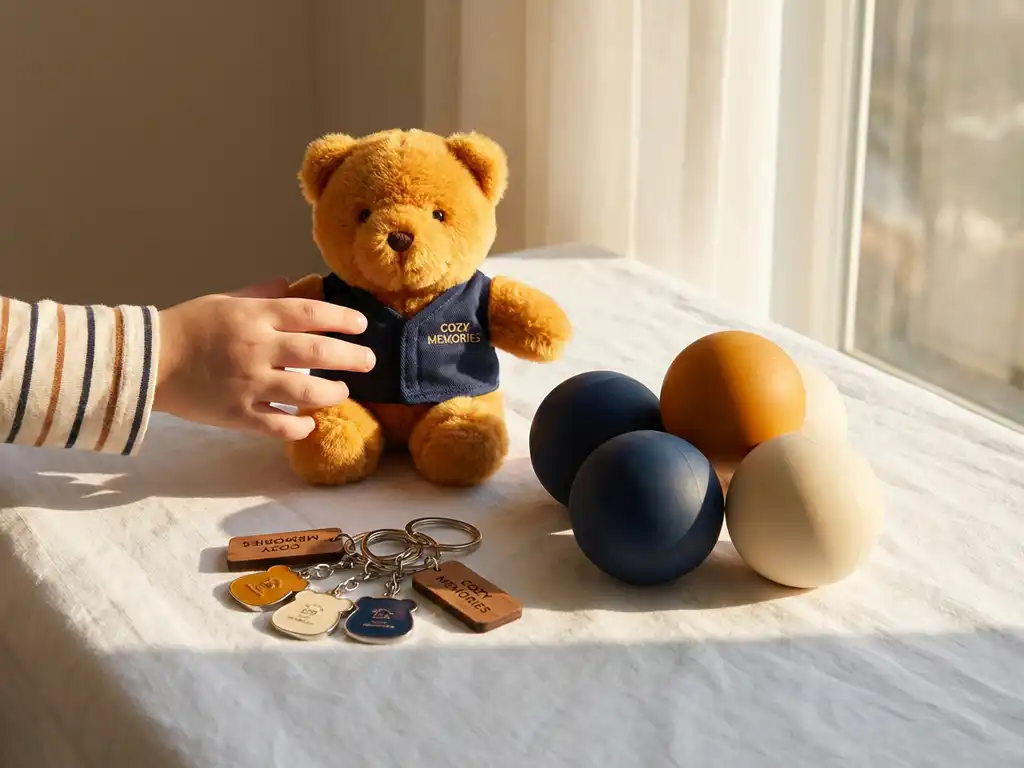
- Custom plush toys and mascot merchandise, which create emotional connections and are particularly powerful for schools, sports teams, and consumer brands
- Novelty and tactile items such as custom-shaped stress balls, which stand out from generic giveaways and invite interaction
The common thread across all high-performing promotional products is that they solve a small problem or bring a moment of delight. When a product does that, it earns a place in someone’s life, and your brand comes along for the ride.
How do promotional products compare to digital advertising for brand awareness?
Promotional products and digital advertising serve different but complementary roles in brand awareness. Digital advertising offers speed, reach, and precise targeting, but it is fleeting. Promotional products are slower to distribute but generate ongoing impressions over months or even years. For long-term brand recall specifically, physical products consistently outperform digital ads because they create tangible, multisensory memories that are harder to ignore and easier to remember.
The staying power of physical vs. digital
A digital ad typically earns a few seconds of attention before a user scrolls past. A promotional product, by contrast, can generate hundreds or even thousands of impressions over its lifetime. A branded stress ball sitting on a desk is seen every workday. A branded tote bag travels through a city. Neither of these requires a repeat media buy.
Cost per impression over time
When you factor in the lifespan of a quality promotional product, the cost per impression becomes remarkably competitive. A well-made custom item that lasts two or three years distributes its cost across an enormous number of brand interactions. Digital campaigns, by contrast, stop delivering the moment the budget runs out.
The smartest brands use both channels in tandem. Digital advertising drives initial awareness and traffic, while promotional products deepen the relationship and create lasting recall among existing customers, event attendees, and key stakeholders.
How can companies use promotional products to boost customer engagement?
Companies can boost customer engagement with promotional products by aligning the item with a specific moment, emotion, or action in the customer journey. The most engaging promotional products are those that feel relevant, timely, and genuinely useful. They invite interaction, spark conversation, and give recipients a reason to share their experience with others.
Here are practical ways to use promotional products to drive engagement:
- Event giveaways: Distribute branded items at trade shows, product launches, or community events to create a memorable first impression and give attendees something to take home.
- Loyalty rewards: Send branded merchandise to long-term customers as a thank-you, reinforcing the relationship and encouraging repeat business.
- Onboarding kits: Welcome new employees or clients with a curated set of branded items that communicate your company culture and values from day one.
- Social media campaigns: Use limited-edition or custom-shaped promotional items as prizes or incentives for user-generated content campaigns, turning customers into brand advocates.
- Seasonal campaigns: Time your promotional product distribution around key moments in the calendar to stay relevant and top of mind.
The most effective engagement strategies treat promotional products not as an afterthought, but as a deliberate touchpoint in the customer experience. When the product is genuinely good, people talk about it, share it, and remember the brand that gave it to them.
What mistakes should brands avoid when choosing promotional products?
The biggest mistake brands make with promotional products is prioritizing low cost over relevance and quality. A cheap item that breaks after a week, or a generic product with no connection to the brand’s identity, does more harm than good. It signals that the brand does not value the recipient’s experience, which is the opposite of the intended effect.
Other common mistakes include:
- Choosing products without considering the target audience’s lifestyle or preferences
- Applying a logo without considering how the product design reflects the brand’s visual identity
- Ordering too late and compromising on quality due to rushed production timelines
- Ignoring the power of custom shapes and designs in favor of standard, forgettable items
- Failing to align the product with a specific campaign goal or moment in the customer journey
Planning ahead is especially important when ordering fully custom products. Custom items, such as bespoke stress balls molded to a specific shape, require production time to get right. At Promo Bears, for example, custom stress balls take 10 to 12 weeks to produce after design approval because they are precision-molded to your exact specifications rather than pulled from a shelf. Brands that factor this lead time into their campaign planning consistently get better results.
How Promo Bears helps with long-term brand recall
We specialize in turning brand identities into physical, memorable experiences that people hold on to. Our custom stress balls are a perfect example of how a well-crafted promotional product can become a lasting brand ambassador. Every piece is built entirely to your specifications, from the shape and color to the finest details of your logo or mascot design.
Here is what makes our approach different:
- Fully custom shapes based on your own design or concept, not standard off-the-shelf molds
- Precise PMS color matching so your brand colors are always accurate
- Full-color printing available on round stress balls
- Free concept artwork and unlimited revisions before production begins
- A dedicated project manager guiding your order from design to delivery
- Worldwide shipping to clients across the United States, Canada, Europe, Australia, and beyond
With over 19 years of experience and more than 4,000 custom projects delivered for brands including NASA, Amazon, and Nestlé, we know how to create promotional products that people actually keep. Production takes 10 to 12 weeks after design approval, so the earlier you plan, the better your results will be.
Ready to create a promotional product that people will remember? Contact us and let our team bring your brand to life.