
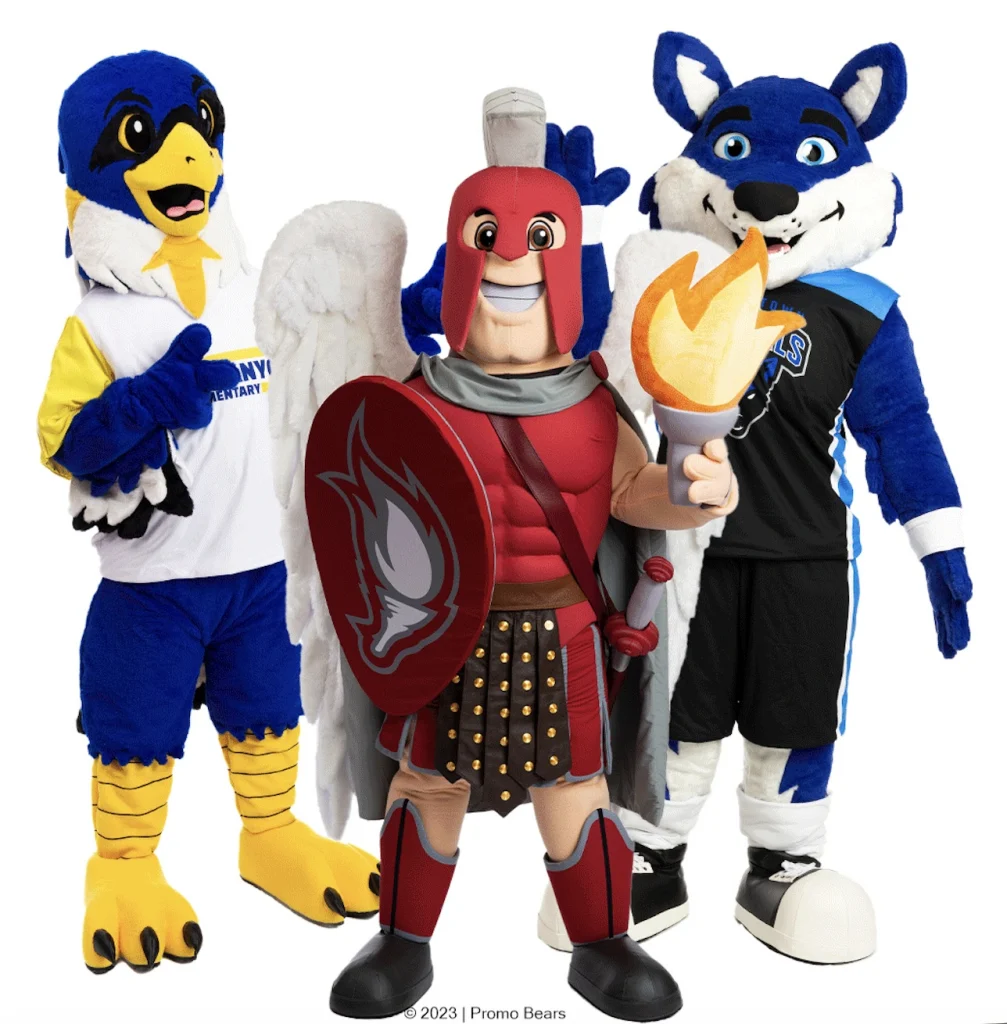
A great mascot combines a strong visual identity, a personality that mirrors the brand it represents, and a design flexible enough to work across every format — from a full costume worn at a live event to a tiny keychain sold in a gift shop. The best mascots are instantly recognizable, emotionally engaging, and built to last far beyond a single campaign. Below, we answer the most common questions about mascot design so you can make confident, informed decisions for your brand.
What qualities make a mascot instantly recognizable?
An instantly recognizable mascot has a bold silhouette, a limited and consistent color palette, and one or two defining features that set it apart at a glance. Recognizability is not about complexity — it is about clarity. The most iconic mascots in the world can be identified even when reduced to a simple outline.
Think about what makes a mascot stick in someone’s memory. It is rarely the fine detail. It is the overall shape, the dominant color, and the expression. A mascot with too many competing elements becomes visually noisy and forgettable. Strip it back, and you create something that burns itself into the viewer’s mind after a single encounter.
Strong mascot design also relies on consistency. When the same character appears on a banner, a plush toy, a stress ball, and a social media post, every version should feel unmistakably the same. That visual consistency builds familiarity over time, and familiarity is the foundation of brand trust.
How does a mascot reflect a brand’s personality?
A mascot reflects a brand’s personality through its species or form, its expression, its posture, and its color choices — each of these communicates something specific about who the brand is and what it stands for. A mascot is not decoration. It is a visual shorthand for everything your organization values.
A university sports team mascot built around a fierce predator communicates strength, competitiveness, and pride. A children’s brand mascot with a soft, round shape and a warm smile communicates safety, friendliness, and approachability. These are not accidents — they are deliberate design decisions that align the character with the audience’s expectations and the brand’s positioning.
For B2B brands, mascots can convey professionalism, innovation, or reliability depending on the design approach. A tech company might opt for a sleek, forward-leaning character, while a community-focused nonprofit might choose something warmer and more human. The key is that the mascot should feel like a natural extension of the brand, not a separate creative project bolted on afterward.
What’s the difference between a logo mascot and a costume mascot?
A logo mascot is a two-dimensional illustrated character used in print, digital, and branded materials, while a costume mascot is a wearable, three-dimensional version of that character brought to life at events, activations, and public appearances. Both serve different purposes, but the strongest mascot programs use both in harmony.
A logo mascot lives in the visual identity system. It appears on packaging, websites, social media, merchandise, and marketing materials. It needs to work at any scale, from a business card to a billboard, and it needs to reproduce cleanly in full color and in black and white.
A costume mascot, by contrast, is a physical experience. It creates live engagement, generates social media moments, and gives audiences something to interact with directly. Because it is worn by a person, it needs to account for comfort, visibility, ventilation, and durability in a way that a flat illustration never has to. The design also needs to translate from two dimensions into three without losing the character’s core identity — which is why the illustration and the costume should always be developed with each other in mind.
How do you design a mascot that works across all formats?
Designing a mascot that works across all formats requires starting with a simple, bold concept that holds up at any size and in any medium. The design must be tested early across both flat and three-dimensional applications, and every version — from a digital illustration to a physical costume to a printed sticker — must feel like the same character.
Here are the key principles that make a mascot format-flexible:
- Simple silhouette: The character should be recognizable as an outline alone, without relying on color or detail to carry the identity.
- Limited color palette: Stick to two or three core colors that reproduce consistently across print, digital, embroidery, and molded products.
- Scalable features: Avoid fine lines or intricate details that disappear when the design is reduced to a small format like a keychain or enamel pin.
- Consistent expression: The character’s defining expression should be reproducible across every medium, whether it is sculpted into a stress ball or printed on a sticker.
- 3D translation planning: If a costume is part of the plan, the illustration should be designed with the three-dimensional version in mind from the very beginning.
Working with experienced mascot designers from the start saves significant time and cost. Retrofitting a poorly planned mascot design to work across multiple formats is far more difficult than building that flexibility in from day one.
What makes a mascot costume comfortable enough to wear for hours?
A mascot costume is comfortable enough to wear for extended periods when it features a built-in ventilation system, lightweight construction, a well-balanced fit, and clear sightlines for the performer inside. Comfort is not a luxury in costume design — it is a functional requirement that directly affects performance quality and the mascot’s ability to engage audiences effectively.
Heat buildup is the biggest challenge in mascot costume wear. A proper ventilation system circulates air through the costume, keeping the performer cooler and reducing fatigue. Without it, even a short appearance can become physically demanding and limit how long the mascot can stay active.
Fit is equally important. A costume that is too heavy, too rigid, or poorly balanced forces the performer to compensate with awkward movement — which undermines the character’s presence. The best costumes are designed to move naturally with the person wearing them, allowing for expressive gestures and fluid interaction with the crowd.
Ease of cleaning is another practical factor that is easy to overlook at the design stage. A mascot costume sees a lot of use, and the ability to clean it properly between appearances keeps it looking sharp and extends its lifespan significantly.
How long does it take to create a custom mascot?
Creating a custom mascot costume typically takes 12 to 16 weeks from design approval to delivery. This timeline covers the full production process, including the initial concept illustration, revision rounds, manufacturing, quality control, and shipping. Rush options are available for time-sensitive projects.
The timeline varies depending on what type of mascot product is being produced. Here is a quick reference for the most common mascot-related products:
- Mascot costume: 12 to 16 weeks after design approval
- Giant mascot inflatable: 3 to 4 weeks
- Mascot stickers: approximately 4 weeks
- Plush toys: 12 to 18 weeks depending on the shipping method
- Stress balls: 10 to 12 weeks after design approval
The design phase is where most of the time is invested in the early stages. Getting the concept right before production begins is essential — changes made during manufacturing are costly and time-consuming. That is why starting with a thorough, revision-friendly illustration process protects the overall timeline and ensures the final product matches expectations precisely.
For organizations planning around a specific event or campaign launch, building in extra lead time is always the smarter approach. Ordering well in advance gives you room for revisions without pressure, and it ensures your mascot arrives ready to perform at its best.
How Promo Bears helps you bring a great mascot to life
We handle every stage of the mascot design and production process, making us a natural fit for marketing managers and brand directors who need a reliable, end-to-end partner. Here is what working with us looks like in practice:
- Free concept illustration: Every project starts with a no-commitment illustration based on your logo or design idea, with unlimited revisions until the design is exactly right.
- Experienced design team: Our mascot experts bring over 19 years of experience in mascot design and production, with more than 4,000 mascots created for clients ranging from schools and sports teams to global brands.
- Full product range: Beyond costumes, we produce giant inflatables, custom mascot merchandise including plush toys, stress balls, stickers, keychains, and more — all featuring your mascot character for consistent brand presence across every touchpoint.
- Dedicated project manager: One point of contact oversees your project from first sketch to final delivery, keeping everything on track and on brief.
- Quality control before shipping: Every costume goes through a thorough quality check, and result photos are shared for your approval before anything is packed and shipped.
Whether you are building a mascot from scratch or expanding an existing character into new product formats, we are ready to help. Request your free quote and get your concept illustration started today.
Frequently Asked Questions
How much does it cost to create a custom mascot costume?
The cost of a custom mascot costume varies depending on complexity, size, materials, and the number of features like ventilation systems or animatronic elements. As a general range, professional custom mascot costumes typically start in the hundreds and can run into the thousands of dollars for highly detailed or fully articulated designs. The best approach is to request a free quote with your specific requirements — this gives you an accurate figure based on your actual design rather than a generic estimate.
Can I use an existing logo or character as the basis for a mascot design?
Yes, and in many cases this is the ideal starting point. An existing logo character, illustrated figure, or even a rough sketch can serve as the foundation for a fully developed mascot. The design team will refine and adapt it to ensure it works across all formats — from flat digital use to a wearable costume — while preserving the essence of what you already have. If you only have a concept or a general direction in mind with no existing artwork, that works too; a skilled mascot designer can build the character from scratch based on your brand brief.
What if I need multiple mascot products — do they all need to be ordered at the same time?
They do not all need to be ordered simultaneously, but there are real advantages to planning your full mascot product range together from the start. When the illustration is developed with all intended formats in mind — costume, plush toy, stress ball, inflatables, and more — every product comes out more cohesive and production is more efficient. Ordering products in phases is completely workable, but having a master design locked in early ensures every new product you add later stays consistent with the original character.
How do I know if my mascot design will translate well into a 3D costume?
The best way to ensure a smooth 2D-to-3D translation is to work with designers who specialize in mascot production — not just general illustration. Experienced mascot designers know how to flag potential issues early, such as features that are difficult to sculpt, proportions that won’t hold up in foam and fabric, or details that will be lost in the physical build. Reviewing construction mockups or reference photos of similar completed costumes before production begins also gives you a clear sense of how the final product will look and move.
How should I care for and maintain a mascot costume to extend its lifespan?
Proper maintenance starts with following the cleaning guidelines provided by your manufacturer, as different materials — foam heads, fabric bodies, and soft components — each require specific care. After each use, allow the costume to air out fully before storing it to prevent odor and material degradation. Store the costume in a cool, dry environment away from direct sunlight, and keep the head and body supported to avoid compression damage to the foam structure. Scheduling periodic professional cleaning and inspection, especially for high-use costumes, will keep the mascot looking performance-ready and significantly extend its working life.
What are the most common mistakes brands make when designing a mascot?
The most common mistake is overcomplicating the design — adding too many details, colors, or features that look impressive in a single illustration but fail to reproduce consistently across different formats and scales. Another frequent misstep is designing the mascot in isolation from the brand’s broader visual identity, resulting in a character that feels disconnected from the logo, color system, and overall tone. Brands also frequently underestimate lead times and rush the process, which compresses the revision stage and increases the risk of receiving a final product that doesn’t fully meet expectations.
Can a mascot be updated or refreshed without starting over from scratch?
Yes — a mascot refresh is often a smarter and more cost-effective option than a complete redesign, especially for established characters that already carry brand recognition and audience familiarity. A refresh typically involves modernizing the color palette, refining proportions, simplifying details for better scalability, or updating the expression and posture to better reflect where the brand is today. The goal is to evolve the character while preserving the visual equity that audiences already associate with it, rather than introducing something entirely new that has to rebuild recognition from zero.