
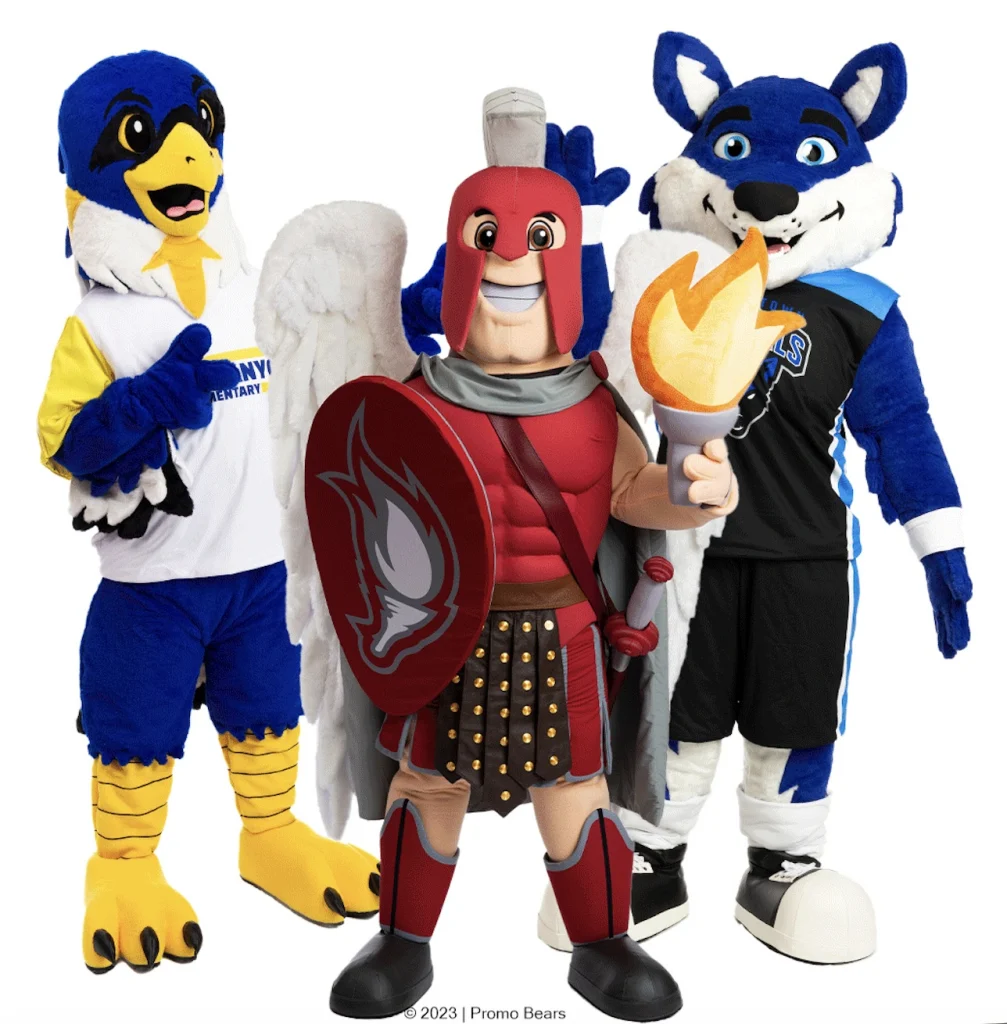
Mascot marketing and influencer marketing are two distinct brand strategies. Mascot marketing builds long-term brand identity through a custom character your organization owns outright, while influencer marketing uses real people’s audiences for short-term reach and campaign-specific awareness. The right choice depends on your goals, budget, and how you want people to remember your brand. Below, we break down the key differences across the questions marketers ask most.
Which delivers better long-term brand recognition: mascots or influencers?
Brand mascots deliver stronger long-term recognition than influencers in most cases. A mascot is a permanent brand asset that never ages out, never posts something controversial, and never walks away to sign with a competitor. Over time, a well-designed mascot becomes synonymous with your brand in a way that even the most popular influencer partnership rarely achieves.
Think about the brands that have stayed iconic for decades. Their characters are instantly recognizable across generations because the mascot belongs to the brand, not to a person with their own evolving public identity. Influencers, by contrast, deliver excellent reach during a campaign window, but their connection to your brand fades once the partnership ends.
For organizations that want people to remember them years from now, a custom brand mascot is the more durable investment. It compounds over time rather than expiring after a campaign cycle.
What are the main costs of mascot marketing versus influencer marketing?
The cost structures of mascot marketing and influencer marketing are fundamentally different. Influencer marketing involves recurring fees paid per campaign or per post, meaning costs scale up every time you want visibility. Mascot marketing requires a higher upfront investment but produces an asset you own and can reuse indefinitely without ongoing licensing fees.
Here is how the two compare at a high level:
- Influencer marketing costs: Per-post fees, campaign management, content production, and renewal costs each time you want to activate a partnership. Costs vary widely based on follower count and engagement rates.
- Mascot marketing costs: A one-time design and production investment covering concept illustration, costume production (typically 12 to 16 weeks), and any accompanying merchandise. No recurring fees once the mascot is yours.
- Ongoing activation: Mascots can appear at events, on packaging, in digital content, and across all marketing channels without additional licensing costs. Influencers require renegotiation for each new campaign.
- Merchandise potential: A mascot character can be extended into plush toys, stress balls, stickers, and other promotional products, creating additional revenue or gifting opportunities that influencer content cannot replicate.
For brands running frequent campaigns, the cumulative cost of influencer partnerships often exceeds the total investment in a mascot within a few years. The mascot becomes more cost-efficient the longer you use it.
How does a brand mascot work as a marketing tool?
A brand mascot works by giving your organization a consistent, recognizable visual identity that people form an emotional connection with. Unlike a logo, a mascot has personality and presence. It can interact with audiences at events, appear in advertising, anchor merchandise lines, and represent your brand values in a tangible, human way.
The marketing power of a mascot comes from a few core mechanisms. First, characters are easier for the human brain to remember than abstract logos or taglines alone. Second, a mascot creates emotional association, which is one of the strongest drivers of brand loyalty. Third, a mascot is versatile across channels, from live events and social media to packaging and in-store displays.
Practically speaking, a mascot shows up at a trade show and draws a crowd. It appears on a product and makes it stand out on a shelf. It gets photographed at events and shared on social media by attendees without any paid promotion required. That organic amplification is something a static brand element simply cannot generate.
What types of organizations benefit most from mascot marketing?
Organizations that interact directly with audiences in person, or that need to build lasting community loyalty, benefit most from mascot marketing. This includes sports teams, universities, retailers, entertainment brands, and FMCG companies, but the strategy is effective for any organization where brand personality drives purchasing decisions or fan engagement.
Specifically, mascot marketing tends to deliver the highest return for:
- Sports teams and schools: Mascots build community spirit and give fans something to rally around at games and events.
- Consumer brands in competitive categories: A distinctive character helps a product stand out when shelf space is crowded and brand switching is common.
- Event-driven organizations: Brands that attend trade shows, festivals, or community events use mascots to attract attention and create memorable interactions.
- Brands targeting families and younger audiences: Characters resonate strongly with children and create positive associations that carry into adulthood.
- Non-profits and government organizations: A mascot makes abstract missions feel approachable and gives campaigns a friendly, relatable face.
B2B brands are also increasingly using mascots at conferences and in digital content to differentiate themselves in industries where most competitors look and sound identical.
Can mascot marketing and influencer marketing work together?
Yes, mascot marketing and influencer marketing can work together very effectively. The two strategies serve different functions, and combining them lets a brand capture both short-term reach and long-term recognition within the same campaign.
A practical approach is to use influencers to introduce or amplify a mascot launch. An influencer’s audience gets exposed to your new character, and because the mascot is a tangible, visual asset, it gives the influencer genuinely interesting content to create around. The mascot then continues working for your brand long after the influencer campaign ends.
Mascot merchandise also creates natural collaboration opportunities. Sending a custom plush toy or branded merchandise featuring your mascot to influencers gives them a physical product to feature, which tends to perform well as content because it is unique and visually distinctive. This approach extends the life of the influencer post beyond a simple mention and keeps your brand character at the center of the content.
When should a brand choose a mascot over an influencer?
Choose a mascot over an influencer when your goal is to build a brand asset that appreciates in value over time rather than generate a short-term spike in awareness. If you need reach for a specific product launch or seasonal campaign, an influencer partnership can deliver that quickly. But if you are building a brand that you want people to recognize and feel connected to for years, a mascot is the stronger strategic choice.
Specific situations where a mascot is clearly the better investment include:
- You want consistent brand representation across all channels without ongoing costs
- Your brand attends live events where physical presence and audience interaction matter
- You want to sell or distribute branded merchandise that people actually want to keep
- Your organization serves a community, fan base, or recurring customer group that benefits from a shared identity
- You have experienced the volatility of influencer partnerships and want a more stable, controllable brand asset
A mascot also removes the reputational risk that comes with tying your brand to a real person. You control the character entirely, which means your brand identity stays consistent regardless of what happens in the broader cultural conversation.
How Promo Bears helps you build a mascot marketing strategy
We work with marketing managers, brand directors, and event teams who are ready to invest in a brand asset that delivers value across every channel. At Promo Bears, we have created over 4,000 custom mascots for organizations ranging from globally recognized brands to universities and non-profits, and we bring more than 19 years of mascot design and production experience to every project.
Here is what working with us looks like:
- Free concept illustration: Every project starts with a no-commitment design based on your logo or idea, with unlimited revisions until it is exactly right
- Custom mascot costumes: Produced in 12 to 16 weeks, featuring 3D realistic eyes, a built-in ventilation system, and a comfortable fit for performers
- Mascot merchandise: Extend your character into plush toys, stress balls (ready in 10 to 12 weeks), giant inflatables (3 to 4 weeks), stickers, and more
- Dedicated project manager: One point of contact from first sketch to final delivery, with quality checks and approval photos before shipment
Whether you are launching a new mascot or expanding an existing character across merchandise, we handle the entire process from concept to delivery. Get your free quote and see what your mascot could look like.
Frequently Asked Questions
How do I know if my brand is ready to invest in a mascot?
Your brand is ready for a mascot investment when you have a clear brand identity, a defined target audience, and a consistent presence across at least one or two marketing channels. You don’t need to be a large organization — what matters more is that you have recurring touchpoints with your audience, whether that’s live events, product packaging, social media, or a loyal customer community. If you find yourself repeatedly paying for short-term visibility without building anything lasting, that’s a strong signal that a mascot could be a more strategic use of your marketing budget.
What are the biggest mistakes brands make when launching a mascot?
The most common mistake is designing a mascot in isolation from the brand’s core identity — creating a character that looks appealing but doesn’t actually reflect the brand’s personality, values, or audience. Another frequent misstep is underutilizing the mascot after launch: introducing it at one event and then letting it sit in storage rather than integrating it consistently across channels. A mascot compounds in value the more it appears, so building an activation plan before the costume even arrives is essential to getting a strong return on the investment.
How long does it typically take to see results from mascot marketing?
Unlike influencer campaigns that can generate immediate spikes in impressions, mascot marketing builds momentum over time — most brands start seeing meaningful brand recognition gains within 6 to 12 months of consistent activation. The timeline depends heavily on how frequently and strategically the mascot is deployed across events, digital content, and merchandise. Brands that integrate their mascot across multiple channels simultaneously — rather than limiting it to a single use case — tend to see results significantly faster.
Can a small business or startup realistically use mascot marketing, or is it only for large brands?
Mascot marketing is absolutely viable for small businesses and startups, and in some ways it gives smaller brands a disproportionate advantage by creating a memorable identity in markets where larger competitors rely on media spend alone. The key for smaller organizations is to start with a versatile mascot design that works across both digital content and physical appearances, maximizing the return on the initial investment. Mascot merchandise like plush toys and stickers can also serve as affordable, high-impact marketing tools that extend the character’s reach without additional production costs.
What happens if we want to refresh or update our mascot down the line?
Mascots can absolutely be evolved over time — many of the world’s most iconic brand characters have gone through thoughtful redesigns that modernized their look while preserving the core identity audiences already recognize and love. The key is to treat a refresh as an evolution rather than a replacement, maintaining visual continuity so that existing brand equity isn’t lost. If you’re working with a mascot costume, updates can often be incorporated into new production runs, and your merchandise can be updated in parallel to keep all brand touchpoints consistent.
How do we measure the ROI of a mascot compared to an influencer campaign?
Measuring mascot ROI requires looking beyond single-campaign metrics and tracking long-term indicators like brand recall, merchandise sales, event engagement rates, and organic social media appearances — such as attendees photographing and sharing the mascot without any paid promotion. For a direct comparison with influencer marketing, calculate the cumulative cost of all influencer campaigns over a 2 to 3 year period and compare that against the total mascot investment including production and activation costs. Most brands find the mascot delivers a lower cost-per-impression over time, plus it generates assets like merchandise revenue that influencer content simply cannot produce.
What should we look for when choosing a mascot design and production partner?
Look for a partner with a strong portfolio of completed mascots across different industries, a clear and structured production process, and transparent timelines — costume production typically takes 12 to 16 weeks, so any partner promising significantly faster turnarounds without explanation warrants scrutiny. It’s also important to confirm that the design process includes revision rounds and approval checkpoints, so you’re not locked into a final product you haven’t fully signed off on. Experience with both costume production and mascot merchandise is a strong advantage, since it allows you to extend your character across multiple formats without coordinating between multiple vendors.